

2025 New Training Course 200-301 Tutorial Preparation Guide
Dumps of 200-301 Cover all the requirements of the Real Exam
NEW QUESTION # 391
Drag and drop the statement about networking from the left into the Corresponding networking types on the right. Not all statements are used.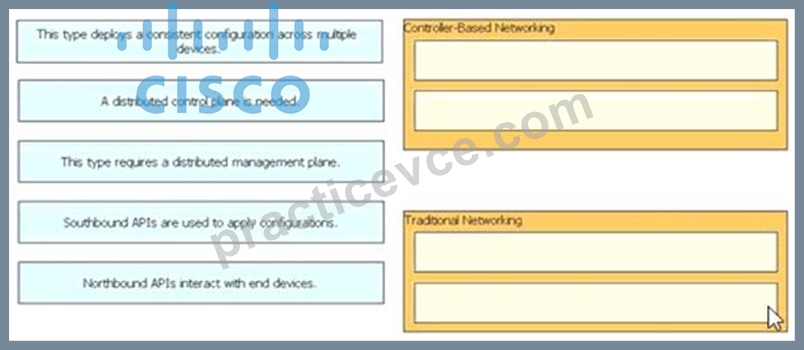
Answer:
Explanation: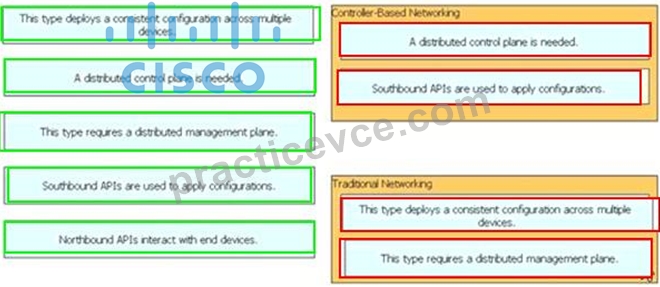
NEW QUESTION # 392
Refer to the exhibit.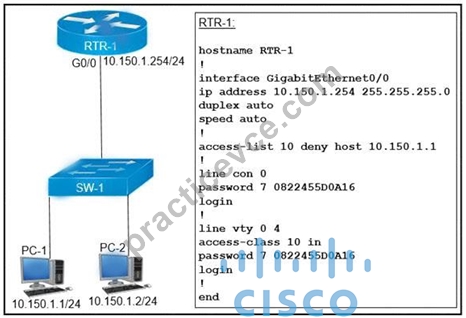
An access list is created to deny Telnet access from host PC-1 to RTR-1 and allow access from all other hosts A Telnet attempt from PC-2 gives this message:"% Connection refused by remote host" Without allowing Telnet access from PC-1, which action must be taken to permit the traffic?
- A. Remove the password command from line vty 0 4.
- B. Add the access-list 10 permit any command to the configuration
- C. Add the ip access-group 10 out command to interface g0/0.
- D. Remove the access-class 10 in command from line vty 0.4.
Answer: B
NEW QUESTION # 393
What are two reasons for an engineer to configure a floating static route? (Choose two.)
- A. to enable fallback static routing when the dynamic routing protocol fails
- B. to automatically route traffic on a secondary path when the primary path goes down
- C. to control the return path of traffic that is sent from the router
- D. to support load balancing via static routing
- E. to route traffic differently based on the source IP of the packet
Answer: A,B
Explanation:
Section: IP Connectivity
NEW QUESTION # 394
Refer to the exhibit.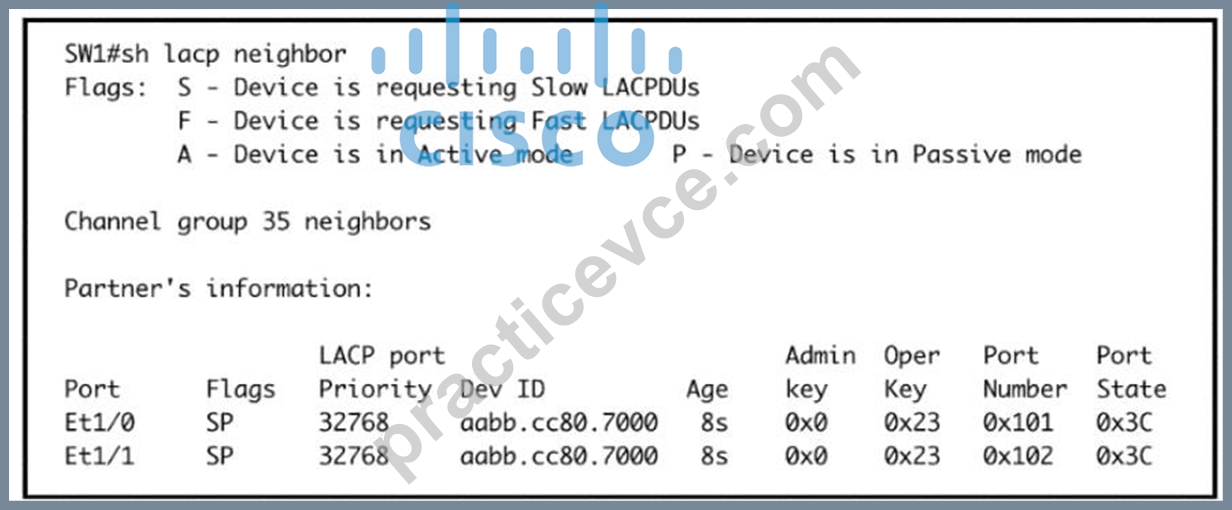
Based on the LACP neighbor status, in which mode is the SW1 port channel configured?
- A. mode on
- B. passive
- C. active
- D. auto
Answer: C
Explanation:
Explanation
From the neighbor status, we notice the "Flags" are SP. "P" here means the neighbor is in Passive mode.In order to create an Etherchannel interface, the (local) SW1 ports should be in Active mode.Moreover, the "Port State" in the exhibit is "0x3c" (which equals to "00111100 in binary format).Bit 3 is "1" which means the ports are synchronizing -> the ports are working so the local ports should be in Active mode.
NEW QUESTION # 395
Refer to Exhibit.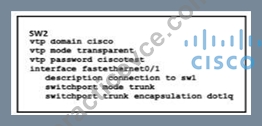
How does SW2 interact with other switches in this VTP domain?
- A. It processes VTP updates from any VTP clients on the network on its access ports.
- B. It transmits and processes VTP updates from any VTP Clients on the network on its trunk ports
- C. It forwards only the VTP advertisements that it receives on its trunk ports.
- D. It receives updates from all VTP servers and forwards all locally configured VLANs out all trunk ports
Answer: C
NEW QUESTION # 396
Physical connectivity is implemented between the two Layer 2 switches,
and the network connectivity between them must be configured.
I . Configure an LACP EtherChanneI and number it as 44; configure it
between switches SWI and SW2 using interfaces EthernetO/O and
Ethernet0/1 on both sides. The LACP mode must match on both ends.
2. Configure the EtherChanneI as a trunk link.
3. Configure the trunk link with 802. Iq tags.
4. Configure VLAN 'MONITORING' as the untagged VLAN of the
EtherChannel.
Guidelines
This is a lab item in which tasks will be performed on virtual devices.
* Refer to the Tasks tab to view the tasks for this lab item.
* Refer to the Topology tab to access the device console(s) and perform the tasks.
* Console access is available for all required devices by clicking the device icon or using
the tab(s) above the console window.
* All necessary preconfigurations have been applied.
* Do not change the enable password or hostname for any device.
* Save your configurations to NVRAM before moving to the next item.
* Click Next at the bottom of the screen to submit this lab and move to the next question.
* When Next is clicked, the lab closes and cannot be reopened.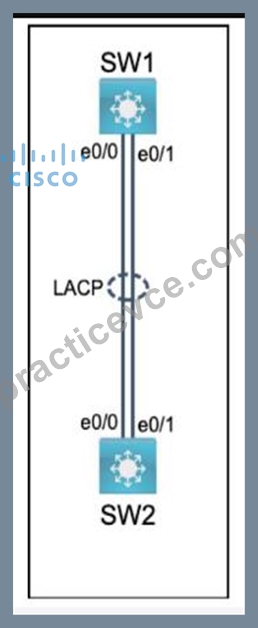
- A. Solution is given below explanation
Answer: A
Explanation:
To configure an LACP EtherChannel and number it as 44, configure it between switches SW1 and SW2 using interfaces Ethernet0/0 and Ethernet0/1 on both sides, configure the EtherChannel as a trunk link, configure the trunk link with 802.1q tags, and configure VLAN 'MONITORING' as the untagged VLAN of the EtherChannel, you need to follow these steps:
On both SW1 and SW2, enter the global configuration mode by using the configure terminal command.
On both SW1 and SW2, select the two interfaces that will form the EtherChannel by using the interface range ethernet 0/0 - 1 command. This will enter the interface range configuration mode.
On both SW1 and SW2, set the protocol to LACP by using the channel-protocol lacp command.
On both SW1 and SW2, assign the interfaces to an EtherChannel group number 44 by using the channel-group 44 mode active command. This will create a logical interface named Port-channel44 and set the LACP mode to active on both ends. The LACP mode must match on both ends for the EtherChannel to form.
On both SW1 and SW2, exit the interface range configuration mode by using the exit command.
On both SW1 and SW2, enter the Port-channel interface configuration mode by using the interface port-channel 44 command.
On both SW1 and SW2, configure the Port-channel interface as a trunk link by using the switchport mode trunk command.
On both SW1 and SW2, configure the Port-channel interface to use 802.1q tags for VLAN identification by using the switchport trunk encapsulation dot1q command.
On both SW1 and SW2, configure VLAN 'MONITORING' as the untagged VLAN of the Port-channel interface by using the switchport trunk native vlan MONITORING command.
On both SW1 and SW2, exit the Port-channel interface configuration mode by using the exit command.
On both SW1 and SW2, save the configuration to NVRAM by using the copy running-config startup-config command.
NEW QUESTION # 397
What are two fundamentals of virtualization? (Choose two.)
- A. It allows multiple operating systems and applications to run independently on one physical server.
- B. It allows logical network devices to move traffic between virtual machines and the rest of the physical network.
- C. It requires that some servers, virtual machines, and network gear reside on the Internet.
- D. It allows a physical router to directly connect NICs from each virtual machine into the network.
- E. The environment must be configured with one hypervisor that serves solely as a network manager to monitor SNMP traffic.
Answer: A,B
Explanation:
Section: Automation and Programmability
NEW QUESTION # 398
Refer to the exhibit.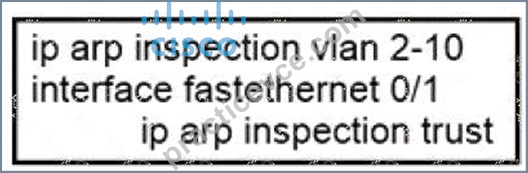
If the network environment is operating normally, which type of device must be connected to interface FastEthernet 0/1?
- A. PC
- B. DHCP client
- C. access point
- D. router
Answer: B
NEW QUESTION # 399
Refer to the exhibit.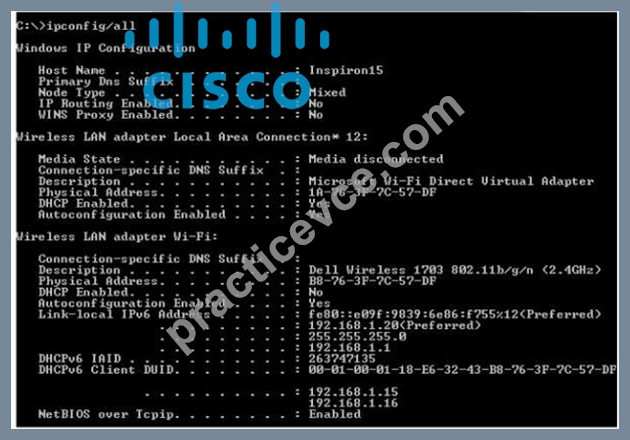
An engineer is tasked with verifying network configuration parameters on a client workstation to report back to the team lead. Drag and drop the node identifiers from the left onto the network parameters on the right.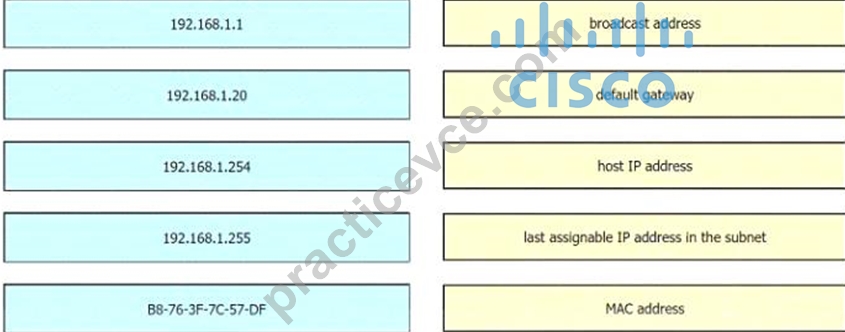
Answer:
Explanation: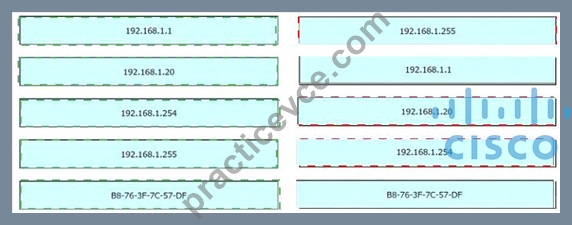
Explanation: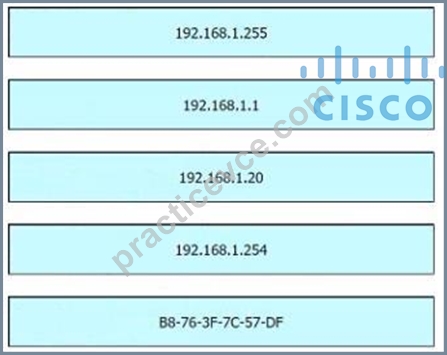
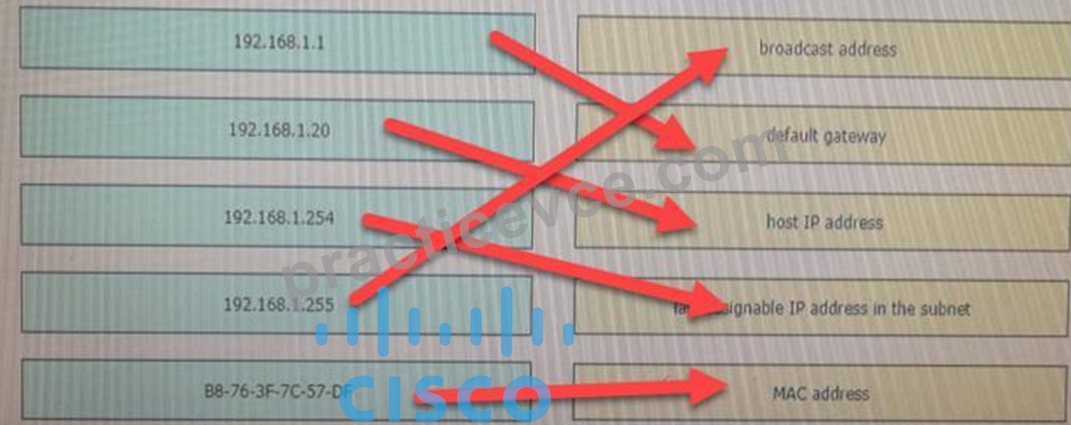
NEW QUESTION # 400
An engineer is tasked to configure a switch with port security to ensure devices that forward unicasts multicasts and broadcasts are unable to flood the port The port must be configured to permit only two random MAC addresses at a time Drag and drop the required configuration commands from the left onto the sequence on the right Not all commands are used.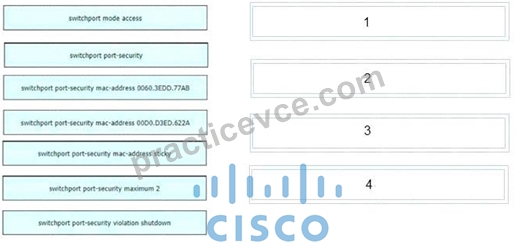
Answer:
Explanation: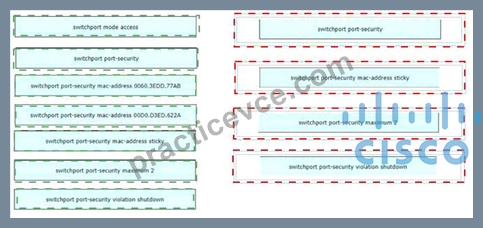
Explanation: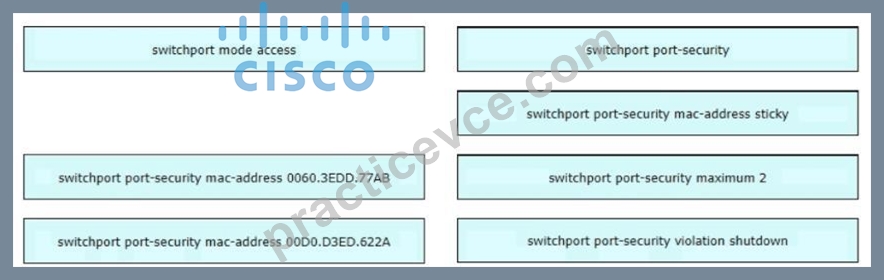
NEW QUESTION # 401 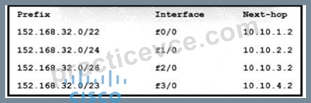
Refer to the exhibit. Which next hop is used to route packets to the application server at 152.168.32.85?
- A. 10.10.2.2
- B. 10.10.1.2
- C. 10.10.4.2
- D. 10.10.3.2
Answer: A
NEW QUESTION # 402
How do servers connect to the network in a virtual environment?
- A. a virtual switch that links to an access point that is physically connected to the network
- B. wireless to an access point that is physically connected to the network
- C. a cable connected to a physical switch on the network
- D. a software switch on a hypervisor that is physically connected to the network
Answer: D
NEW QUESTION # 403
Refer to exhibit.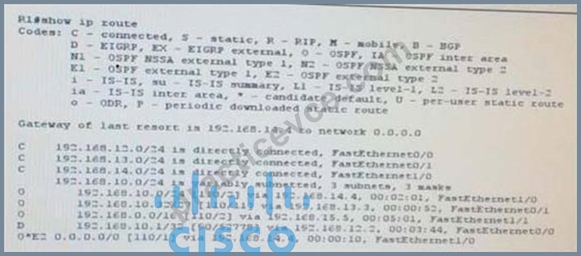
What Administrative distance has route to 192.168.10.1?
- A. 0
- B. 1
- C. 2
- D. 3
Answer: B
NEW QUESTION # 404
Which two statements about VTP are true? (Choose two.)
- A. All switches must be configured with a unique VTP domain name
- B. The VTP server must have the highest revision number in the domain
- C. All switches must be configured with the same VTP domain name
- D. All switches must use the same VTP version.
- E. All switches must be configured to perform trunk negotiation.
Answer: C,D
Explanation:
https://www.cisco.com/c/en/us/td/docs/switches/lan/catalyst3750/software/release/12- 2_25_sea/configuration/guide/3750scg/swvtp.pdf
NEW QUESTION # 405
A user configured OSPF and advertised the Gigabit Ethernet interface in OSPF. By default, to which type of OSPF network does this interface belong?
- A. nonbroadcast
- B. point-to-multipoint
- C. broadcast
- D. point-to-point
Answer: C
Explanation:
Section: IP Connectivity
Explanation:
The Broadcast network type is the default for an OSPF enabled ethernet interface (while Point-to-Point is the default OSPF network type for Serial interface with HDLC and PPP encapsulation).
Reference: https://www.oreilly.com/library/view/cisco-ios-cookbook/0596527225/ch08s15.html
NEW QUESTION # 406
An organization has decided to start using cloud-provided services. Which cloud service allows the organization to install its own operating system on a virtual machine?
- A. software-as-a-service
- B. platform-as-a-service
- C. infrastructure-as-a-service
- D. network-as-a-service
Answer: C
Explanation:
Section: Automation and Programmability
Explanation:
Below are the 3 cloud supporting services cloud providers provide to customer:
* SaaS (Software as a Service): SaaS uses the web to deliver applications that are managed by a third-party vendor and whose interface is accessed on the clients' side. Most SaaS applications can be run directly from a web browser without any downloads or installations required, although some require plugins.
* PaaS (Platform as a Service): are used for applications, and other development, while providing cloud components to software. What developers gain with PaaS is a framework they can build upon to develop or customize applications. PaaS makes the development, testing, and deployment of applications quick, simple, and cost-effective. With this technology, enterprise operations, or a third-party provider, can manage OSes, virtualization, servers, storage, networking, and the PaaS software itself. Developers, however, manage the applications.
* IaaS (Infrastructure as a Service): self-service models for accessing, monitoring, and managing remote datacenter infrastructures, such as compute (virtualized or bare metal), storage, networking, and networking services (e.g. firewalls). Instead of having to purchase hardware outright, users can purchase IaaS based on consumption, similar to electricity or other utility billing.
In general, IaaS provides hardware so that an organization can install their own operating system.
NEW QUESTION # 407
......
CCNA Certification Details
Attaining the new Cisco CCNA certification marks a critical step in building a career in information technology. This certification provides a detailed understanding of security fundamentals, IP services, IP connectivity, network fundamentals, and network access. Unlike in the past where students would attempt a series of exams to attain a Cisco certification at the associate level, today, they can certify by simply passing one exam coded 200-301.
Sample Questions of 200-301 Dumps With 100% Exam Passing Guarantee: https://www.practicevce.com/Cisco/200-301-practice-exam-dumps.html
Correct Practice Tests of 200-301 Dumps with Practice Exam: https://drive.google.com/open?id=1AXM2klu9_Z4hi7-qIDae2jZu0Wud4_rG