

2026 CSP-Assessor Dumps PDF - CSP-Assessor Real Exam Questions Answers
Valid CSP-Assessor Test Answers & Swift CSP-Assessor Exam PDF
Swift CSP-Assessor Exam Syllabus Topics:
| Topic | Details |
|---|---|
| Topic 1 |
|
| Topic 2 |
|
| Topic 3 |
|
NEW QUESTION # 57
What are the key elements that usually need to be considered by a cloud provider in an IaaS cloud model?
(Select the two correct answers that apply)
*Swift Customer Security Controls Policy
*Swift Customer Security Controls Framework v2025
*Independent Assessment Framework
*Independent Assessment Process for Assessors Guidelines
*Independent Assessment Framework - High-Level Test Plan Guidelines
*Outsourcing Agents - Security Requirements Baseline v2025
*CSP Architecture Type - Decision tree
*CSP_controls_matrix_and_high_test_plan_2025
*Assessment template for Mandatory controls
*Assessment template for Advisory controls
*CSCF Assessment Completion Letter
*Swift_CSP_Assessment_Report_Template
- A. The cloud provider must give full assurance on the change management process of the SWIFT-users' components/applications deployed by the user
- B. The cloud provider must give comfort of control implementation effectiveness on the virtualization layer hosting the SWIFT users' components
- C. The cloud provider must cover all CSCF controls applicable to the related in-scope components for which the cloud provider is responsible (such as the underlying infrastructure in line with appendix G)
- D. The cloud provider must give comfort regarding the resiliency put in place to ensure continuity of SWIFT connectivity service
Answer: B,C
Explanation:
In an Infrastructure as a Service (IaaS) cloud model, such as SWIFT's Alliance Cloud, the cloud provider is responsible for the underlying infrastructure (e.g., hardware, virtualization layer, network) while the customer manages the applications and data. The SWIFT CSP, particularly the "Outsourcing Agents - Security Requirements Baseline v2025" and "Swift Customer Security Controls Framework v2025," outlines the responsibilities of cloud providers. Let's evaluate each option:
*Option A: The cloud provider must cover all CSCF controls applicable to the related in-scope components for which the cloud provider is responsible (such as the underlying infrastructure in line with appendix G) This is correct. In an IaaS model, the cloud provider is responsible for securing the underlying infrastructure (e.g., physical servers, network, virtualization layer) that hosts the SWIFT components. Appendix G of the CSCF (or related outsourcing guidelines) specifies the controls the provider must implement, such as those under CSCF Control "1.1 SWIFT Environment Protection" and "2.3 System Hardening." The provider must ensure these controls are met for the infrastructure it manages.
*Option B: The cloud provider must give comfort of control implementation effectiveness on the virtualization layer hosting the SWIFT users' components This is correct. The virtualization layer (e.g., hypervisors) is part of the IaaS provider's responsibility, and the provider must provide assurance (e.g., through audits or reports) that security controls are effectively implemented. This aligns with CSCF requirements for outsourcing agents, ensuring the virtualization layer supports the SWIFT secure zone, as noted in the "Independent Assessment Framework."
*Option C: The cloud provider must give full assurance on the change management process of the SWIFT- users' components/applications deployed by the user This is incorrect. Change management for the SWIFT-users' components (e.g., Alliance Access configurations) is the customer's responsibility in an IaaS model. The cloud provider is not accountable for the applications deployed by the user, only for the underlying infrastructure. The "Outsourcing Agents - Security Requirements Baseline v2025" clarifies this boundary.
*Option D: The cloud provider must give comfort regarding the resiliency put in place to ensure continuity of SWIFT connectivity service This is incorrect as a primary key element. While resiliency is important (e.g., CSCF Control 1.1), it is a broader operational concern rather than a specific IaaS responsibility. The provider ensures infrastructure availability, but continuity of SWIFT connectivity is a shared responsibility, with the customer managing the communication interface (e.g., Alliance Gateway).
Summary of Correct Answers:
The key elements for a cloud provider in an IaaS model are covering applicable CSCF controls for the infrastructure (A) and providing comfort on the effectiveness of controls on the virtualization layer (B).
References to SWIFT Customer Security Programme Documents:
*Swift Customer Security Controls Framework v2025: Defines responsibilities in cloud models (Control 1.1, Appendix G).
*Outsourcing Agents - Security Requirements Baseline v2025: Outlines provider responsibilities in IaaS.
*Independent Assessment Framework: Requires assurance on virtualization layer security.
========
NEW QUESTION # 58
The Physical Security protection control is also aimed at protecting the "on call" and "working from home" employees' equipment used to access the Swift-related components.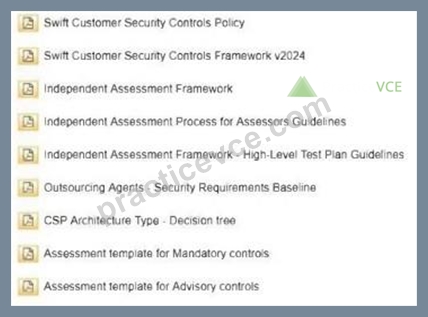
- A. FALSE
- B. TRUE
Answer: B
NEW QUESTION # 59
Is the restriction of Internet access only relevant when having Swift-related components in a secure zone?
- A. Yes, because if there is no secure zone then the internet connectivity does not need to be restricted
- B. No, because there can be in-scope general operator PCs used to access a Swift-related application hosted at a service provider
Answer: B
NEW QUESTION # 60
The only type of HSM devices offered by Swift are HSM tokens and HSM boxes.
- A. FALSE
- B. TRUE
Answer: B
Explanation:
This question addresses the types of Hardware Security Module (HSM) devices offered by SWIFT:
* Step 1: SWIFT HSM Overview
* SWIFT provides HSMs to secure Public Key Infrastructure (PKI) certificates and cryptographic operations for its users. The CSCF and related security documentation specify two primary types:
HSM tokens(portable devices) andHSM boxes(rack-mounted hardware).
NEW QUESTION # 61
Select the components a SwiftNet Link (SNL) may communicate with. (Choose all that apply.)
- A. The messaging interface (such as Alliance Access)
- B. The VPN boxes
- C. The Graphical User Interface
- D. The HSM device
Answer: A,B,D
Explanation:
This question identifies the components with which the SwiftNet Link (SNL) communicates, based on its role in the Swift ecosystem under theSwift Customer Security Controls Framework (CSCF) v2024.
Step 1: Understand the Role of SwiftNet Link (SNL)
The SNL is a communication layer that facilitates secure connectivity between a Swift user's environment and the Swift network. It handles encrypted data transmission and interacts with specific infrastructure components, as detailed in theSwift Alliance Gateway Technical DocumentationandControl 1.1: Swift Environment Protectionof theCSCF v2024.
Step 2: Evaluate Each Option
* A. The Graphical User InterfaceThe GUI (e.g., operator interface) is used by personnel to interact with Swift applications (e.g., Alliance Access), but it does not directly communicate with the SNL. The SNL operates at the network and security layer, not the user interface layer, per theSwift User Handbook
.Conclusion: Incorrect.
* B. The VPN boxesThe SNL communicates with VPN boxes to establish secure tunnels (e.g., using NTLS) for data transmission to the Swift network, as specified in theSwift Security Best Practicesand Control 2.6: Internet Accessibility Restriction.Conclusion: Correct.
* C. The HSM deviceThe SNL interacts with the Hardware Security Module (HSM) to manage cryptographic keys and secure communications, as outlined inControl 2.5B: Cryptographic Key Managementand theSwift Alliance Gateway Technical Documentation.Conclusion: Correct.
* D. The messaging interface (such as Alliance Access)The SNL connects to the messaging interface (e.
g., Alliance Access or Entry) to transmit and receive Swift messages, a core function described in the CSCF v2024underControl 1.1.Conclusion: Correct.
Step 3: Conclusion and Verification
The correct answers areB, C, and D, as the SNL communicates with VPN boxes, HSM devices, and messaging interfaces to ensure secure and functional connectivity to the Swift network, consistent withCSCF v2024and related documentation.
References
* Swift Customer Security Controls Framework (CSCF) v2024, Control 1.1: Swift Environment Protection, Control 2.5B: Cryptographic Key Management, Control 2.6: Internet Accessibility Restriction.
* Swift Alliance Gateway Technical Documentation, Section: SNL Communication.
* Swift Security Best Practices, Section: Network Infrastructure.
NEW QUESTION # 62
Which ones are Alliance Lite2 key components? (Choose all that apply.)
- A. A WebSphere MQ Server
- B. A web interface
- C. An AutoClient
- D. A HSM box
Answer: B,C
Explanation:
This question identifies the key components of Alliance Lite2 under theSwift Customer Security Programme (CSP).
Step 1: Understand Alliance Lite2 Components
Alliance Lite2 is a browser-based Swift solution for smaller institutions, with a simplified architecture. Its components are detailed in theSwift Alliance Lite2 User Guideand referenced in theCSCF v2024context.
Step 2: Evaluate Each Option
* A. A web interfaceThe web interface is the primary user access point for Alliance Lite2, enabling message sending and receiving via a browser. This is a core component, as confirmed in theSwift Alliance Lite2 User Guide.Conclusion: Correct.
* B. An AutoClientThe AutoClient is an optional automated client for batch processing and integration with back-office systems, considered a key component for enhanced functionality, per theSwift Alliance Lite2 Technical Documentation.Conclusion: Correct.
* C. A HSM boxWhile HSMs are used for cryptographic security in Swift environments, Alliance Lite2 relies on Swift-managed HSM infrastructure, not user-managed HSM boxes. It is not a key user-side component, per theSwift Security Best Practices.Conclusion: Incorrect.
* D. A WebSphere MQ ServerWebSphere MQ is a middleware solution not integral to Alliance Lite2, which uses a lightweight architecture without requiring such servers. TheSwift Alliance Lite2 User Guidedoes not list it as a component.Conclusion: Incorrect.
Step 3: Conclusion and Verification
The correct answers areAandB, as the web interface and AutoClient are the key user-side components of Alliance Lite2, consistent with theSwift Alliance Lite2 User GuideandCSCF v2024.
References
* Swift Alliance Lite2 User Guide, Section: System Components.
* Swift Customer Security Controls Framework (CSCF) v2024, Control 1.1: Swift Environment Protection.
* Swift Alliance Lite2 Technical Documentation, Section: Architecture.
NEW QUESTION # 63
Compliance to 2.9 Transaction Business Controls can be obtained through different ways. Which of the following one does not ensure compliance?
*Swift Customer Security Controls Policy
*Swift Customer Security Controls Framework v2025
*Independent Assessment Framework
*Independent Assessment Process for Assessors Guidelines
*Independent Assessment Framework - High-Level Test Plan Guidelines
*Outsourcing Agents - Security Requirements Baseline v2025
*CSP Architecture Type - Decision tree
*CSP_controls_matrix_and_high_test_plan_2025
*Assessment template for Mandatory controls
*Assessment template for Advisory controls
*CSCF Assessment Completion Letter
*Swift_CSP_Assessment_Report_Template
- A. More than one of the measures proposed in the implementation guidelines are implemented
- B. Reliance on a recent business assessment or regulator response confirming effectiveness of the existing control
- C. Any implementation if approved by the CIO
- D. A customer-designed implementation that encounters the control objective and addresses the risk driver
Answer: C
Explanation:
CSCF Control 2.9 (Transaction Business Controls) requires institutions to implement measures to ensure the accuracy and integrity of SWIFT transactions (e.g., payment validation, authorization). Compliance can be achieved through various methods, as outlined in the "Swift Customer Security Controls Framework v2025" and its implementation guidelines. Let's evaluate each option:
*Option A: More than one of the measures proposed in the implementation guidelines are implemented This ensures compliance. The CSCF provides implementation guidelines for Control 2.9, suggesting measures like dual authorization or automated validation. Implementing multiple measures meets the control's objective of ensuring transaction integrity.
*Option B: A customer-designed implementation that encounters the control objective and addresses the risk driver This ensures compliance. The CSCF allows flexibility for customer-designed solutions, provided they meet the control objective (e.g., preventing fraudulent transactions) and address the identified risk drivers (e.g., human error), as validated in the "Assessment template for Mandatory controls."
*Option C: Reliance on a recent business assessment or regulator response confirming effectiveness of the existing control This ensures compliance. If a recent assessment (e.g., by an internal audit or regulator) confirms that existing controls effectively meet the CSCF 2.9 requirements, this can be accepted as evidence of compliance, per the
"Independent Assessment Framework."
*Option D: Any implementation if approved by the CIO
This does not ensure compliance. The Chief Information Officer (CIO) approval alone does not guarantee that the implementation meets CSCF requirements. Compliance must be based on objective evidence and alignment with the control's intent, as assessed against the "CSP_controls_matrix_and_high_test_plan_2025" and validated by an independent assessor, not just internal approval.
Summary of Correct answer:
Reliance on CIO approval alone (D) does not ensure compliance with CSCF 2.9.
References to SWIFT Customer Security Programme Documents:
*Swift Customer Security Controls Framework v2025: Control 2.9 and implementation guidelines.
*Independent Assessment Framework: Requires objective validation, not just CIO approval.
*Assessment template for Mandatory controls: Specifies evidence-based compliance.
========
NEW QUESTION # 64
A Swift user relies on a sFTP server to connect through an externally exposed connection with a service provider or a group hub What architecture type is the Swift user? (Choose all that apply.)
- A. A1
- B. A4
- C. A2
- D. A3
Answer: B,C
Explanation:
The Swift Customer Security Programme (CSP) defines specific architecture types in itsCustomer Security Controls Framework (CSCF)documentation to classify how Swift users connect to the Swift network. These architecture types help determine the applicable security controls based on the user's connectivity and infrastructure setup. The architecture types relevant to this question-A1, A2, A3, and A4-are outlined in the CSCF v2024(and prior versions like CSCF v2023), which is the latest framework as of March 06, 2025, unless superseded by a newer release.
Step 1: Understand the Scenario
The question specifies that the Swift user relies on ansFTP server(Secure File Transfer Protocol) to connect through anexternally exposed connectionwith aservice provider or a group hub. This implies that the user' s Swift environment involves external connectivity, potentially managed by a third party (service provider) or a centralized entity (group hub), rather than a fully self-managed, local setup.
Step 2: Define Swift Architecture Types
According to theSwift Customer Security Controls Framework (CSCF)and supporting documentation (e.g., Swift Customer Security Programme - Architecture Types Explained), the architecture types are categorized as follows:
* A1: Messaging Interface Only (Local Deployment)
* The user operates a local Swift messaging interface (e.g., Alliance Access/Entry) with no external connectivity to a service provider or hub.
* Connectivity to Swift is direct and locally managed.
* A2: Messaging Interface with Connectivity Service (External Connectivity)
* The user operates a local Swift messaging interface but connects to Swift via anexternally provided connectivity service(e.g., through a service provider or third-party connection).
* The connection point is exposed externally to the service provider.
* A3: Hosted Messaging Interface
* The Swift messaging interface itself is hosted externally by a service provider, and the user accesses it remotely (e.g., via a browser or client application).
* No local messaging interface exists at the user's site.
* A4: Group Hub or Shared Connectivity
* The user connects to Swift via agroup hubor shared infrastructure operated by a parent entity, affiliate, or third-party provider.
* This may involve centralized messaging and connectivity services shared across multiple entities.
Step 3: Analyze the Scenario Against Architecture Types
* sFTP Server Usage: The use of an sFTP server suggests a file transfer mechanism, commonly employed in Swift environments to exchange payment messages or files with external parties (e.g., service providers or hubs). This aligns with scenarios where connectivity extends beyond the user's local environment.
* Externally Exposed Connection: The phrase "externally exposed connection" indicates that the Swift user's infrastructure interfaces with an external entity (service provider or group hub), ruling out a fully self-contained setup.
* Service Provider or Group Hub:
* Aservice providertypically implies a third-party entity managing connectivity or hosting services, which could align withA2(external connectivity) orA3(hosted interface).
* Agroup hubsuggests a shared infrastructure within a corporate group or consortium, pointing towardA4.
Step 4: Match to Architecture Types
* A1: Does not apply. A1 requires a fully local deployment with no external connectivity reliance. The externally exposed sFTP connection contradicts this.
* A2: Applies. If the Swift user maintains a local messaging interface (e.g., Alliance Access) and uses the sFTP server to connect to a service provider's external infrastructure, this fits A2. The "externally exposed connection" aligns with A2's requirement of relying on an external connectivity service.
* A3: Unlikely, but possible with clarification. A3 involves a fully hosted messaging interface (e.g., no local Alliance software). The question does not explicitly state that the messaging interface is hosted externally, only that an sFTP server is used for connectivity. Without evidence of a hosted interface, A3 is not a strong fit.
* A4: Applies if a group hub is involved. If the sFTP server connects to a centralized group hub (e.g., a shared Swift infrastructure within a corporate group), this matches A4. The "group hub" reference in the question supports this possibility.
Step 5: Conclusion and Verification
Based on theCSCF v2024architecture definitions and theSwift CSP Architecture Types Explainedguidance:
* A2is confirmed because the sFTP server and externally exposed connection suggest reliance on a service provider for connectivity, with a local messaging interface assumed unless otherwise specified.
* A4is also applicable if the "group hub" scenario is active, indicating shared connectivity infrastructure.
* The question asks to "choose all that apply," and since it specifies "service providerorgroup hub," both A2 and A4 are valid depending on the context. However, A2 is the most universally applicable based on the sFTP and external connection details, with A4 as an additional fit for group hub cases.
References
* Swift Customer Security Controls Framework (CSCF) v2024, Section: Architecture Types.
* Swift Customer Security Programme - Architecture Types Explained, available via Swift's official documentation portal (swift.com).
* Swift CSP FAQ, clarifying connectivity and hosting scenarios.
NEW QUESTION # 65
A Swift user can only exchange FIN messages via the Swift network.
- A. TRUE
- B. FALSE
Answer: B
NEW QUESTION # 66
A Swift user uses an application integrating a sFTP client to push files to a service bureau sFTP server What architecture type is the Swift user? (Choose all that apply.)
- A. A4
- B. A1
- C. A3
- D. B
Answer: C,D
NEW QUESTION # 67
Which of the following infrastructures has the smallest SWIFT footprint? (Select the correct answer)
*Connectivity
*Generic
*Products Cloud
*Products OnPrem
*Security
- A. Alliance Remote Gateway
- B. Full stack of products up to the Messaging Interface
- C. Lite 2 or Alliance Cloud
- D. A user with a Messaging Interface behind a Service Bureau
Answer: C
NEW QUESTION # 68
May an assessor rely on an ISAE 3000 report dating back 2 years to support a CSP independent assessment?
(Select the correct answer)
*Swift Customer Security Controls Policy
*Swift Customer Security Controls Framework v2025
*Independent Assessment Framework
*Independent Assessment Process for Assessors Guidelines
*Independent Assessment Framework - High-Level Test Plan Guidelines
*Outsourcing Agents - Security Requirements Baseline v2025
*CSP Architecture Type - Decision tree
*CSP_controls_matrix_and_high_test_plan_2025
*Assessment template for Mandatory controls
*Assessment template for Advisory controls
*CSCF Assessment Completion Letter
*Swift_CSP_Assessment_Report_Template
- A. Yes, there is no time limit for an ISAE 3000 report
- B. No, that is too old, the maximum is 18 months
- C. Yes, provided there is no change to the SWIFT user's infrastructure
- D. No, an ISAE 3000 report is no valid substitute as a rule
Answer: B
Explanation:
The "Independent Assessment Process for Assessors Guidelines" and "Independent Assessment Framework" provide guidance on using external audit reports (e.g., ISAE 3000) to support CSP assessments. ISAE 3000 is an international standard for assurance engagements. Let's evaluate each option:
*Option A: No, that is too old, the maximum is 18 months
This is correct. The CSP specifies that external reports like ISAE 3000 must be no older than 18 months to ensure relevance, as security environments can change. The "Independent Assessment Framework" and
"CSP_controls_matrix_and_high_test_plan_2025" set this time limit to validate current compliance status.
*Option B: Yes, there is no time limit for an ISAE 3000 report
This is incorrect. A time limit is enforced to ensure the report reflects the current security posture, as per CSP guidelines.
*Option C: No, an ISAE 3000 report is no valid substitute as a rule
This is incorrect. An ISAE 3000 report can be used as supporting evidence if relevant and recent, but it is not a full substitute for the independent assessment, per the "Independent Assessment Process for Assessors Guidelines."
*Option D: Yes, provided there is no change to the SWIFT user's infrastructure This is incorrect. Even with no changes, the 18-month limit applies to ensure the report's currency, not just infrastructure stability.
Summary of Correct answer:
An assessor cannot rely on an ISAE 3000 report dating back 2 years; the maximum is 18 months (A).
References to SWIFT Customer Security Programme Documents:
*Independent Assessment Process for Assessors Guidelines: Limits ISAE 3000 reports to 18 months.
*Independent Assessment Framework: Specifies timeframe for external evidence.
*CSP_controls_matrix_and_high_test_plan_2025: Enforces currency of supporting reports.
========
NEW QUESTION # 69
- A. Option D
- B. 1. Bridging Server (Middleware Server)
2. Bridging Server (Middleware Server)
3. Bridging Server (Middleware Server)
4. Bridging Server (Middleware Server) - C. Option A
- D. 1. Customer Connector
2. Bridging Server (Middleware Server)
3. Customer Connector
4. Customer Connector - E. Option B
- F. Option C
- G. 1. Customer Connector
2. Customer Connector
3. Customer Connector
4. Customer Connector - H. 1. Customer Connector
2. Bridging Server (Middleware Server)
3. Customer Connector
4. Bridging Server (Middleware Server)
Answer: C,H
NEW QUESTION # 70
A Swift user relies on a sFTP server to connect through an externally exposed connection with a service provider or a group hub What architecture type is the Swift user? (Choose all that apply.)
- A. A1
- B. A4
- C. A2
- D. A3
Answer: B,C
NEW QUESTION # 71
Select the supporting documents to conduct a CSP assessment. (Choose all that apply.)
- A. The mapping to industry standards article
- B. The CSP User Handbook
- C. The Customer Security Controls Framework
- D. The Controls Matrix and High Level Test P an
Answer: C
NEW QUESTION # 72
In an entity having a small infrastructure and only 2 operators, the HR manager explains in a short interview how the security training is implemented providing one example. Would it be acceptable?
- A. No. more evidence are required
- B. Yes. it's a risk based testing approach this can be enough in this case
Answer: B
NEW QUESTION # 73
The Physical Security control also includes a regular review of physical access lists of the SWIFT-related servers' locations.
*Swift Customer Security Controls Policy
*Swift Customer Security Controls Framework v2025
*Independent Assessment Framework
*Independent Assessment Process for Assessors Guidelines
*Independent Assessment Framework - High-Level Test Plan Guidelines
*Outsourcing Agents - Security Requirements Baseline v2025
*CSP Architecture Type - Decision tree
*CSP_controls_matrix_and_high_test_plan_2025
*Assessment template for Mandatory controls
*Assessment template for Advisory controls
- A. FALSE
- B. TRUE
Answer: B
Explanation:
CSCF Control "1.2 Physical Security" requires SWIFT users to protect the physical locations of SWIFT- related servers and infrastructure from unauthorized access. Let's evaluate:
*The control mandates measures such as restricting physical access, using surveillance, and maintaining an access control list for individuals entering server locations.
*Regular review of physical access lists is explicitly included to ensure that only authorized personnel have access and to identify any anomalies or outdated permissions. This is part of the ongoing monitoring requirement under CSCF Control "1.2" and is detailed in the "Assessment template for Mandatory controls."
*The "Independent Assessment Framework" and "CSP_controls_matrix_and_high_test_plan_2025" emphasize this as a mandatory practice to maintain physical security integrity.
Summary of Correct answer:
The Physical Security control includes a regular review of physical access lists (TRUE).
References to SWIFT Customer Security Programme Documents:
*Swift Customer Security Controls Framework v2025: Control 1.2 requires access list reviews.
*Assessment template for Mandatory controls: Includes this as a compliance criterion.
*CSP_controls_matrix_and_high_test_plan_2025: Tests for regular access list reviews.
NEW QUESTION # 74
How are online SwiftNet Security Officers authenticated?
- A. Via their swift.com account
- B. Via their swift.com account and secure code card
- C. Via their PKI certificate
Answer: C
NEW QUESTION # 75
In the illustration, identify which components are in scope of the CSCF? (Choose all that apply.)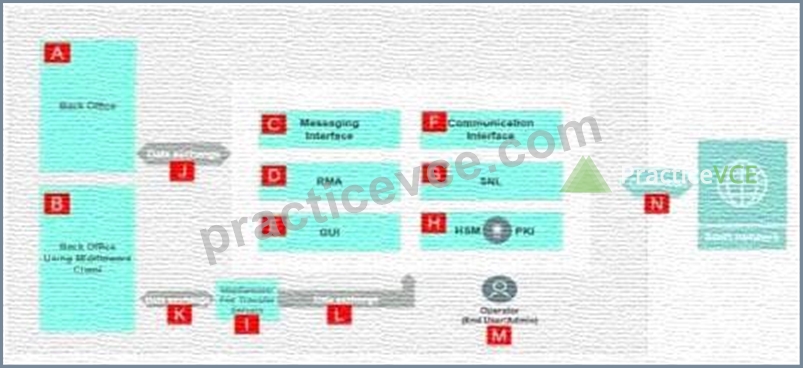
- A. Components A, B, K
- B. Components J, K, I
- C. Components C, E, M
- D. Components F, G, H
Answer: C,D
Explanation:
The Swift Customer Security Controls Framework (CSCF) defines the scope of components that must comply with its security controls. This scope is detailed in theCSCF v2024(and prior versions like CSCF v2023), which specifies that the CSCF applies to systems directly involved in the Swift messaging and connectivity ecosystem. Let's analyze the diagram to identify which components fall within this scope.
Step 1: Understand the Scope of CSCF
According to theSwift Customer Security Controls Framework (CSCF) v2024, the scope includes:
* Swift messaging interfaces(e.g., Alliance Access/Entry, RMA).
* Communication interfacesto the Swift network (e.g., SNL, HSM, PKI).
* Operator systemsdirectly interacting with Swift components (e.g., GUIs, admin/operator workstations).
* Middlewareor connectors directly facilitating Swift message flows.Systems that are not directly involved in Swift messaging or connectivity (e.g., back-office systems, general-purpose servers) are typically out of scope unless they pose a direct risk to the Swift environment.
Step 2: Analyze the Diagram and Identify Components
The diagram includes the following labeled components:
* A. Back Office: A system for back-office operations, not directly part of Swift messaging.
* B. Back Office Using Middleware Client: A back-office system with middleware for data exchange.
* C. Messaging Interface: Likely a Swift messaging interface (e.g., Alliance Access).
* D. RMA: Relationship Management Application, a Swift component for managing messaging relationships.
* E. GUI: Graphical User Interface for operators to interact with the messaging interface.
* F. Communication Interface: Interface for connecting to the Swift network.
* G. SNL: SwiftNet Link, a communication layer for Swift connectivity.
* H. HSM & PKI: Hardware Security Module and Public Key Infrastructure, used for secure Swift connectivity.
* I. Middleware File Transfer Servers: Servers facilitating data exchange between back-office and Swift systems.
* J, K, L. Data Exchange Paths: Represent data flows between systems (not components themselves).
* M. Operator (End User): The operator's workstation interacting with the Swift GUI.
* N. Connector: The connection point to the Swift network.
Step 3: Evaluate Each Option Against CSCF Scope
* A. Components A, B, K
* A (Back Office): Back-office systems are not in scope unless they directly process Swift messages. The CSCF focuses on Swift-specific infrastructure, and back-office systems are typically considered out of scope unless they pose a direct risk (e.g., via middleware).
* B (Back Office Using Middleware Client): While this system uses middleware to exchange data with Swift components, it is still a back-office system, not a core Swift component. The middleware itself (I) may be in scope, but the client (B) is not.
* K (Data Exchange Path): This is a data flow, not a component, and thus not directly in scope.
Conclusion: This option is incorrect.
* B. Components J, K, I
* J, K (Data Exchange Paths): These are data flows, not components, and are not directly in scope.
* I (Middleware File Transfer Servers): Middleware that facilitates Swift message flows (e.g., between back-office and messaging interface) can be in scope if it directlyprocesses or transmits Swift messages. PerControl 1.1: Swift Environment Protection, middleware in the Swift data flow must be secured, making it in scope. However, this option pairs I with J and K, which are not components.Conclusion: This option is incorrect due to J and K, though I alone would be in scope.
* C. Components F, G, H
* F (Communication Interface): This is the interface connecting to the Swift network, clearly in scope perControl 1.1.
* G (SNL): SwiftNet Link is a core communication component for Swift connectivity, in scope per Control 1.1.
* H (HSM & PKI): HSM and PKI are critical for secure Swift connectivity, in scope perControl
1.1.Conclusion: This option is correct.
* D. Components C, E, M
* C (Messaging Interface): This is a core Swift component (e.g., Alliance Access), in scope per Control 1.1.
* E (GUI): The GUI used by operators to interact with the messaging interface is in scope, as specified inControl 1.2: Logical Access Control, which includes operator systems.
* M (Operator End User): The operator's workstation is in scope as it directly interacts with Swift systems, perControl 1.2.Conclusion: This option is correct.
Step 4: Conclusion and Verification
The components in scope of the CSCF are those directly involved in Swift messaging, connectivity, and operator interaction. Based on the analysis:
* C (F, G, H)includes communication components, all in scope.
* D (C, E, M)includes the messaging interface, GUI, and operator workstation, all in scope.Components A, B, and data exchange paths (J, K, L) are not directly in scope, though middleware (I) would be if considered separately.
References
* Swift Customer Security Controls Framework (CSCF) v2024, Control 1.1: Swift Environment Protection.
* Swift Customer Security Programme - Scope and Applicability, Section: CSCF Scope Definition.
* CSCF v2024, Control 1.2: Logical Access Control.
NEW QUESTION # 76
......
CSP-Assessor Exam Dumps - PDF Questions and Testing Engine: https://www.practicevce.com/Swift/CSP-Assessor-practice-exam-dumps.html
Realistic CSP-Assessor Exam Dumps with Accurate & Updated Questions: https://drive.google.com/open?id=1Nu3YOAOOMVTDggNQV5lftF1sSNGUhdMI