

PracticeVCE FCP_FWF_AD-7.4 Real Exam Question Answers Updated [Oct 27, 2025]
Easily To Pass New Fortinet FCP_FWF_AD-7.4 Dumps with 169 Questions
Fortinet FCP_FWF_AD-7.4 Exam Syllabus Topics:
| Topic | Details |
|---|---|
| Topic 1 |
|
| Topic 2 |
|
| Topic 3 |
|
| Topic 4 |
|
NEW QUESTION # 19
What could be a potential solution in a high-density environment where clients face slow speeds and frequent disconnects?
Response:
- A. Increasing the number of SSIDs
- B. Reducing the AP transmit power
- C. Decreasing the DHCP lease time
- D. Enabling more security protocols
Answer: B
NEW QUESTION # 20
Refer to the exhibit.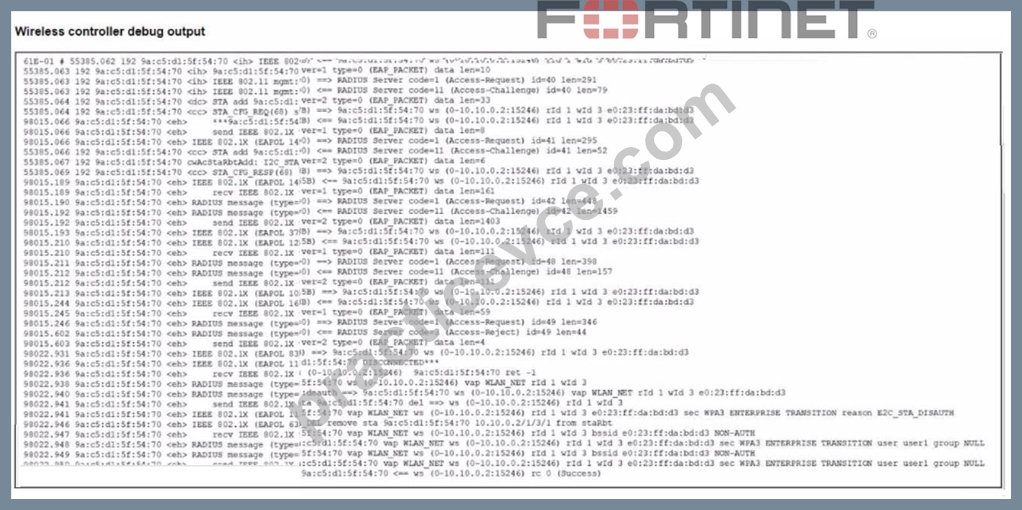
The wireless client connects to the wireless network on WLAN_NET tunnel mode interface The exhibit stows the client exchange communication with the wireless controller and the RADIUS server Which two issues can you observe in the wireless station debug outputs (Choose two.)
- A. The wireless client has incorrect credentials to authenticate with the authentication server
- B. The wireless client has an unsuccessful association with the wireless controller
- C. The wireless client has denied the connection after many failed trials
- D. The wireless client has failed to complete the four-way handshake process.
Answer: C,D
NEW QUESTION # 21
Refer to the exhibits.
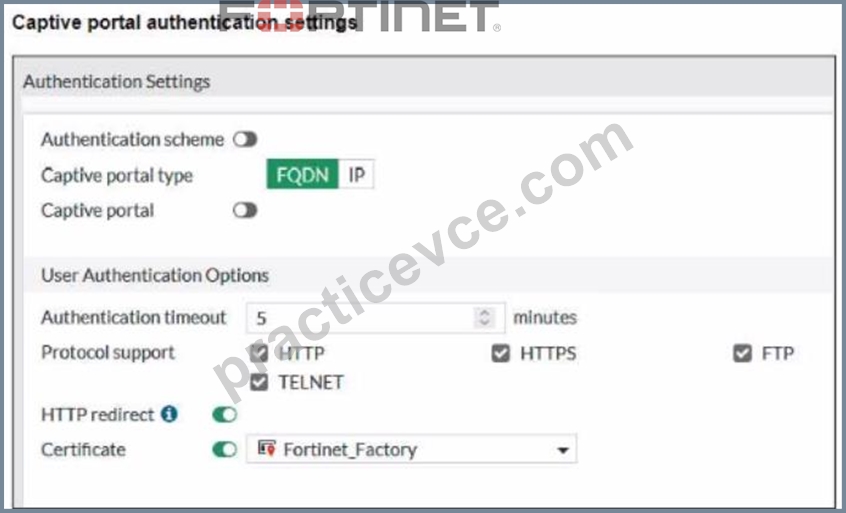
FortiGate is pushing the POST parameters shown in the exhibit to the external captive portal server The wireless client redirection fails because certificate validation occurred while loading the web page The wireless client browser uses the FortiGate self-signed certificate to access secured web pages The SSID on FortiGate has the captive portal setting What could cause the certification validation error on the wireless client?
- A. The external server address is not the FQDN address
- B. The FortiGate IP address in the POST parameters is using a numerical IP address
- C. The used credential is not embedded in the captive portal parameters
- D. The captive portal setting in the authentication setting is set to use FQDN as the captive portal type
Answer: B
NEW QUESTION # 22
Which of the following features distinguishes FortiPresence from FortiPlanner?
Response:
- A. FortiPlanner is a cloud-based deployment tool.
- B. FortiPresence is used primarily for network threat detection.
- C. FortiPlanner is used as a wireless controller.
- D. FortiPresence provides analytics solutions.
Answer: D
NEW QUESTION # 23
How are wireless clients assigned to a dynamic VLAN configured for hash mode?
Response:
- A. Using the current number of wireless clients connected to the SSID and the number of VLANs available in the pool
- B. Using the current number of wireless clients connected to the SSID and the number of IPs available in the least busy VLAN
- C. Using the current number of wireless clients connected to the SSID and the number of clients allocated to each of the VLANs
- D. Using the alphabetical order of the client device names and the VLAN names.
Answer: A
NEW QUESTION # 24
What is the primary purpose of configuring FortiAP profiles on a FortiGate wireless controller?
Response:
- A. To monitor real-time traffic on FortiAP devices
- B. To manage guest accounts on the network
- C. To configure VLANs on SSIDs
- D. To deploy advanced wireless settings to FortiAP devices
Answer: D
NEW QUESTION # 25
Advanced bridge mode options on FortiAP devices allow for direct communication between wireless and wired networks.
Response:
- A. False
- B. True
Answer: B
NEW QUESTION # 26
What actions can be taken using WIDS profiles in FortiGate?
(Select all that apply)
Response:
- A. Detecting rogue APs
- B. Suppressing unauthorized access points
- C. Enhancing wireless signal strength
- D. Managing SSID broadcast settings
Answer: A,B
NEW QUESTION # 27
When deploying a wireless network that is authenticated using EAP PEAP, which two configurations are required?
(Choose two.)
Response:
- A. A WPA2 or WPA3 Enterprise wireless network
- B. An X.509 certificate to authenticate the client
- C. A WPA2 or WPA3 personal wireless network
- D. An X.509 to authenticate the authentication server
Answer: A,D
NEW QUESTION # 28
You have just authorized a newly added FortiAP device on FortiGate. It went offline for an extended time without coming back online again. What troubleshooting process must you take to bring FortiAP back online?
Response:
- A. Access FortiAP management using HTTPs.
- B. Check the power feed to the FortiAP device and PoE status if powered by a switch.
- C. Restart the wireless controller if it is unresponsive for the newly added FortiAP device.
- D. Verify that communication between FortiAP and the wireless controller is not blocked.
Answer: D
NEW QUESTION # 29
Refer to the exhibit.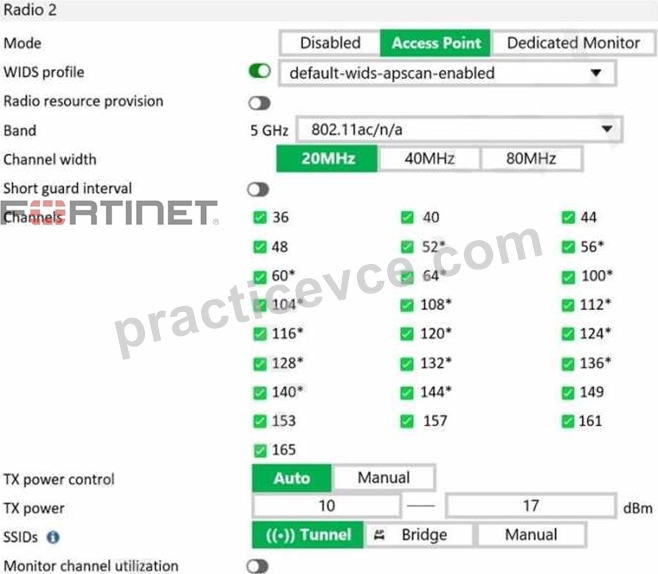
What does the asterisk (*) symbol beside the channel mean? Response:
- A. Indicates channels that can be used only when Radio Resource Provisioning is enabled
- B. Indicates channels that will be scanned by the Wireless Intrusion Detection System (WIDS)
- C. Indicates channels that cannot be used because of regulatory channel restrictions
- D. Indicates channels that are subject to dynamic frequency selection (DFS) regulations
Answer: D
NEW QUESTION # 30
Which of the following options are considered wireless security measures?
Response:
- A. Firmware updating
- B. WPA3 encryption
- C. SSID hiding
- D. Rogue AP scanning
Answer: B,C,D
NEW QUESTION # 31
What steps are necessary for provisioning and managing FortiAP devices using a FortiGate integrated wireless controller?
(Select all that apply)
Response:
- A. Assign a VLAN to each SSID
- B. Create and apply a FortiAP profile
- C. Configure a tunnel mode for all wireless networks
- D. Preauthorize APs on the FortiGate
Answer: B,D
NEW QUESTION # 32
What is the first discovery method used by FortiAP to locate the FortiGate wireless controller in the default configuration?
Response:
- A. Broadcast
- B. Multicast
- C. DHCP
- D. Static
Answer: D
NEW QUESTION # 33
Which of the following tools are associated with predictive modeling or analytics?
Response:
- A. FortiPresence
- B. FortiAP Cloud
- C. FortiPlanner
- D. FortiGate
Answer: A,C
NEW QUESTION # 34
When enabling a Security Fabric connection on a FortiGate interface to manage FortiAP devices, which two types of CAPWAP communication channels are established between FortiGate and the FortiAP devices'? (Choose two)
- A. Data channels
- B. Security channels
- C. Fortlink channels
- D. Control channels
Answer: A,D
NEW QUESTION # 35
What factors should be considered when troubleshooting FortiGuard issues?
(Select all that apply)
Response:
- A. Time synchronization between FortiGate and NTP servers
- B. Active FortiGuard subscription status
- C. Firewall rules that may block FortiGuard updates
- D. DNS resolution for FortiGuard servers
Answer: B,C,D
NEW QUESTION # 36
Refer to the exhibit.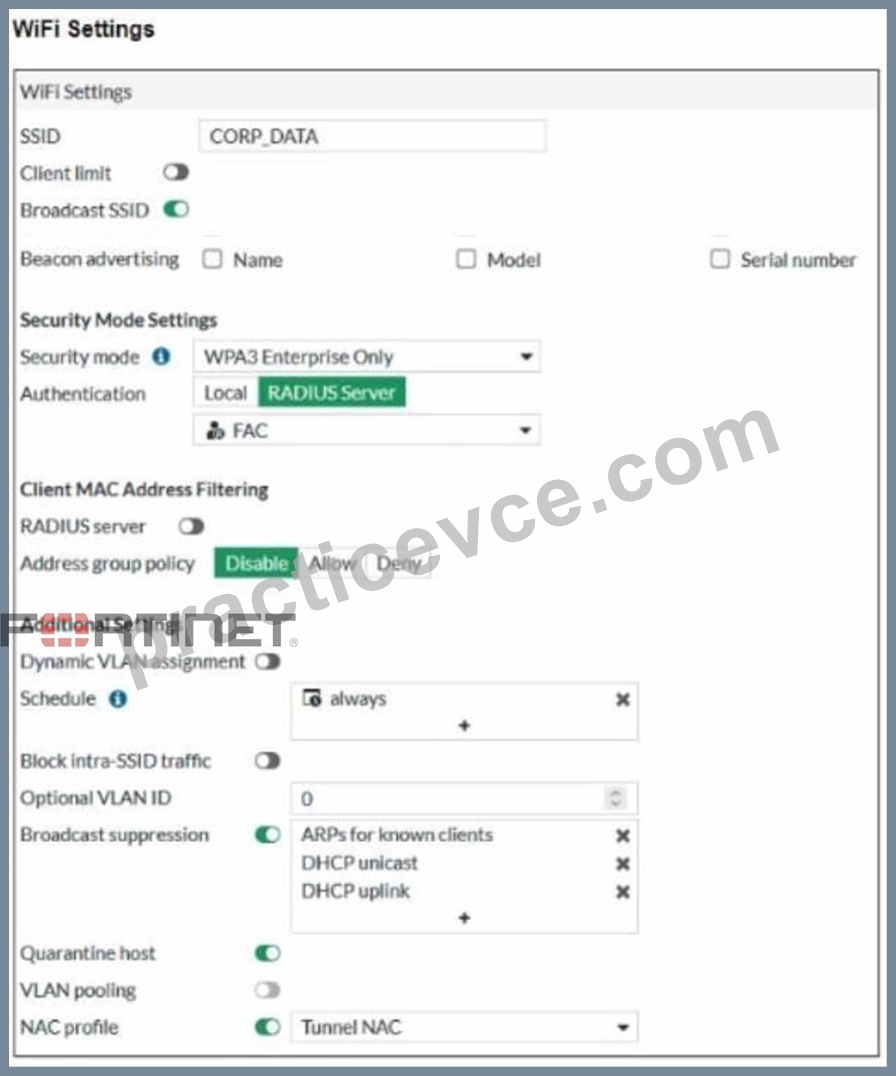
FortiGate sends logs to FortiAnalyzer using the default settings to report security events for all wireless stations as part of the Security Fabric configuration Which security action will FortiGate take when it detects a compromised wireless station in the CORP_DATASSlD?
- A. FortiAnalyzer generates security reports to inform security operations to further Investigate the compromised stations
- B. FortiGate disassociates compromised stations and prevents them from connecting again
- C. FortiAP devices broadcasting CORP_DATA wireless network place compromised stations in quarantine
- D. CORP_DATA is in NAC mode and onboards compromised stations for a period until malicious activity stops
Answer: D
NEW QUESTION # 37
Why is capturing and analyzing AP-to-controller traffic essential?
Response:
- A. Monitoring the number of connected client devices
- B. Troubleshooting potential connectivity or performance issues
- C. Determining client browsing history
- D. Identifying any RF interference
Answer: B
NEW QUESTION # 38
What are the benefits of using SSID hiding in a wireless network?
(Select all that apply)
Response:
- A. Reducing the visibility of the network to unauthorized users
- B. Enhancing wireless signal strength
- C. Preventing casual scanning of the network
- D. Allowing automatic connection for authorized devices
Answer: A,C
NEW QUESTION # 39
Which three IETF attributes must the RADIUS server supply for dynamic VLAN allocation to work with wireless?
(Choose three.)
Response:
- A. 65 Tunnel-Medium-Type
- B. 81 Tunnel-Private-Group-ID
- C. 66 Tunnel-Client-Endpoint
- D. 69 Tunnel-Password
- E. 64 Tunnel-Type
Answer: A,B,E
NEW QUESTION # 40
For protecting against wireless network intrusions, you would configure:
Response:
- A. Wi-Fi signal boosters.
- B. WIDS profiles.
- C. Bandwidth management profiles.
- D. DHCP options.
Answer: B
NEW QUESTION # 41
......
Latest FCP_FWF_AD-7.4 Study Guides 2025 - With Test Engine PDF: https://www.practicevce.com/Fortinet/FCP_FWF_AD-7.4-practice-exam-dumps.html
Get New FCP_FWF_AD-7.4 Practice Test Questions Answers: https://drive.google.com/open?id=1vmhGEQ7eiwWMGGQFZty5JIMvpFU3O_tV