

[2021] 200-301 by CCNA Actual Free Exam Practice Test
Free CCNA 200-301 Exam Question
Career Prospects
The individuals who complete the Cisco 200-301 exam will fulfill the requirement for earning the CCNA certification. The specialists with this certificate can get the positions that deal with managing the network security of an enterprise, protecting it from different cyber threats, drawing markup, data validation, device counts, and process records, among others. They can also work with security teams in researching and recommending the latest security techniques. All in all, the professionals with this certification can take up the roles of a Network Administrator, a Network Engineer, and an Information Technology Manager. The average salary outlook for the certificate holders is $79,000 per annum.
NEW QUESTION 13
What is the purpose of traffic shaping?
- A. to mitigate delays over slow links
- B. to provide fair queuing for buffered flows
- C. to limit the bandwidth that a flow can use to
- D. be a marking mechanism that identifies different flows
Traffic shaping retains excess packets in a queue and then schedules the excess for later transmission over increments of time.
Answer: B
NEW QUESTION 14
Refer to the exhibit.
An attempt to deny web access to a subnet blocks all traffic from the subnet.
Which interface command immedicately removes the effect of ACL 102?
- A. no ip access-group 102 in
- B. no ip access-class 102 in
- C. no ip access-list 102 in
- D. no ip access-class 102 out
- E. no ip access-group 102 out
Answer: E
NEW QUESTION 15
which command should you enter to verify the priority of a router in an HSRP group?
- A. show sessions
- B. show standby
- C. show interfaces
- D. show hsrp
Answer: B
NEW QUESTION 16
Which utility can you use to identify the cause of a traffic-flow blockage between two devices in a network?
- A. The ACL trace tool in Cisco APIC-EM
- B. The Cisco APIC-EM automation scheduler.
- C. The ACL path analysis tool in Cisco APIC-EM
- D. The Cisco IWAN application.
Answer: C
NEW QUESTION 17
Which configuration ensures that the switch is always the root for VLAN 750?
- A. Switch(config)#spanning-tree vlan 750 priority 614440
- B. Switch(config)#spanning-tree vlan 750 priority 38418607
- C. Switch(config)#spanning-tree vlan 750 root primary
- D. Switch(config)#spanning-tree vlan 750 priority 0
Answer: C
Explanation:
Section: Network Access
NEW QUESTION 18
Refer to the exhibit.
Which two commands were used to create port channel 10? (Choose two )
- A. Option D
- B. Option B
- C. Option E
- D. Option A
- E. Option C
Answer: D,E
NEW QUESTION 19
Refer to the exhibit.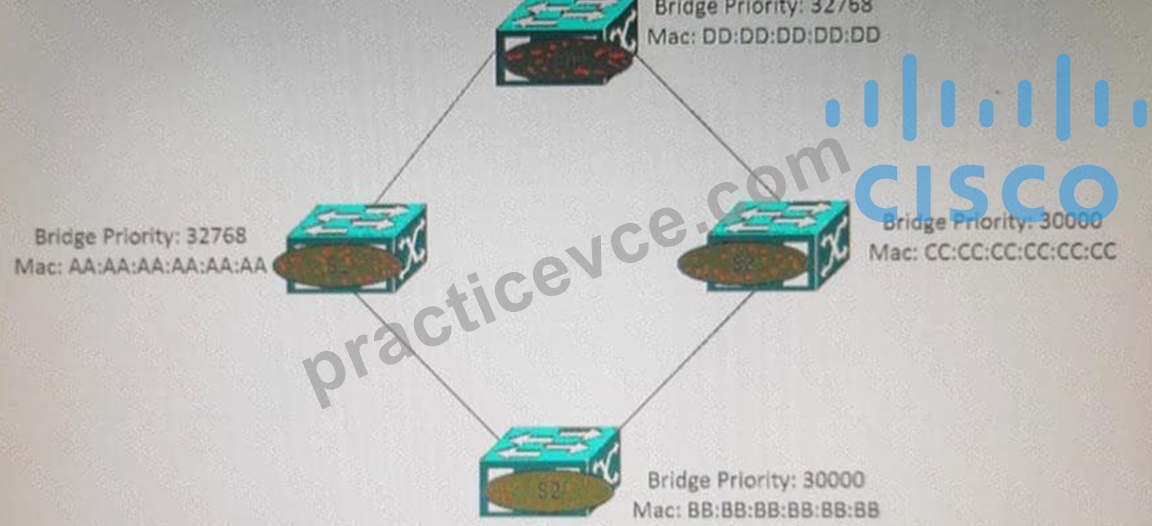
Which switch becomes the root bridge?
- A. S4
- B. S2
- C. S3
- D. S1
Answer: D
NEW QUESTION 20
VLAN 3 is not yet configured on your switch.
What happens if you set the switchport access vlan 3commmand interface configuration mode?
- A. The command is accepted and the respective VLAN is added to vlan dat.
- B. The command is rejected.
- C. The port turns amber.
- D. The command is accepted and you must configure the VLAN manually.
Answer: A
NEW QUESTION 21
Drag and drop the SNMP manager and agent identifier commands from the left onto the functions on the right
Answer:
Explanation:

NEW QUESTION 22
Which of the following privilege level is the most secured?
- A. Level 16
- B. Level 0
- C. Level 1
- D. Level 15
Answer: D
NEW QUESTION 23
Which option describes a difference between EIGRP for IPv4 and IPv6?
- A. Only EIGRP for IPv6 requires a router ID to be configured under the routing process
- B. As numbers are configure in EIGRP but not in EIGRPv3.
- C. Only EIGRP for IPv6 advertises all connected networks.
- D. Only EIGRP for IPv6 is enabled in the global configuration mode.
Answer: A
NEW QUESTION 24
A network engineer is configuring an OSPFv2 neighbor adjacency Drag and drop the parameters from the left onto their required categories on the right. Not all parameters are used
Answer:
Explanation:

NEW QUESTION 25
Refer to the exhibit. Which VLAN ID is associated with the default VLAN in the given environment?
- A. VLAN 20
- B. VLAN 1
- C. VLAN 5
- D. VLAN 10
Answer: B
NEW QUESTION 26
What is the primary effect of the spanning-tree port fast command?
- A. it enables BPDU messages
- B. It immediately puts the port into the forwarding state when the switch is reloaded
- C. It immediately enables the port in the listening state
- D. It minimizes spanning-tree convergence time
Answer: B
Explanation:
Portfast feature should only be used on edge ports (ports directly connected to end stations).
Neither edge ports or PortFast enabled ports generate topology changes when the link toggles so we cannot say Portfast reduces the STP convergence time.
PortFast causes a switch or trunk port to enter the spanning tree forwarding state immediately, bypassing the listening and learning states so answer C is the best choice.
NEW QUESTION 27
Refer to the exhibit.
An engineer configured NAT translations and has verified that the configuration is correct.
Which IP address is the source IP?
- A. 10.4.4.4
- B. 10.4.4.5
- C. 172.23.104.4
- D. 172.23.103.10
Answer: C
NEW QUESTION 28
Refer to the exhibit.
Which password must an engineer use to enter the enable mode?
- A. default
- B. testing 1234
- C. cisco123
If neither the enable password command nor the enable secret command is configured, and if there is a line password configured for the console, the console line password serves as the enable password for all VTY sessions -> The "enable secret" will be used first if available, then "enable password" and line password. - D. adminadmin123
Answer: B
NEW QUESTION 29
Refer to the exhibit
The server on this network is configured with an MTU of 9216 and the two interfaces on router R1 are configured for MTUs of 2000 and 3000, as shown.
What is the largest packet size that can pass between the workstation and the server?
- A. 1500 bytes
- B. 3000 bytes
- C. 2000 bytes
- D. 9216 bytes
Answer: A
NEW QUESTION 30
Refer to the exhibit.
Which configuration issue is preventing the OSPF neighbor relationship from being established between the two routers?
- A. R2 is using the passive-interface default command
- B. R1 has an incorrect network command for interface Gi1/0
- C. R1 interface Gil/0 has a larger MTU size
- D. R2 should have its network command in area 1
Answer: C
NEW QUESTION 31
Drag and drop the Cisco Wireless LAN Controller security settings from the left onto the correct security mechanism categories on the right.
Answer:
Explanation:

NEW QUESTION 32
If you want multiple hosts on a network, where do you configure the setting?
- A. in the IP protocol
- B. in the multicast interface
- C. in the serial interface
- D. in the global configuration
Answer: A
NEW QUESTION 33
......
Cisco 200-301 Exam Syllabus Topics:
| Topic | Details |
|---|---|
| Topic 1 |
|
| Topic 2 |
|
| Topic 3 |
|
| Topic 4 |
|
| Topic 5 |
|
| Topic 6 |
|
| Topic 7 |
|
| Topic 8 |
|
| Topic 9 |
|
| Topic 10 |
|
| Topic 11 |
|
| Topic 12 |
|
| Topic 13 |
|
| Topic 14 |
|
| Topic 15 |
|
| Topic 16 |
|
| Topic 17 |
|
| Topic 18 |
|
| Topic 20 |
|
| Topic 21 |
|
| Topic 22 |
|
Understanding functional and technical aspects of 200-301 CCNA Exam: Cisco Certified Network Associate Network Access
The following will be discussed here:
- Configure and verify interswitch connectivity
- Default VLAN
- Configure and verify Layer 2 discovery protocols (Cisco Discovery Protocol and LLDP)
- Network Access
- Configure the components of a wireless LAN access for client connectivity using GUI only such as WLAN creation, security settings, QoS profiles, and advanced WLAN settings
- Compare Cisco Wireless Architectures and AP modes
- Root port, root bridge (primary/secondary), and other port names
- Port states (forwarding/blocking)
- Native VLAN
- Configure and verify VLANs (normal range) spanning multiple switches
- Trunk ports
- 802.1Q
- Describe physical infrastructure connections of WLAN components (AP, WLC, access/trunk ports, and LAG)
- Access ports (data and voice)
- Describe the need for and basic operations of Rapid PVST+ Spanning Tree Protocol and identify basic operations
- PortFast benefits
- Describe AP and WLC management access connections (Telnet, SSH, HTTP, HTTPS, console, and TACACS+/RADIUS)
- Connectivity
- Configure and verify (Layer 2/Layer - ) EtherChannel (LACP)
Cisco 200-301 Actual Questions and Braindumps: https://www.practicevce.com/Cisco/200-301-practice-exam-dumps.html
200-301 dumps & CCNA sure practice dumps: https://drive.google.com/open?id=1AXM2klu9_Z4hi7-qIDae2jZu0Wud4_rG