

2025 Valid 350-401 Exam Updates - 2025 Study Guide
350-401 Certification - The Ultimate Guide [Updated 2025]
Cisco 350-401 certification exam, also known as Implementing Cisco Enterprise Network Core Technologies (350-401 ENCOR), is a comprehensive exam designed to test an individual's knowledge and skills in implementing and operating enterprise-level Cisco networks. 350-401 exam is part of the Cisco Certified Network Professional (CCNP) certification track and is a crucial step for network professionals who want to demonstrate their expertise in implementing and managing complex enterprise networks.
NEW QUESTION # 199
Refer to the exhibit.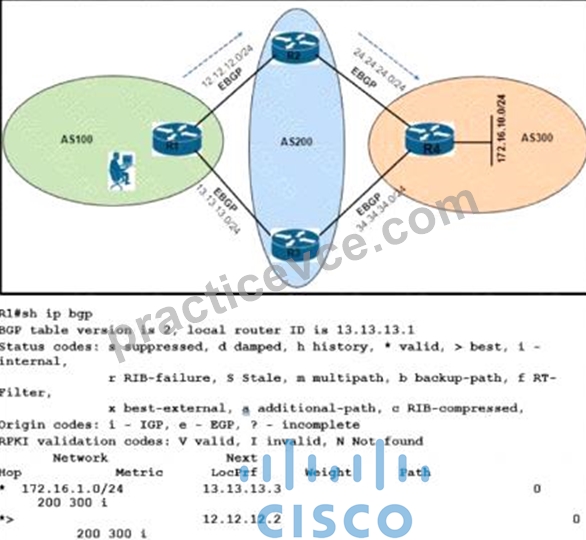
An engineers reaching network 172 16 10 0/24 via the R1-R2-R4 path. Which configuration forces the traffic to take a path of R1-R3-R4?
- A.
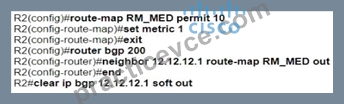
- B.
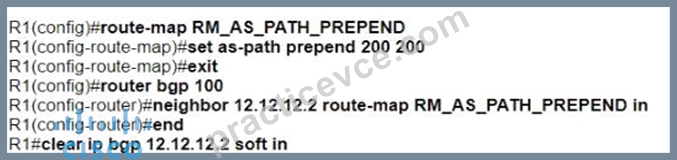
- C.

- D.
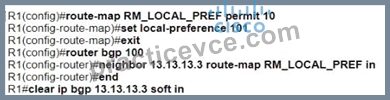
Answer: D
NEW QUESTION # 200
Drag and drop the LISP components from the left onto the function they perform on the right. Not all options are used.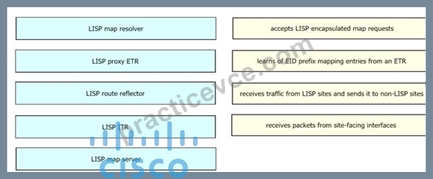
Answer:
Explanation: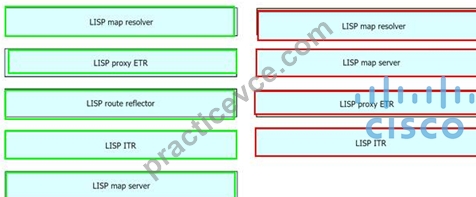
NEW QUESTION # 201
Drag and drop the descriptions from the left onto the routing protocol they describe on the right.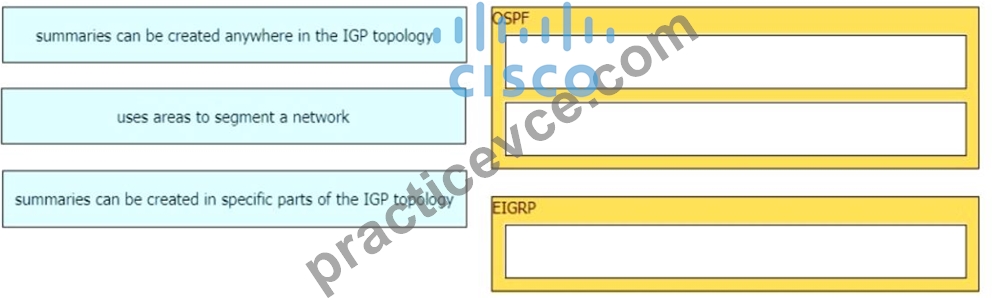
Answer:
Explanation: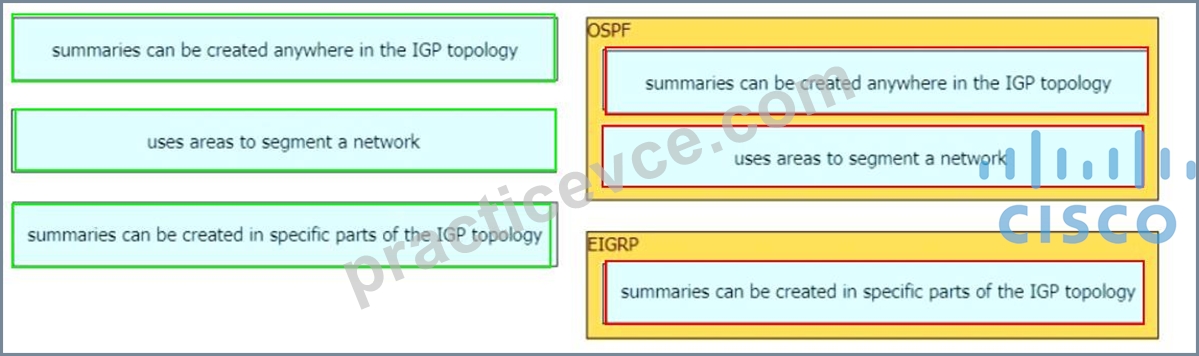
NEW QUESTION # 202
Witch two actions provide controlled Layer 2 network connectivity between virtual machines running on the same hypervisor? (Choose two.)
- A. Use a virtual switch running as a separate virtual machine.
- B. Use a single routed link to an external router on stick.
- C. Use VXLAN fabric after installing VXLAN tunneling drivers on the virtual machines.
- D. Use a single trunk link to an external Layer2 switch.
- E. Use a virtual switch provided by the hypervisor.
Answer: A,E
Explanation:
Explanation
Source 1:
https://www.cisco.com/c/dam/en/us/products/collateral/switches/nexus-1000v-switch-vmware-vsphere/at_a_glan Source 2:
https://www.cisco.com/c/en/us/td/docs/unified_computing/ucs/sw/vm_fex/vmware/gui/config_guide/2-1/b_GUI_
NEW QUESTION # 203
Refer to the exhibit.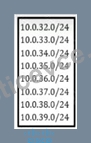
An engineer must permit traffic from these networks and block all other traffic An informational log message should be triggered when traffic enters from these prefixes Which access list must be used?
- A. access-list acl_subnets permit ip 10.0.32.0 255.255.248.0 log
- B. access-list acl_subnets permit ip 10.0.32.0 0 0.0.255 log
- C. access-list acl_subnets permit ip 10.0.32.0 0.0.7.255 log
- D. access-list acl_subnets permit ip 10.0.32.0 0.0.7.255 access-list acl_subnets deny ip any log
Answer: C
Explanation:
The task is to create an access list that allows traffic from a specific range of networks while logging the traffic. The networks in question span from 10.0.32.0/24 to 10.0.39.0/24. To summarize these networks into a single entry, we use a subnet mask that encompasses all the individual /24 networks. The correct summary uses the wildcard mask 0.0.7.255, which corresponds to the subnet mask 255.255.248.0. This wildcard mask allows for all addresses from 10.0.32.0 to 10.0.39.255, which includes all the specified networks.
NEW QUESTION # 204
Drag and drop the DHCP messages that are exchanged between a client and an AP into the order they are exchanged on the right.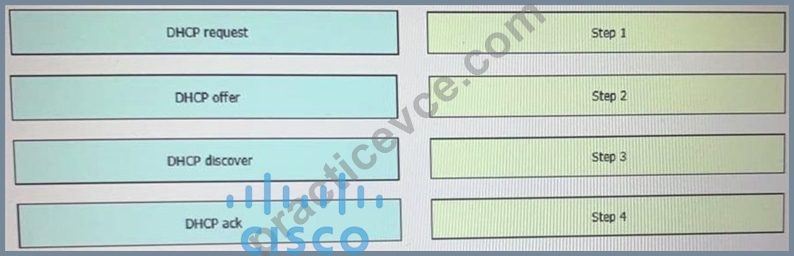
Answer:
Explanation:
Explanation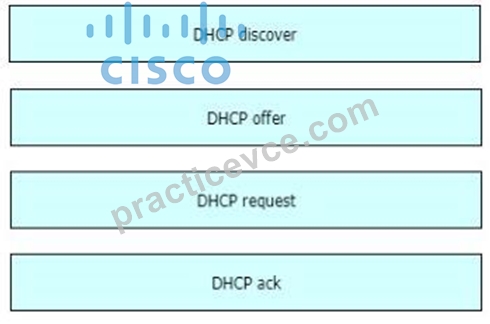
There are four messages sent between the DHCP Client and DHCP Server: DHCPDISCOVER, DHCPO FFER, DHCPREQUEST and DHCPACKNOWLEDGEMENT.
This process is often abbreviated as DORA (for Discover, Offer, Request, Acknowledgement).
NEW QUESTION # 205
A network administrator applies the following configuration to an IOS device.
What is the process of password checks when a login attempt is made to the device?
- A. A TACACS+server is checked first. If that check fail, a database is checked?
- B. A local database is checked first. If that check fails, a TACACS+server is checked.
- C. A TACACS+server is checked first. If that check fail, a RADIUS server is checked. If that check fail. a local database is checked.
- D. A local database is checked first. If that fails, a TACACS+server is checked, if that check fails, a RADUIS server is checked.
Answer: B
NEW QUESTION # 206
Refer to the exhibit.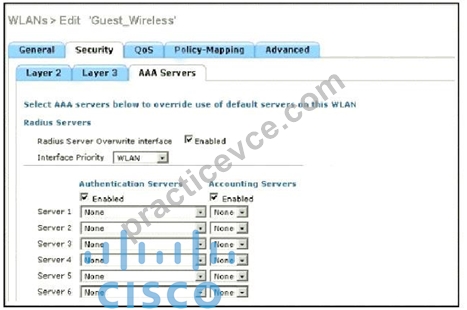
Assuming the WLC's interfaces are not in the same subnet as the RADIUS server, which interface would the WLC use as the source for all RADIUS-related traffic?
- A. the controller virtual interface
- B. the interface specified on the WLAN configuration
- C. any interface configured on the WLC
- D. the controller management interface
Answer: B
NEW QUESTION # 207
Drag and drop the characteristics from the left to the correct Infrastructure deployment types on the right.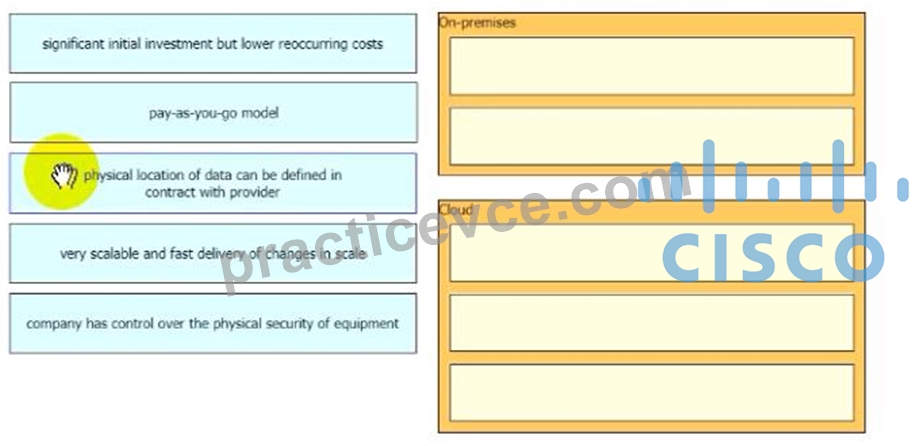
Answer:
Explanation: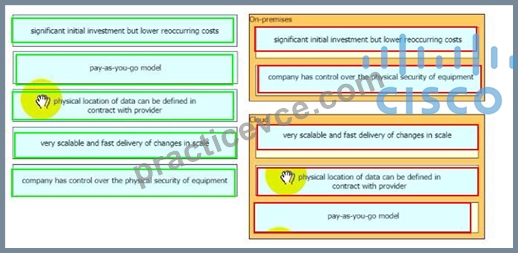
NEW QUESTION # 208
Drag and drop the characteristics from the left onto the infrastructure deployment models they describe on the right.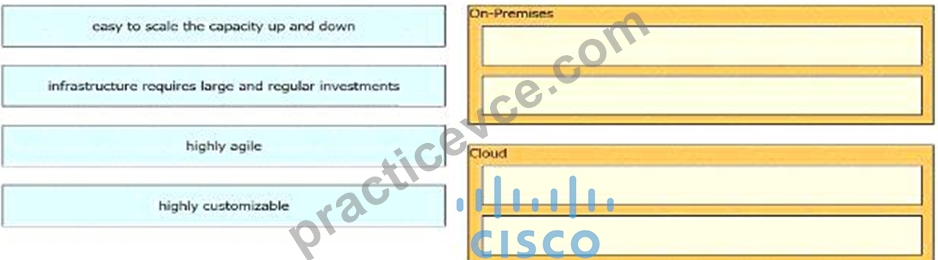
Answer:
Explanation: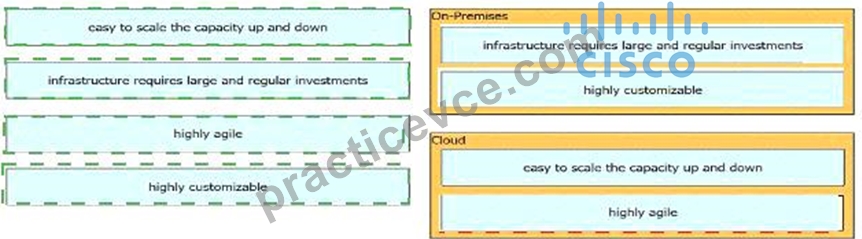
Explanation:
Graphical user interface, application Description automatically generated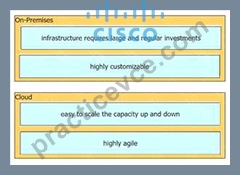
NEW QUESTION # 209
Refer to the exhibit.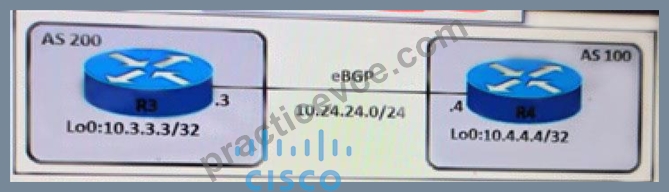
An engineer must establish eBGP peering between router R3 and router R4. Both routers should use their loopback interfaces as the BGP router ID. Which configuration set accomplishes this task?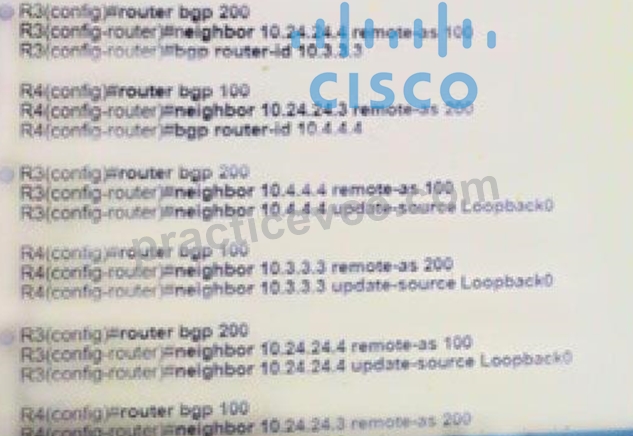
- A. Option D
- B. Option A
- C. Option B
- D. Option C
Answer: B
NEW QUESTION # 210
A network engineer is enabling HTTPS access to the core switch, which requires a certificate to be installed on the switch signed by the corporate certificate authority Which configuration commands are required to issue a certificate signing request from the core switch?
- A.

- B.

- C.

- D.

Answer: C
Explanation:
Reference: https://www.cisco.com/c/en/us/td/docs/ios/ios_xe/sec_secure_connectivity/configuration/guide/conve
NEW QUESTION # 211
Drag and drop the descriptions from the left onto the routing protocol they describe on the right.
Answer:
Explanation: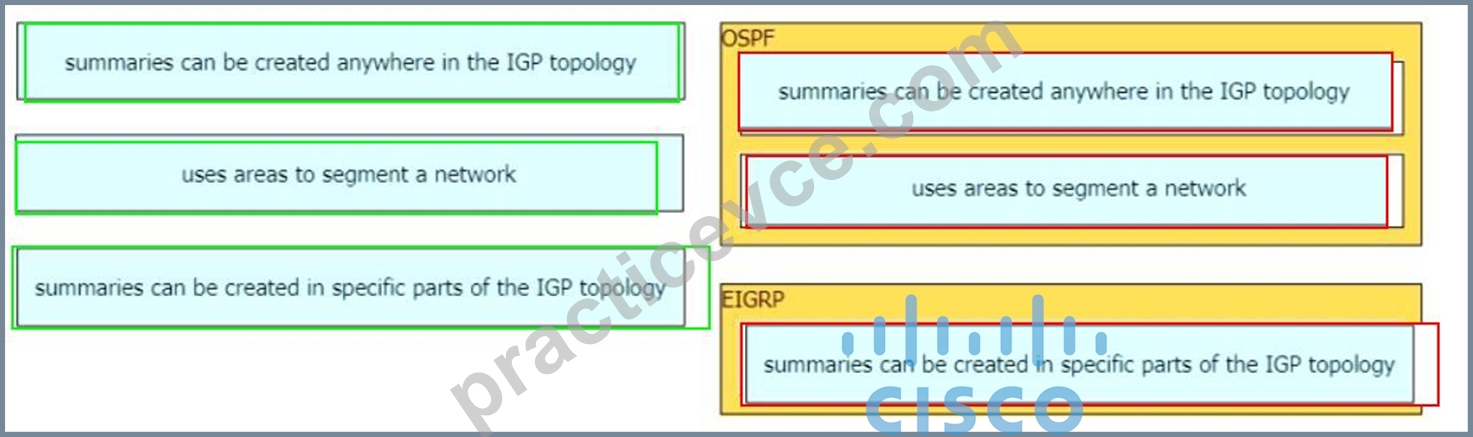
NEW QUESTION # 212
Refer to the exhibit. Which configuration establishes EBGP neighborship between these two directly connected neighbors and exchanges the loopback network of the two routers through BGP?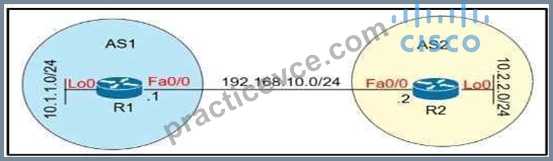
- A. R1(config)#router bgp 1
R1(config-router)#neighbor 192.168.10.2 remote-as 2
R1(config-router)#network 10.1.1.0 mask 255.255.255.0
R2(config)#router bgp 2
R2(config-router)#neighbor 192.168.10.1 remote-as 1
R2(config-router)#network 10.2.2.0 mask 255.255.255.0 - B. R1(config)#router bgp 1
R1(config-router)#neighbor 10.2.2.2 remote-as 2
R1(config-router)#neighbor 10.2.2.2 update-source lo0
R1(config-router)#network 10.1.1.0 mask 255.255.255.0
R2(config)#router bgp 2
R2(config-router)#neighbor 10.1.1.1 remote-as 1
R2(config-router)#neighbor 10.1.1.1 update-source lo0
R2(config-router)#network 10.2.2.0 mask 255.255.255.0 - C. R1(config)#router bgp 1
R1(config-router)#neighbor 10.2.2.2 remote-as 2
R1(config-router)#network 10.1.1.0 mask 255.255.255.0
R2(config)#router bgp 2
R2(config-router)#neighbor 10.1.1.1 remote-as 1
R2(config-router)#network 10.2.2.0 mask 255.255.255.0 - D. R1(config)#router bgp 1
R1(config-router)#neighbor 192.168.10.2 remote-as 2
R1(config-router)#network 10.0.0.0 mask 255.0.0.0
R2(config)#router bgp 2
R2(config-router)#neighbor 192.168.10.1 remote-as 1
R2(config-router)#network 10.0.0.0 mask 255.0.0.0
Answer: A
Explanation:
With BGP, we must advertise the correct network and subnet mask in the "network" command ( in this case network 10.1.1.0/24 on R1 and network 10.2.2.0/24 on R2). BGP is very strict in the routing advertisements. In other words, BGP only advertises the network which exists exactly in the routing table. In this case, if you put the command "network x.x.0.0 mask 255.255.0.0" or
"network x.0.0.0 mask 255.0.0.0" or "network x.x.x.x mask 255.255.255.255" then BGP will not advertise anything.
It is easy to establish eBGP neighborship via the direct link. But let's see what are required when we want to establish eBGP neighborship via their loopback interfaces. We will need two commands:
+ The command "neighbor 10.1.1.1 ebgp-multihop 2" on R1 and "neighbor 10.2.2.2 ebgp- multihop 2" on R1. This command increases the TTL value to 2 so that BGP updates can reach the BGP neighbor which is two hops away.
+ A route to the neighbor loopback interface. For example: "ip route 10.2.2.0 255.255.255.0
192.168.10.2" on R1 and "ip route 10.1.1.0 255.255.255.0 192.168.10.1" on R2
NEW QUESTION # 213
Refer to the exhibit. What are two effect of this configuration? (Choose two.)
- A. The 10.1.1.0/27 subnet is assigned as the inside global address range.
- B. The 209.165.201.0/27 subnet is assigned as the outside local address range.
- C. Inside source addresses are translated to the 209.165.201.0/27 subnet.
- D. The 10.1.1.0/27 subnet is assigned as the inside local addresses.
- E. It establishes a one-to-one NAT translation.
Answer: C,D
Explanation:
Inside local address - An IP address that is assigned to a host on the inside network. 10.1.1.0/27 Inside global address - A legitimate IP address assigned by the NIC or service provider that represents one or more inside local IP addresses to the outside world. 209.165.201.0/27.
NEW QUESTION # 214
Drag and drop the characteristics from the left onto the routing protocols they describe on the right.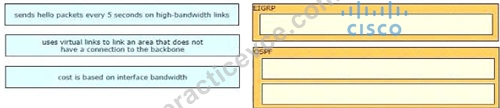
Answer:
Explanation: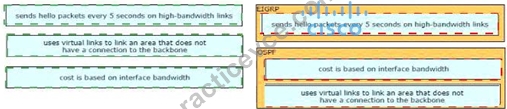
NEW QUESTION # 215 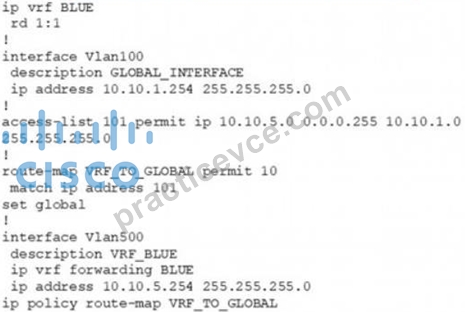
Refer to the exhibit. An engineer attempts to create a configuration to allow the Blue VRF to leak into the global routing table, but the configuration does not function as expected. Which action resolves this issue?
- A. Change the access-list number in the route map
- B. Change the source network that Is specified in access-list 101.
- C. Change the access-list destination mask to a wildcard.
- D. Change the route-map configuration to VRF_BLUE.
Answer: C
NEW QUESTION # 216
Drag and drop the solutions that comprise Cisco Cyber Threat Defense from the left onto the objectives they accomplish on the right.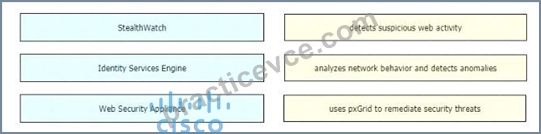
Answer:
Explanation: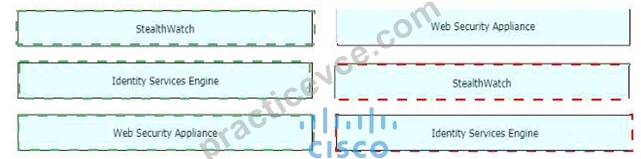
Explanation
Graphical user interface, application Description automatically generated with medium confidence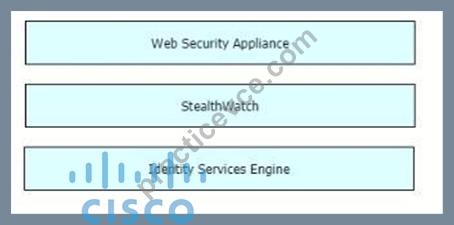
NEW QUESTION # 217 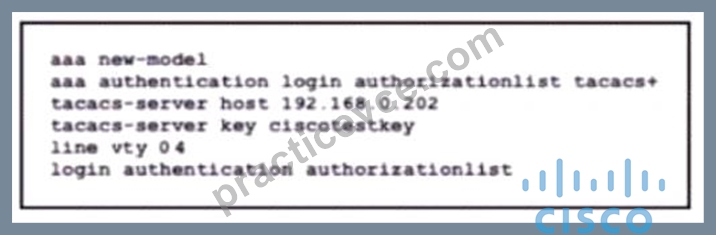
Refer to the exhibit. What is the effect of this configuration?
- A. The device will allow users at 192.168.0.202 to connect to vty lines 0 through 4 using the password ciscotestkey
- B. The device will allow only users at 192.166.0.202 to connect to vty lines 0 through 4
- C. The device will authenticate all users connecting to vty lines 0 through 4 against TACACS+
- D. When users attempt to connect to vty lines 0 through 4, the device will authenticate them against TACACS+ if local authentication fails
Answer: C
NEW QUESTION # 218
Refer to the exhibit.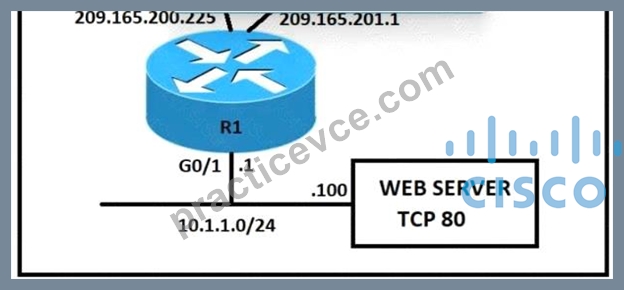
An engineer must configure static NAT on R1 lo allow users HTTP access to the web server on TCP port 80.
The web server must be reachable through ISP 1 and ISP 2. Which command set should be applied to R1 to fulfill these requirements?
- A. ip nat inside source static tcp 10.1.1.100 80 209.165.200.225 80
ip nat inside source static tcp 10.1.1.100 8080 209.165.201.1 8080 - B. ip nat inside source static tcp 10.1.1.100 80 209.165.200.225 80 no-alias ip nat inside source static tcp 10.1.1.100 80 209.165.201.1 80 no-alias
- C. ip nat inside source static tcp 10.1.1.100 80 209.165.200.225 80
ip nat inside source static tcp 10.1.1.100 80 209.165.201.1 80 - D. ip nat inside source static tcp 10.1.1.100 80 209.165.200.225 80 extendable ip nat inside source static tcp 10.1.1.100 80 209.165.201.1 80 extendable
Answer: C
NEW QUESTION # 219
Refer to the exhibit.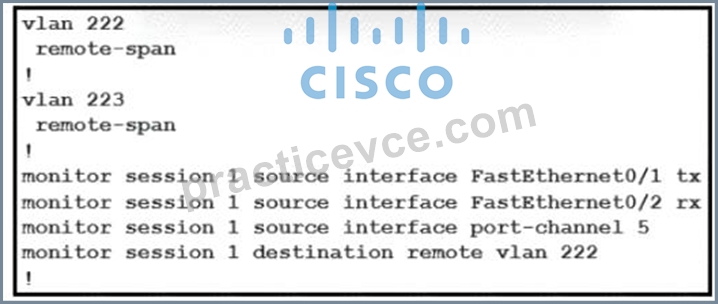
What is the result when a technician adds the monitor session 1 destination remote vlan 223 command1?
- A. An error is flagged for configuring two destinations.
- B. RSPAN traffic is split between VLANs 222 and 223.
- C. RSPAN traffic is sent to VLANs 222 and 223
- D. The RSPAN VLAN is replaced by VLAN 223.
Answer: D
Explanation:
When the command monitor session 1 destination remote vlan 223 is added to the configuration, it replaces the existing RSPAN VLAN destination with VLAN 223. This is because a monitor session can only have one remote VLAN destination at a time. If there was already a destination configured, such as VLAN 222 in this case, it would be overridden by the new command specifying VLAN 223. References: Cisco's official training and certification resources on Implementing and Operating Cisco Service Provider Network Core Technologies (SPCOR).
NEW QUESTION # 220
What is the purpose of an RP in PIM?
- A. send join messages toward a multicast source SPT
- B. ensure the shortest path from the multicast source to the receiver.
- C. secure the communication channel between the multicast sender and receiver.
- D. receive IGMP joins from multicast receivers.
Answer: A
Explanation:
In the figure below, we can see RP sent "join 234.1.1.1" message toward Source.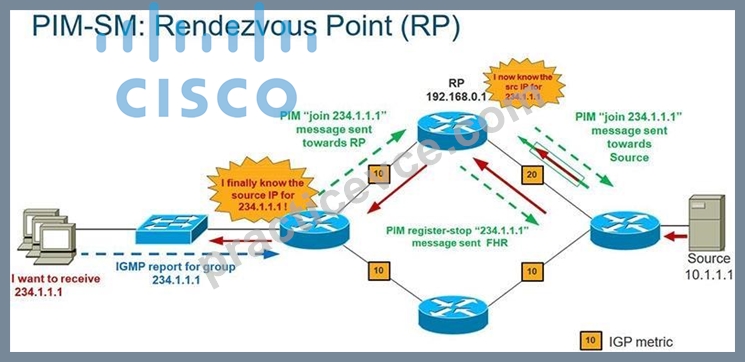
Reference: https://www.ciscolive.com/c/dam/r/ciscolive/apjc/docs/2018/pdf/BRKIPM-1261.pdf
NEW QUESTION # 221
Refer to the exhibit.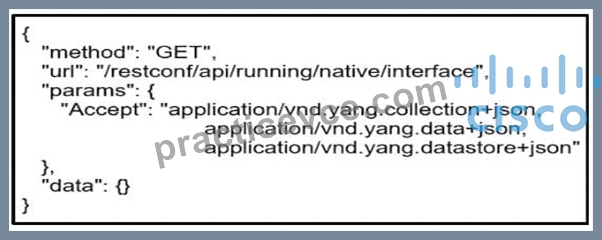
What is the result of the API request?
- A. The "params" variable reads data fields from the network appliance
- B. The Information for all interfaces is read from the network appliance.
- C. The native interface information is read from the network appliance.
- D. The "params" variable sends data fields to the network appliance.
Answer: A
NEW QUESTION # 222
Refer to the exhibit.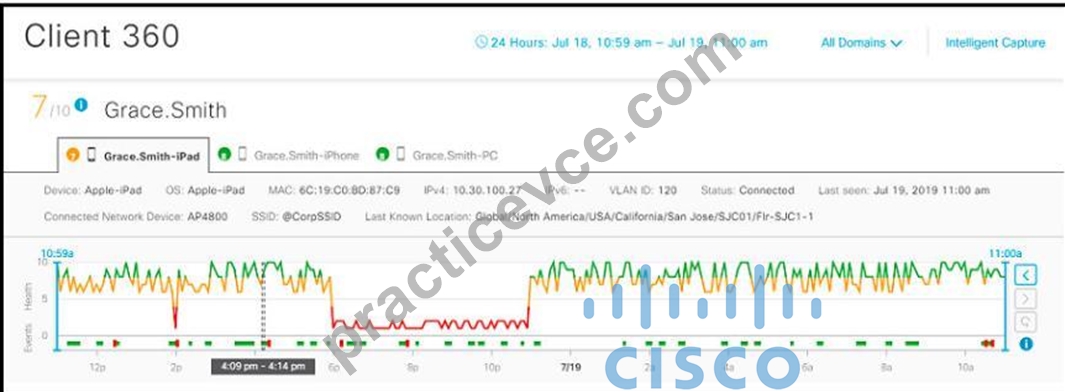
Cisco DNA Center has obtained the username of the client and the multiple devices that the client is using on the network. How is Cisco DNA Center getting these context details?
- A. The administrator had to assign the username to the IP address manually in the user database tool on Cisco DNA Center.
- B. Cisco DNA Center pulled those details directly from the edge node where the user connected.
- C. Those details are provided to Cisco DNA Center by the Identity Services Engine
- D. User entered those details in the Assurance app available on iOS and Android devices
Answer: B
Explanation:
Explanation
Features of the Cisco DNA Assurance solution includes Device 360 and client 360, which provides a detailed view of the performance of any device or client over time and from any application context. Provides very granular troubleshooting in seconds.
NEW QUESTION # 223
Drag and drop the characteristics from the left onto the orchestration tools they describe on the right.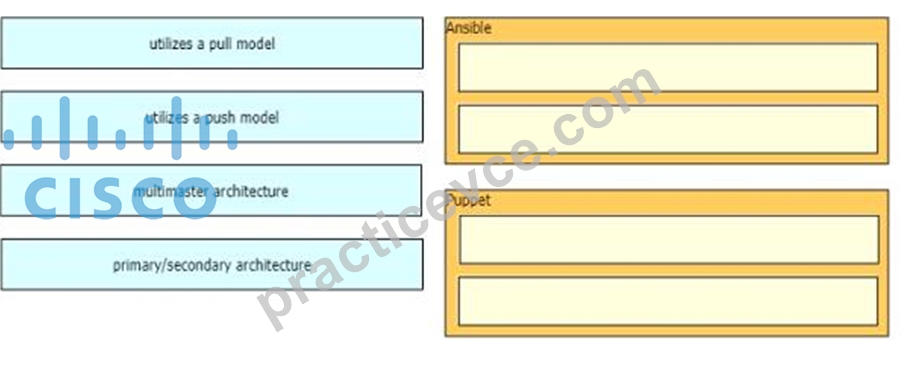
Answer:
Explanation: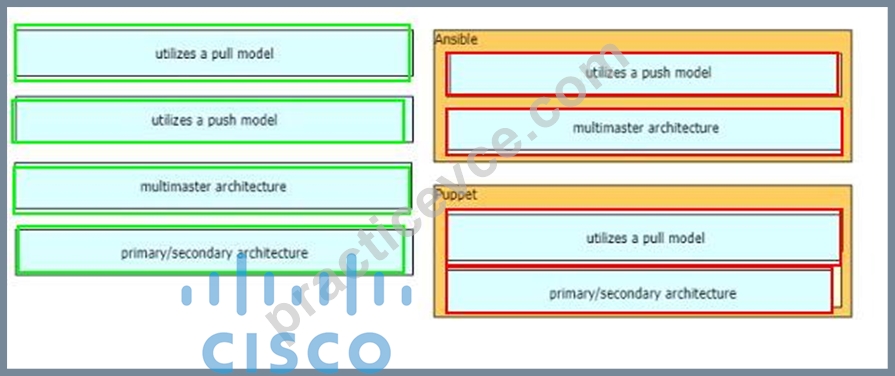
NEW QUESTION # 224
......
Cisco 350-401 certification exam is an ideal choice for individuals who want to demonstrate their expertise in enterprise network technologies. 350-401 exam is designed to test the knowledge of candidates on various network technologies and their ability to implement and manage enterprise network infrastructures. Implementing Cisco Enterprise Network Core Technologies (350-401 ENCOR) certification exam also covers topics such as network automation, network security, and network design.
350-401 Practice Exam and Study Guides - Verified By PracticeVCE: https://www.practicevce.com/Cisco/350-401-practice-exam-dumps.html
2025 Updated Verified Pass 350-401 Study Guides & Best Courses: https://drive.google.com/open?id=1tcr8UZuTu8vpEi2pfqJLSYo7Db_RhFXU