

Authentic Best resources for 300-425 Test Engine Practice Exam
[2022] 300-425 PDF Questions - Perfect Prospect To Go With PracticeVCE Practice Exam
More Details for Exam 300-425
Candidates looking forward to 300-425 have to hold skills which come by thoroughly exploring the aspect of developing wireless networks. Topics to venture into include site surveys, wireless in addition to wired architecture, high availability for wireless LAN, and mobility. Proving abilities in these areas is through a test lasting for 1.5 hours and presented in the English language and Japanese. Professional concentration tests like 300-425 go for $300. About the passing score, Cisco does not state the minimum points to get for one to be accredited. But it is always good to strive to get very high marks and promote your chances of passing. Revision guides and training serve the great purpose of assisting exam-takers to build appropriate knowledge around the stated topics.
WLAN High Availability
The questions from this section cover 20% of the entire content and are dedicated to evaluating the following abilities of the candidates:
- Design high availability for various controllers, including network availability through LAG, stateful switchover, as well as anchor controller priority & redundancy;
- Design high availability for APs, including fall-back (primary, secondary, and assigning tertiary) and AP prioritization.
Mobility
In the framework of this domain that covers 25% of the exam questions, the students are required to prove their competence in the following areas:
- Designing mobility groups based on the mobility roles;
- Improving client roaming;
- Verifying mobility tunneling for the control path & data.
NEW QUESTION 31
An engineer has deployed a group of APs in an auditorium and notices that the APs are showing high cochannel interference. Which profile can be used to adjust the parameters for these high-density APs?
- A. RF profile
- B. QoS profile
- C. AVC profile
- D. ISE profile
Answer: A
Explanation:
NEW QUESTION 32
An engineer has deployed a group of APs in an auditorium and notices that the APs are showing high cochannel interference. Which profile can be used to adjust the parameters for these high-density APs?
- A. RF profile
- B. QoS profile
- C. AVC profile
- D. ISE profile
Answer: A
Explanation:
NEW QUESTION 33
Which CLI command does an engineer use to validate that the redundancy peer of a Stateful Switchover pair of controllers is up and connected?
- A. mping
- B. rping
- C. eping
- D. ping
Answer: D
Explanation:
NEW QUESTION 34
A customer is looking for a network design with Cisco Hyperloctation using AP4800 for location tracking via a custom mobile app Issues appeared in the past with refresh rates for location updates. What needs to be implemented to meet these requirements?
- A. Cisco FastLocate technology
- B. redundant CMX and fetch location in round-robin fashion.
- C. device Bluetooth via the app
- D. Cisco CMX SDK in the location app
Answer: A
NEW QUESTION 35
Which non-Wi-Fi interferer can be identified by Metageek Chanalyzer?
- A. smartphones
- B. printers
- C. jammers
- D. PDAs
Answer: C
Explanation:
Section: Wireless Site Survey
NEW QUESTION 36
During a client roaming event, which device is responsible for communicating the new Layer 2 EID mapping of a wireless supplicant to the fabric domain?
- A. WLC
- B. BN
- C. CP1
- D. CP2
Answer: A
Explanation:
https://www.cisco.com/c/dam/en/us/td/docs/cloud-systems-management/network-automation-and-management/dna-center/deploy-guide/cisco-dna-center-sd-access-wl-dg.pdf
NEW QUESTION 37
An engineer as performing a Layer 1 passive wireless site survey utilizing a channel analyzer software in the
2.4 GHz spectrum. Which chart indicates the ratio of interference present during the duration of the capture?
A)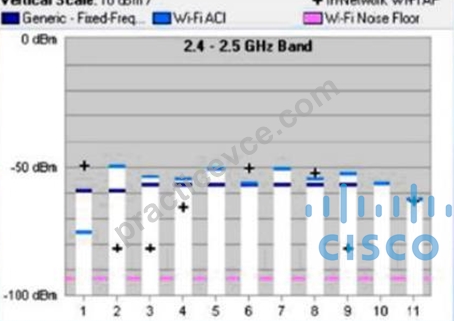
B)
C)
- A. Option C
- B. Option D
- C. Option B
- D. Option A
Answer: A
NEW QUESTION 38
As part of a wireless site survey in a hospital, an engineer needs to identify potential Layer 1 interferers. In which two areas is the engineer most likely to find sources of 2.4 GHz and 5 GHz RF noise? (Choose two.)
- A. patient room
- B. kitchen
- C. Gamma Knife radiation treatment
- D. X-ray radiography
- E. magnetic resonance imaging
Answer: A,B
Explanation:
Explanation
https://www.ciscopress.com/articles/article.asp?p=2351131&seqNum=2
NEW QUESTION 39
Refer to the exhibit.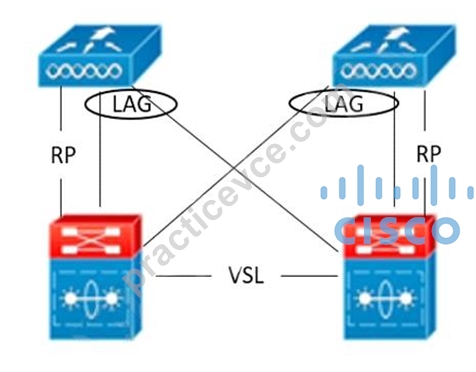
A WLC SSO pair is set up. Which failure scenario causes a split-brain scenario?
- A. Two distribution ports on the active WLC are down.
- B. VSL is down.
- C. One distribution port on the active WLC is down.
- D. RP is down.
Answer: B
NEW QUESTION 40
A network engineer needs to create a wireless design to bridge wired IP surveillance cameras in the parking lot through a mesh AP. To which operate mode of the AP should the cameras connect?
- A. Flexconnect
- B. RAP
- C. MAP
- D. Local
Answer: C
NEW QUESTION 41
A wireless engineer is utilizing the voice readiness tool in Cisco Prime for a customer that wants to deploy Cisco IP phones. Which dBm range is the network inspected against?
- A. -85 to -65 dBm
- B. -85 to -67 dBm
- C. -72 to -67 dBm
- D. -78 to -65 dBm
Answer: B
Explanation:
Explanation
https://www.cisco.com/c/en/us/td/docs/net_mgmt/prime/infrastructure/34/user/guide/bk_CiscoPrimeInfrastructur minimum is -90 and maximum is -67 for IP phone
NEW QUESTION 42
Which Cisco IOS VPN technology leverages Ipsec, mGRE, dynamic routing protocol, NHRP, and Cisco Express Forwarding?
- A. FlexVPN
- B. DMVPN
- C. Cisco Easy VPN
- D. GETVPN
Answer: B
Explanation:
Dynamic Multipoint Virtual Private Network (DMVPN) is a dynamic tunneling form of a virtual private network (VPN) supported on Cisco IOS-based routers and Unix-like Operating Systems based on the standard protocols, GRE, NHRP and Ipsec. This DMVPN provides the capability for creating a dynamic-mesh VPN network without having to pre-configure (static) all possible tunnel end-point peers, including Ipsec (Internet Protocol Security) and ISAKMP (Internet Security Association and Key Management Protocol) peers. DMVPN is initially configured to build out a hub-and-spoke network by statically configuring the hubs (VPN headends) on the spokes, no change in the configuration on the hub is required to accept new spokes. Using this initial hub-and-spoke network, tunnels between spokes can be dynamically built on demand (dynamic-mesh) without additional configuration on the hubs or spokes. This dynamic-mesh capability alleviates the need for any load on the hub to route data between the spoke networks.
DMVPN is combination of the following technologies:
Multipoint GRE (mGRE)
Next-Hop Resolution Protocol (NHRP)
Dynamic Routing Protocol (EIGRP, RIP, OSPF, BGP)
Dynamic Ipsec encryption
Cisco Express Forwarding (CEF)
Reference: http://en.wikipedia.org/wiki/Dynamic_Multipoint_Virtual_Private_Network
NEW QUESTION 43
Which two criteria must be considered when conducting an outdoor bridge site survey? (Choose two.)
- A. power lines
- B. weather
- C. Fresnel zone
- D. traffic lights
- E. near-far effect
Answer: A,E
NEW QUESTION 44
What are the three RSTP port states? (Choose three.)
- A. Learning
- B. Initializing
- C. Listening
- D. Discarding
- E. Blocking
- F. Forwarding
Answer: A,D,F
Explanation:
Rapid Spanning Tree Protocol (RSTP) uses only three port states: discarding, learning, and forwarding. The learning and forwarding states are the same as the original STP standard, but the discarding state performs the functions originally performed in the disabled, blocking, and listening STP states.
With STP, you can safely assume that a listening port is either designated or root, and is on its way to the forwarding state. Unfortunately, once a port is in the forwarding state, there is no way to tell whether the port is root or designated. There is no difference in the operation of a port in blocking state and a port in listening state, since they both discard frames and do not learn MAC addresses. The real difference is in the role the spanning tree assigns to the port. RSTP decouples the role and the state of a port.
With RSTP, a role is assigned to a port. The root port and designated port roles are the same as with STP, while the blocking port role is split into the backup and alternative port roles. The Spanning Tree Algorithm (STA) determines the role of a port based on Bridge Protocol Data Units (BPDUs). The RSTP roles can be defined as follows:
Root port: The port receiving the best BPDU on a bridge (lowest-cost path to the root bridge) is the root port.
Designated port: The port that has the best path to the root bridge on a given segment is the designated port.
The bridges connected to a given segment listen to each other's BPDUs and agree on the bridge sending the best BPDU as the designated bridge for the segment. The corresponding port on that bridge is the designated port.
Alternative port: An alternative port is a port blocked by receiving more useful BPDUs from another bridge. It becomes the root port if the active port fails.
Backup port: A backup port is a port blocked by receiving more useful BPDUs originating from the same bridge. It becomes the designated port if the existing designated port fails.
Ports on the switch can also be classified as edge ports and non-edge ports. Access ports or edge ports are those that attach to devices such as workstations or printers. Non-edge ports are those that connect to other switches. If a non-edge port transitions to a forwarding state, a TC BPDU will be generated. On the other hand, when an edge ports transitions to the forwarding state, such as after a computer boots up or a device is connected to the port, no TC BPDU is generated.
Objective:
Layer 2 Technologies
Sub-Objective:
Configure and verify spanning tree
References:
Cisco > Support > Technology Support > LAN Switching > Spanning Tree Protocol > Technology Information > Technology White Paper > Understanding Rapid Spanning Tree Protocol (802.1w)
NEW QUESTION 45
A network engineer is preparing for an office site survey with a height of 2.5 meters. Which three components are recommended to complete the survey? (Choose three.)
- A. Use a battery pack to power APs
- B. Use APs with directional antennas.
- C. Use a drawing of the office space to draw AP and client placements.
- D. Use APs with external antennas.
- E. Use APs with built-in antennas.
- F. Use DoS attack on APs while measuring the throughput.
Answer: A,C,E
Explanation:
Explanation
https://www.cisco.com/c/en/us/td/docs/wireless/technology/mesh/8-4/b_mesh_84/Site_Preparation_and_Plannin
NEW QUESTION 46
An engineer has performed a predictive site survey for high-speed data and voice in an indoor office. What is the recommended data rate with -67 dBm signal level for optimal VoWLAN design?
- A. 6 Mbps on 802.11 bgn
- B. 12 Mbps on 802.11 an
- C. 24 Mbps on 802.11 an
- D. 24 Mbps on 802.11 bgn
Answer: D
Explanation:

NEW QUESTION 47
Which Cisco VPN technology uses AAA to implement group policies and authorization and is also used for the XAUTH authentication method?
- A. Cisco Easy VPN
- B. GREVPN
- C. DMVPN
- D. GETVPN
Answer: A
NEW QUESTION 48
......
Best updated resource for 300-425 Online Practice Exam: https://www.practicevce.com/Cisco/300-425-practice-exam-dumps.html
Realistic Practice 300-425 Designing Cisco Enterprise Wireless Networks Exam Braindumps: https://drive.google.com/open?id=1TachLrH8Sudg6MtklLa1LVhtK_Z_o15O