

New 2023 Latest Questions CKS Dumps - Use Updated Linux Foundation Exam
Latest CKS Exam Dumps Linux Foundation Exam from Training Expert PracticeVCE
NEW QUESTION # 24
Context
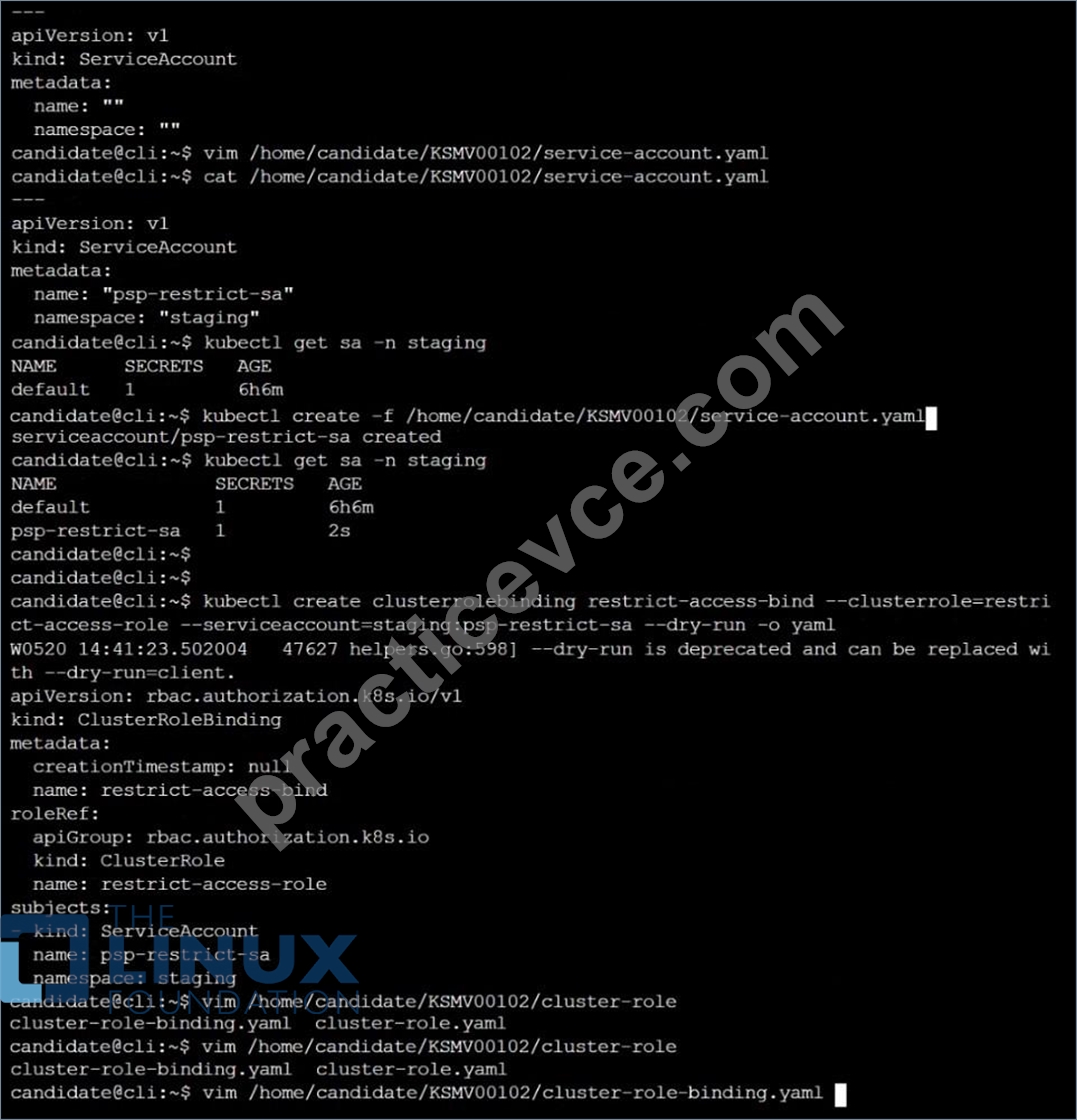
A PodSecurityPolicy shall prevent the creation of privileged Pods in a specific namespace.
Task
Create a new PodSecurityPolicy named prevent-psp-policy,which prevents the creation of privileged Pods.
Create a new ClusterRole named restrict-access-role, which uses the newly created PodSecurityPolicy prevent-psp-policy.
Create a new ServiceAccount named psp-restrict-sa in the existing namespace staging.
Finally, create a new ClusterRoleBinding named restrict-access-bind, which binds the newly created ClusterRole restrict-access-role to the newly created ServiceAccount psp-restrict-sa.
Answer:
Explanation:






NEW QUESTION # 25
SIMULATION
Create a network policy named restrict-np to restrict to pod nginx-test running in namespace testing.
Only allow the following Pods to connect to Pod nginx-test:-
1. pods in the namespace default
2. pods with label version:v1 in any namespace.
Make sure to apply the network policy.
- A. Send us your Feedback on this.
Answer: A
NEW QUESTION # 26
Create a Pod name Nginx-pod inside the namespace testing, Create a service for the Nginx-pod named nginx-svc, using the ingress of your choice, run the ingress on tls, secure port.
Answer:
Explanation:
$ kubectl get ing -n <namespace-of-ingress-resource>
NAME HOSTS ADDRESS PORTS AGE
cafe-ingress cafe.com 10.0.2.15 80 25s
$ kubectl describe ing <ingress-resource-name> -n <namespace-of-ingress-resource> Name: cafe-ingress Namespace: default Address: 10.0.2.15 Default backend: default-http-backend:80 (172.17.0.5:8080) Rules:
Host Path Backends
---- ---- --------
cafe.com
/tea tea-svc:80 (<none>)
/coffee coffee-svc:80 (<none>)
Annotations:
kubectl.kubernetes.io/last-applied-configuration: {"apiVersion":"networking.k8s.io/v1","kind":"Ingress","metadata":{"annotations":{},"name":"cafe-ingress","namespace":"default","selfLink":"/apis/networking/v1/namespaces/default/ingresses/cafe-ingress"},"spec":{"rules":[{"host":"cafe.com","http":{"paths":[{"backend":{"serviceName":"tea-svc","servicePort":80},"path":"/tea"},{"backend":{"serviceName":"coffee-svc","servicePort":80},"path":"/coffee"}]}}]},"status":{"loadBalancer":{"ingress":[{"ip":"169.48.142.110"}]}}} Events:
Type Reason Age From Message
---- ------ ---- ---- -------
Normal CREATE 1m ingress-nginx-controller Ingress default/cafe-ingress
Normal UPDATE 58s ingress-nginx-controller Ingress default/cafe-ingress
$ kubectl get pods -n <namespace-of-ingress-controller>
NAME READY STATUS RESTARTS AGE
ingress-nginx-controller-67956bf89d-fv58j 1/1 Running 0 1m
$ kubectl logs -n <namespace> ingress-nginx-controller-67956bf89d-fv58j
------------------------------------------------------------------------------- NGINX Ingress controller Release: 0.14.0 Build: git-734361d Repository: https://github.com/kubernetes/ingress-nginx
-------------------------------------------------------------------------------
....
NEW QUESTION # 27
You must complete this task on the following cluster/nodes: Cluster: immutable-cluster Master node: master1 Worker node: worker1 You can switch the cluster/configuration context using the following command: [desk@cli] $ kubectl config use-context immutable-cluster Context: It is best practice to design containers to be stateless and immutable. Task: Inspect Pods running in namespace prod and delete any Pod that is either not stateless or not immutable. Use the following strict interpretation of stateless and immutable: 1. Pods being able to store data inside containers must be treated as not stateless. Note: You don't have to worry whether data is actually stored inside containers or not already. 2. Pods being configured to be privileged in any way must be treated as potentially not stateless or not immutable.
Answer:
Explanation:

Reference: https://kubernetes.io/docs/concepts/policy/pod-security-policy/ https://cloud.google.com/architecture/best-practices-for-operating-containers
NEW QUESTION # 28
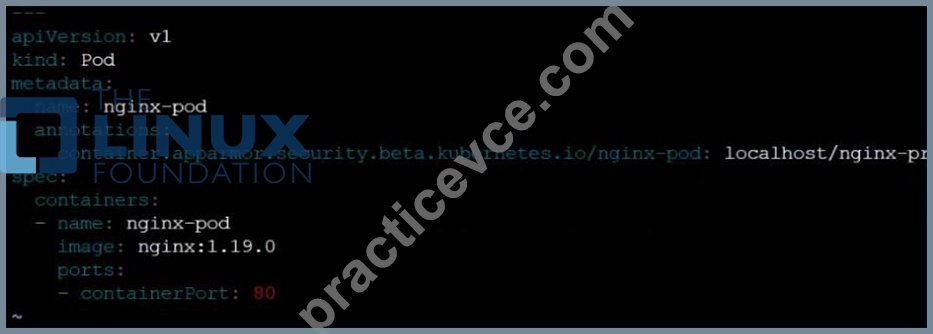
On the Cluster worker node, enforce the prepared AppArmor profile
#include <tunables/global>
profile nginx-deny flags=(attach_disconnected) {
#include <abstractions/base>
file,
# Deny all file writes.
deny /** w,
}
EOF'
Edit the prepared manifest file to include the AppArmor profile.
apiVersion: v1
kind: Pod
metadata:
name: apparmor-pod
spec:
containers:
- name: apparmor-pod
image: nginx
Finally, apply the manifests files and create the Pod specified on it.
Verify: Try to make a file inside the directory which is restricted.
Answer:
Explanation:

NEW QUESTION # 29
SIMULATION
Fix all issues via configuration and restart the affected components to ensure the new setting takes effect.
Fix all of the following violations that were found against the API server:- a. Ensure that the RotateKubeletServerCertificate argument is set to true.
b. Ensure that the admission control plugin PodSecurityPolicy is set.
c. Ensure that the --kubelet-certificate-authority argument is set as appropriate.
Fix all of the following violations that were found against the Kubelet:- a. Ensure the --anonymous-auth argument is set to false.
b. Ensure that the --authorization-mode argument is set to Webhook.
Fix all of the following violations that were found against the ETCD:-
a. Ensure that the --auto-tls argument is not set to true
b. Ensure that the --peer-auto-tls argument is not set to true
Hint: Take the use of Tool Kube-Bench
Answer:
Explanation:
Fix all of the following violations that were found against the API server:- a. Ensure that the RotateKubeletServerCertificate argument is set to true.
apiVersion: v1
kind: Pod
metadata:
creationTimestamp: null
labels:
component: kubelet
tier: control-plane
name: kubelet
namespace: kube-system
spec:
containers:
- command:
- kube-controller-manager
+ - --feature-gates=RotateKubeletServerCertificate=true
image: gcr.io/google_containers/kubelet-amd64:v1.6.0
livenessProbe:
failureThreshold: 8
httpGet:
host: 127.0.0.1
path: /healthz
port: 6443
scheme: HTTPS
initialDelaySeconds: 15
timeoutSeconds: 15
name: kubelet
resources:
requests:
cpu: 250m
volumeMounts:
- mountPath: /etc/kubernetes/
name: k8s
readOnly: true
- mountPath: /etc/ssl/certs
name: certs
- mountPath: /etc/pki
name: pki
hostNetwork: true
volumes:
- hostPath:
path: /etc/kubernetes
name: k8s
- hostPath:
path: /etc/ssl/certs
name: certs
- hostPath:
path: /etc/pki
name: pki
b. Ensure that the admission control plugin PodSecurityPolicy is set.
audit: "/bin/ps -ef | grep $apiserverbin | grep -v grep"
tests:
test_items:
- flag: "--enable-admission-plugins"
compare:
op: has
value: "PodSecurityPolicy"
set: true
remediation: |
Follow the documentation and create Pod Security Policy objects as per your environment.
Then, edit the API server pod specification file $apiserverconf
on the master node and set the --enable-admission-plugins parameter to a value that includes PodSecurityPolicy :
--enable-admission-plugins=...,PodSecurityPolicy,...
Then restart the API Server.
scored: true
c. Ensure that the --kubelet-certificate-authority argument is set as appropriate.
audit: "/bin/ps -ef | grep $apiserverbin | grep -v grep"
tests:
test_items:
- flag: "--kubelet-certificate-authority"
set: true
remediation: |
Follow the Kubernetes documentation and setup the TLS connection between the apiserver and kubelets. Then, edit the API server pod specification file
$apiserverconf on the master node and set the --kubelet-certificate-authority parameter to the path to the cert file for the certificate authority.
--kubelet-certificate-authority=<ca-string>
scored: true
Fix all of the following violations that were found against the ETCD:-
a. Ensure that the --auto-tls argument is not set to true
Edit the etcd pod specification file $etcdconf on the master node and either remove the --auto-tls parameter or set it to false. --auto-tls=false b. Ensure that the --peer-auto-tls argument is not set to true Edit the etcd pod specification file $etcdconf on the master node and either remove the --peer-auto-tls parameter or set it to false. --peer-auto-tls=false
NEW QUESTION # 30
Cluster: admission-cluster
Master node: master
Worker node: worker1
You can switch the cluster/configuration context using the following command:
[desk@cli] $ kubectl config use-context admission-cluster
Context:
A container image scanner is set up on the cluster, but it's not yet fully integrated into the cluster's configuration. When complete, the container image scanner shall scan for and reject the use of vulnerable images.
Task:
You have to complete the entire task on the cluster's master node, where all services and files have been prepared and placed.
Given an incomplete configuration in directory /etc/Kubernetes/config and a functional container image scanner with HTTPS endpoint https://imagescanner.local:8181/image_policy:
1. Enable the necessary plugins to create an image policy
2. Validate the control configuration and change it to an implicit deny
3. Edit the configuration to point to the provided HTTPS endpoint correctly Finally, test if the configuration is working by trying to deploy the vulnerable resource /home/cert_masters/test-pod.yml Note: You can find the container image scanner's log file at /var/log/policy/scanner.log
Answer:
Explanation:
[master@cli] $ cd /etc/Kubernetes/config
1. Edit kubeconfig to explicity deny
[master@cli] $ vim kubeconfig.json
"defaultAllow": false # Change to false
2. fix server parameter by taking its value from ~/.kube/config
[master@cli] $cat /etc/kubernetes/config/kubeconfig.yaml | grep server
server:
3. Enable ImagePolicyWebhook
[master@cli] $ vim /etc/kubernetes/manifests/kube-apiserver.yaml
- --enable-admission-plugins=NodeRestriction,ImagePolicyWebhook # Add this
- --admission-control-config-file=/etc/kubernetes/config/kubeconfig.json # Add this Explanation
[desk@cli] $ ssh master
[master@cli] $ cd /etc/Kubernetes/config
[master@cli] $ vim kubeconfig.json
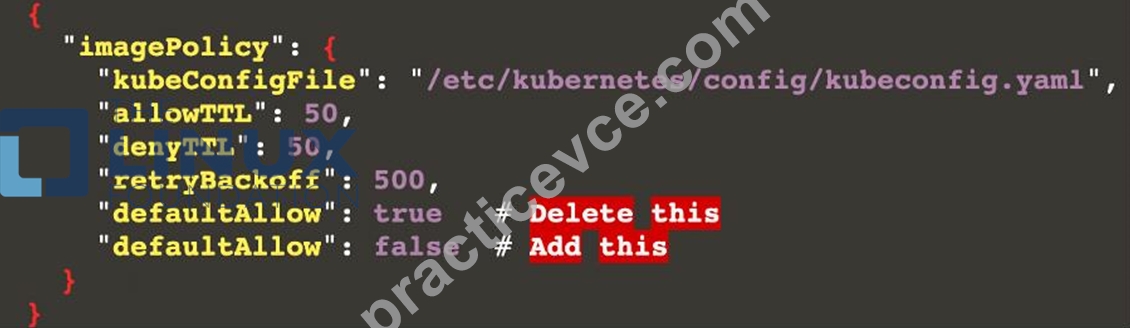
{
"imagePolicy": {
"kubeConfigFile": "/etc/kubernetes/config/kubeconfig.yaml",
"allowTTL": 50,
"denyTTL": 50,
"retryBackoff": 500,
"defaultAllow": true # Delete this
"defaultAllow": false # Add this
}
}
Note: We can see a missing value here, so how from where i can get this value
[master@cli] $cat ~/.kube/config | grep server
or
[master@cli] $cat /etc/kubernetes/manifests/kube-apiserver.yaml
[master@cli] $vim /etc/kubernetes/config/kubeconfig.yaml
[master@cli] $ vim /etc/kubernetes/manifests/kube-apiserver.yaml - --enable-admission-plugins=NodeRestriction # Delete This - --enable-admission-plugins=NodeRestriction,ImagePolicyWebhook # Add this - --admission-control-config-file=/etc/kubernetes/config/kubeconfig.json # Add this Reference: https://kubernetes.io/docs/reference/access-authn-authz/admission-controllers/
- --enable-admission-plugins=NodeRestriction # Delete This
- --enable-admission-plugins=NodeRestriction,ImagePolicyWebhook # Add this
- --admission-control-config-file=/etc/kubernetes/config/kubeconfig.json # Add this
[master@cli] $ vim /etc/kubernetes/manifests/kube-apiserver.yaml - --enable-admission-plugins=NodeRestriction # Delete This - --enable-admission-plugins=NodeRestriction,ImagePolicyWebhook # Add this - --admission-control-config-file=/etc/kubernetes/config/kubeconfig.json # Add this Reference: https://kubernetes.io/docs/reference/access-authn-authz/admission-controllers/
NEW QUESTION # 31
Create a RuntimeClass named untrusted using the prepared runtime handler named runsc.
Create a Pods of image alpine:3.13.2 in the Namespace default to run on the gVisor runtime class.
Answer:
Explanation:
Verify: Exec the pods and run the dmesg, you will see output like this:-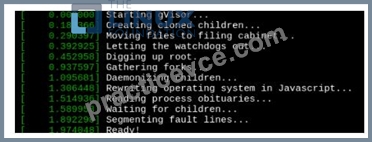
NEW QUESTION # 32
SIMULATION
A container image scanner is set up on the cluster.
Given an incomplete configuration in the directory
/etc/Kubernetes/confcontrol and a functional container image scanner with HTTPS endpoint https://acme.local.8081/image_policy
1. Enable the admission plugin.
2. Validate the control configuration and change it to implicit deny.
Finally, test the configuration by deploying the pod having the image tag as the latest.
- A. Send us the Feedback on it.
Answer: A
NEW QUESTION # 33
Cluster: dev
Master node: master1 Worker node: worker1
You can switch the cluster/configuration context using the following command: [desk@cli] $ kubectl config use-context dev Task: Retrieve the content of the existing secret named adam in the safe namespace.
Store the username field in a file names /home/cert-masters/username.txt, and the password field in a file named /home/cert-masters/password.txt.
1. You must create both files; they don't exist yet. 2. Do not use/modify the created files in the following steps, create new temporary files if needed.
Create a new secret names newsecret in the safe namespace, with the following content: Username: dbadmin Password: moresecurepas Finally, create a new Pod that has access to the secret newsecret via a volume:
Namespace: safe
Pod name: mysecret-pod
Container name: db-container
Image: redis
Volume name: secret-vol
Mount path: /etc/mysecret
Answer:
Explanation: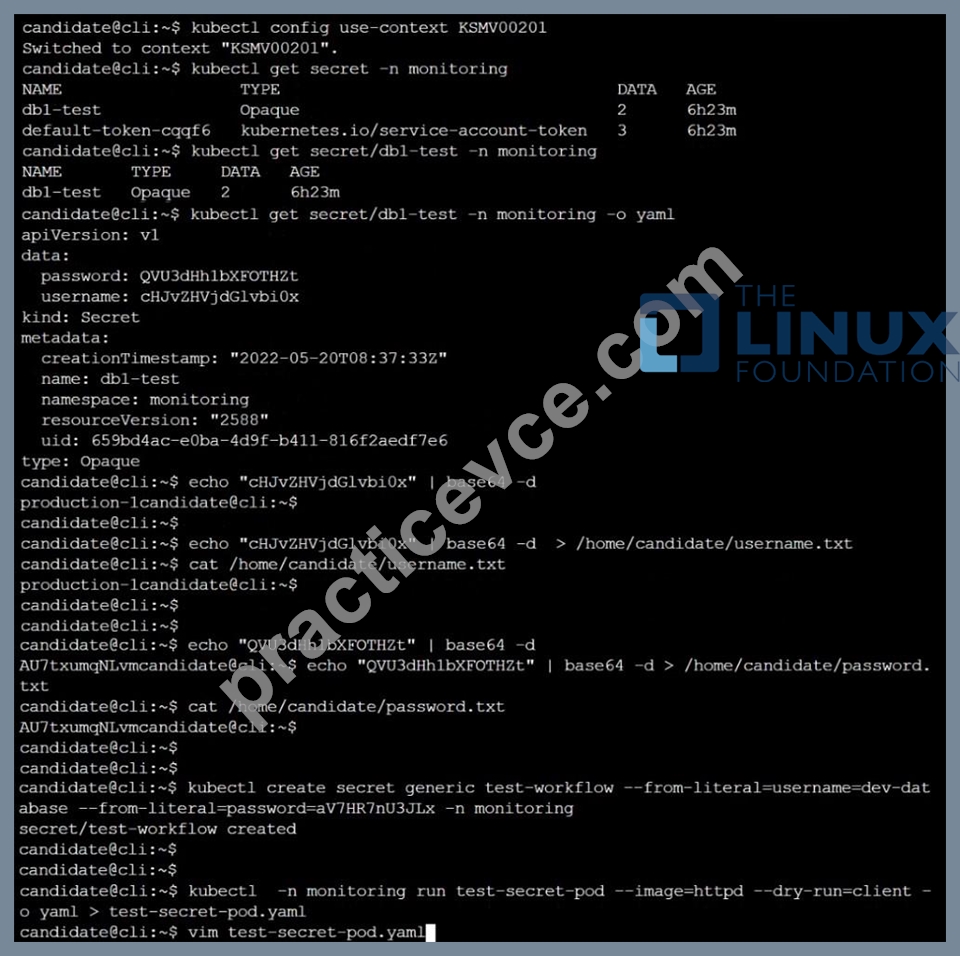


NEW QUESTION # 34
Create a User named john, create the CSR Request, fetch the certificate of the user after approving it.
Create a Role name john-role to list secrets, pods in namespace john
Finally, Create a RoleBinding named john-role-binding to attach the newly created role john-role to the user john in the namespace john. To Verify: Use the kubectl auth CLI command to verify the permissions.
Answer:
Explanation:
se kubectl to create a CSR and approve it.
Get the list of CSRs:
kubectl get csr
Approve the CSR:
kubectl certificate approve myuser
Get the certificate
Retrieve the certificate from the CSR:
kubectl get csr/myuser -o yaml
here are the role and role-binding to give john permission to create NEW_CRD resource:
kubectl apply -f roleBindingJohn.yaml --as=john
rolebinding.rbac.authorization.k8s.io/john_external-rosource-rb created kind: RoleBinding apiVersion: rbac.authorization.k8s.io/v1 metadata:
name: john_crd
namespace: development-john
subjects:
- kind: User
name: john
apiGroup: rbac.authorization.k8s.io
roleRef:
kind: ClusterRole
name: crd-creation
kind: ClusterRole
apiVersion: rbac.authorization.k8s.io/v1
metadata:
name: crd-creation
rules:
- apiGroups: ["kubernetes-client.io/v1"]
resources: ["NEW_CRD"]
verbs: ["create, list, get"]
NEW QUESTION # 35
Create a new ServiceAccount named backend-sa in the existing namespace default, which has the capability to list the pods inside the namespace default.
Create a new Pod named backend-pod in the namespace default, mount the newly created sa backend-sa to the pod, and Verify that the pod is able to list pods.
Ensure that the Pod is running.
Answer:
Explanation:
A service account provides an identity for processes that run in a Pod.
When you (a human) access the cluster (for example, using kubectl), you are authenticated by the apiserver as a particular User Account (currently this is usually admin, unless your cluster administrator has customized your cluster). Processes in containers inside pods can also contact the apiserver. When they do, they are authenticated as a particular Service Account (for example, default).
When you create a pod, if you do not specify a service account, it is automatically assigned the default service account in the same namespace. If you get the raw json or yaml for a pod you have created (for example, kubectl get pods/<podname> -o yaml), you can see the spec.serviceAccountName field has been automatically set.
You can access the API from inside a pod using automatically mounted service account credentials, as described in Accessing the Cluster. The API permissions of the service account depend on the authorization plugin and policy in use.
In version 1.6+, you can opt out of automounting API credentials for a service account by setting automountServiceAccountToken: false on the service account:
apiVersion: v1
kind: ServiceAccount
metadata:
name: build-robot
automountServiceAccountToken: false
...
In version 1.6+, you can also opt out of automounting API credentials for a particular pod:
apiVersion: v1
kind: Pod
metadata:
name: my-pod
spec:
serviceAccountName: build-robot
automountServiceAccountToken: false
...
The pod spec takes precedence over the service account if both specify a automountServiceAccountToken value.
NEW QUESTION # 36
Cluster: qa-cluster
Master node: master Worker node: worker1
You can switch the cluster/configuration context using the following command:
[desk@cli] $ kubectl config use-context qa-cluster
Task:
Create a NetworkPolicy named restricted-policy to restrict access to Pod product running in namespace dev.
Only allow the following Pods to connect to Pod products-service:
1. Pods in the namespace qa
2. Pods with label environment: stage, in any namespace
Answer:
Explanation:
$ k get ns qa --show-labels
NAME STATUS AGE LABELS
qa Active 47m env=stage
$ k get pods -n dev --show-labels
NAME READY STATUS RESTARTS AGE LABELS
product 1/1 Running 0 3s env=dev-team
apiVersion: networking.k8s.io/v1
kind: NetworkPolicy
metadata:
name: restricted-policy
namespace: dev
spec:
podSelector:
matchLabels:
env: dev-team
policyTypes:
- Ingress
ingress:
- from:
- namespaceSelector:
matchLabels:
env: stage
- podSelector:
matchLabels:
env: stage
[desk@cli] $ k get ns qa --show-labels
NAME STATUS AGE LABELS
qa Active 47m env=stage
[desk@cli] $ k get pods -n dev --show-labels
NAME READY STATUS RESTARTS AGE LABELS
product 1/1 Running 0 3s env=dev-team
[desk@cli] $ vim netpol2.yaml
apiVersion: networking.k8s.io/v1
kind: NetworkPolicy
metadata:
name: restricted-policy
namespace: dev
spec:
podSelector:
matchLabels:
env: dev-team
policyTypes:
- Ingress
ingress:
- from:
- namespaceSelector:
matchLabels:
env: stage
- podSelector:
matchLabels:
env: stage
[desk@cli] $ k apply -f netpol2.yaml Reference: https://kubernetes.io/docs/concepts/services-networking/network-policies/
[desk@cli] $ k apply -f netpol2.yaml Reference: https://kubernetes.io/docs/concepts/services-networking/network-policies/
NEW QUESTION # 37
SIMULATION
Given an existing Pod named nginx-pod running in the namespace test-system, fetch the service-account-name used and put the content in /candidate/KSC00124.txt Create a new Role named dev-test-role in the namespace test-system, which can perform update operations, on resources of type namespaces.
Create a new RoleBinding named dev-test-role-binding, which binds the newly created Role to the Pod's ServiceAccount ( found in the Nginx pod running in namespace test-system).
- A. Sendusyourfeedbackonit
Answer: A
NEW QUESTION # 38
SIMULATION
use the Trivy to scan the following images,
1. amazonlinux:1
2. k8s.gcr.io/kube-controller-manager:v1.18.6
Look for images with HIGH or CRITICAL severity vulnerabilities and store the output of the same in /opt/trivy-vulnerable.txt
- A. Send us the Feedback on it.
Answer: A
NEW QUESTION # 39
......
Updated Test Engine to Practice CKS Dumps & Practice Exam: https://www.practicevce.com/Linux-Foundation/CKS-practice-exam-dumps.html
Pass Linux Foundation CKS PDF Dumps Recently Updated 49 Questions: https://drive.google.com/open?id=1YRZGObO0xfvKsqjxU2r6Zhe6QAn8fpnq