

Full Professional-Cloud-Developer Practice Test and 228 unique questions with explanations waiting just for you!
Cloud Developer Dumps Professional-Cloud-Developer Exam for Full Questions - Exam Study Guide
This certification exam measures your ability to perform various tasks required for the successful functioning of different processes. The details of its topics are enumerated below:
Designing Highly Available, Reliable, and Scalable Cloud-Native Apps
- Manage Application Data: The considerations for this subdomain include data volume, structured versus unstructured data, strong versus eventual consistency, and data access frequency within Cloud Storage.
- Design High Performing APIs and Applications: The considerations for this subject area include Microservices, scaling velocity tradeoffs/characteristics of IaaS vs. CaaS vs. PaaS, Geographic distribution of Google Cloud services, and user session management. It also covers the domains, such as caching solutions, securing & deploying API services, Google-recommended documentation & practices, and refined shutdown on the platform termination. The learners should also be able to explain the key structure of high-write apps with the use of Cloud Storage, Cloud SQL, Cloud Spanner, and Cloud Bigtable.
- Design Secure Applications: This topic covers the details, which include security mechanisms securing and protecting services and resources as well as app manifests & binaries. It also involves the skills in implementing the appropriate prerequisites for applicable applications. You should know about rotating & storing application keys & secrets, validating processes of the Google service, service-to-service communications, and IAM roles for groups/service/user accounts. The subtopic also covers your knowledge of how to run the services that have the least privileged access, data retention prerequisites, and certificate-based validation.
- Application Modernization: It covers the learners’ skills in using managed services, designing horizontally state-less scalable services, refactoring the monolith to micro-services, and understanding the Google-recommended practices and documentation.
NEW QUESTION 132
HipLocal wants to improve the resilience of their MySQL deployment, while also meeting their business and technical requirements.
Which configuration should they choose?
- A. Replace the current single instance MySQL instance with Cloud SQL, and Google provides redundancy without further configuration.
- B. Use the current single instance MySQL on Compute Engine and several read-only MySQL servers on Compute Engine.
- C. Replace the current single instance MySQL instance with Cloud SQL, and configure high availability.
- D. Use the current single instance MySQL on Compute Engine, and replicate the data to Cloud SQL in an external master configuration.
Answer: D
NEW QUESTION 133
Your team develops services that run on Google Kubernetes Engine. Your team's code is stored in Cloud Source Repositories. You need to quickly identify bugs in the code before it is deployed to production. You want to invest in automation to improve developer feedback and make the process as efficient as possible.
What should you do?
- A. Use Spinnaker to automate building container images from code based on Git tags.
- B. Use Spinnaker to automate deploying container images to the production environment.
- C. Use Cloud Build to automate building container images from code based on Git tags.
- D. Use Cloud Build to automate building container images from code based on forked versions.
Answer: A
Explanation:
Reference: https://spinnaker.io/docs/guides/tutorials/codelabs/kubernetes-v2-source-to-prod/
NEW QUESTION 134
You are using Cloud Build for your CI/CD pipeline to complete several tasks, including copying certain files to Compute Engine virtual machines. Your pipeline requires a flat file that is generated in one builder in the pipeline to be accessible by subsequent builders in the same pipeline. How should you store the file so that all the builders in the pipeline can access it?
- A. Add a build argument that runs an HTTP POST via curl to a separate web server to persist the value in one builder. Use an HTTP GET via curl from the subsequent build step to read the value.
- B. Output the file contents to a file in /workspace. Read from the same /workspace file in the subsequent build step.
- C. Use gsutil to output the file contents to a Cloud Storage object. Read from the same object in the subsequent build step.
- D. Store and retrieve the file contents using Compute Engine instance metadata.
Answer: B
Explanation:
https://cloud.google.com/build/docs/build-config-file-schema
NEW QUESTION 135
You are parsing a log file that contains three columns: a timestamp, an account number (a string), and a transaction amount (a number). You want to calculate the sum of all transaction amounts for each unique account number efficiently.
Which data structure should you use?
- A. A linked list
- B. A hash table
- C. A two-dimensional array
- D. A comma-delimited string
Answer: B
NEW QUESTION 136
You are deploying a microservices application to Google Kubernetes Engine (GKE). The application will receive daily updates. You expect to deploy a large number of distinct containers that will run on the Linux operating system (OS). You want to be alerted to any known OS vulnerabilities in the new containers. You want to follow Google-recommended best practices. What should you do?
- A. Enable Container Analysis, and upload new container images to Artifact Registry. Review the vulnerability results before each deployment.
- B. Use the gcloud CLI to call Container Analysis to scan new container images. Review the vulnerability results before each deployment.
- C. Use the Container Analysis REST API to call Container Analysis to scan new container images. Review the vulnerability results before each deployment.
- D. Enable Container Analysis, and upload new container images to Artifact Registry. Review the critical vulnerability results before each deployment.
Answer: A
Explanation:
Explanation
https://cloud.google.com/container-analysis/docs/automated-scanning-howto
https://cloud.google.com/container-analysis/docs/os-overview says: The Container Scanning API allows you to automate OS vulnerability detection, scanning each time you push an image to Container Registry or Artifact Registry. Enabling this API also triggers language package scans for Go and Java vulnerabilities (Preview).
NEW QUESTION 137
Which service should HipLocal use to enable access to internal apps?
- A. Cloud VPN
- B. Virtual Private Cloud
- C. Cloud Armor
- D. Cloud Identity-Aware Proxy
Answer: D
NEW QUESTION 138
Your company stores their source code in a Cloud Source Repositories repository. Your company wants to build and test their code on each source code commit to the repository and requires a solution that is managed and has minimal operations overhead.
Which method should they use?
- A. Use a Compute Engine virtual machine instance with an open source continuous integration tool, configured to watch for source code commits.
- B. Use Jenkins deployed via the Google Cloud Platform Marketplace, configured to watch for source code commits.
- C. Use a source code commit trigger to push a message to a Cloud Pub/Sub topic that triggers an App Engine service to build the source code.
- D. Use Cloud Build with a trigger configured for each source code commit.
Answer: D
Explanation:
Explanation
https://cloud.google.com/build/docs/automating-builds/create-manage-triggers#:~:text=A%20Cloud%20Build%2
NEW QUESTION 139
You are a SaaS provider deploying dedicated blogging software to customers in your Google Kubernetes Engine (GKE) cluster. You want to configure a secure multi-tenant platform to ensure that each customer has access to only their own blog and can't affect the workloads of other customers. What should you do?
- A. Enable Application-layer Secrets on the GKE cluster to protect the cluster.
- B. Use GKE Audit Logging to identify malicious containers and delete them on discovery.
- C. Build a custom image of the blogging software and use Binary Authorization to prevent untrusted image deployments.
- D. Deploy a namespace per tenant and use Network Policies in each blog deployment.
Answer: D
Explanation:
Reference: https://cloud.google.com/kubernetes-engine/docs/concepts/multitenancy-overview
NEW QUESTION 140
Your teammate has asked you to review the code below. Its purpose is to efficiently add a large number of small rows to a BigQuery table.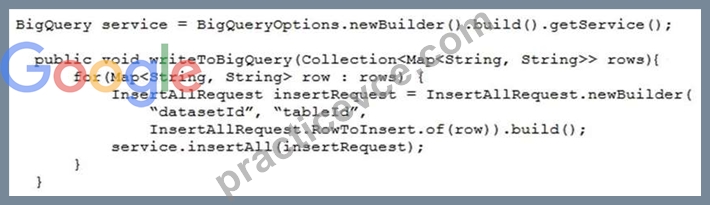
Which improvement should you suggest your teammate make?
- A. Perform the inserts in parallel by creating multiple threads.
- B. Write each row to a Cloud Storage object, then load into BigQuery.
- C. Write each row to a Cloud Storage object in parallel, then load into BigQuery.
- D. Include multiple rows with each request.
Answer: A
Explanation:
Explanation/Reference:
NEW QUESTION 141
Your service adds text to images that it reads from Cloud Storage. During busy times of the year, requests to Cloud Storage fail with an HTTP 429 "Too Many Requests" status code.
How should you handle this error?
- A. Retry the request with a truncated exponential backoff strategy.
- B. Add a cache-control header to the objects.
- C. Change the storage class of the Cloud Storage bucket to Multi-regional.
- D. Request a quota increase from the GCP Console.
Answer: A
Explanation:
Explanation/Reference: https://developers.google.com/gmail/api/v1/reference/quota
NEW QUESTION 142
You migrated your applications to Google Cloud Platform and kept your existing monitoring platform. You now find that your notification system is too slow for time critical problems.
What should you do?
- A. Install the Stackdriver agents on your Compute Engine instances.
- B. Replace your entire monitoring platform with Stackdriver.
- C. Use Stackdriver to capture and alert on logs, then ship them to your existing platform.
- D. Migrate some traffic back to your old platform and perform AB testing on the two platforms concurrently.
Answer: A
Explanation:
Explanation/Reference: https://cloud.google.com/monitoring/
NEW QUESTION 143
You want to re-architect a monolithic application so that it follows a microservices model. You want to accomplish this efficiently while minimizing the impact of this change to the business.
Which approach should you take?
- A. Build a new application with the appropriate microservices separate from the monolith and replace it when it is complete.
- B. Replace the application's features with appropriate microservices in phases.
- C. Refactor the monolithic application with appropriate microservices in a single effort and deploy it.
- D. Deploy the application to Compute Engine and turn on autoscaling.
Answer: C
Explanation:
Explanation/Reference: https://cloud.google.com/solutions/migrating-a-monolithic-app-to-microservices-gke
NEW QUESTION 144
You have deployed an HTTP(s) Load Balancer with the gcloud commands shown below.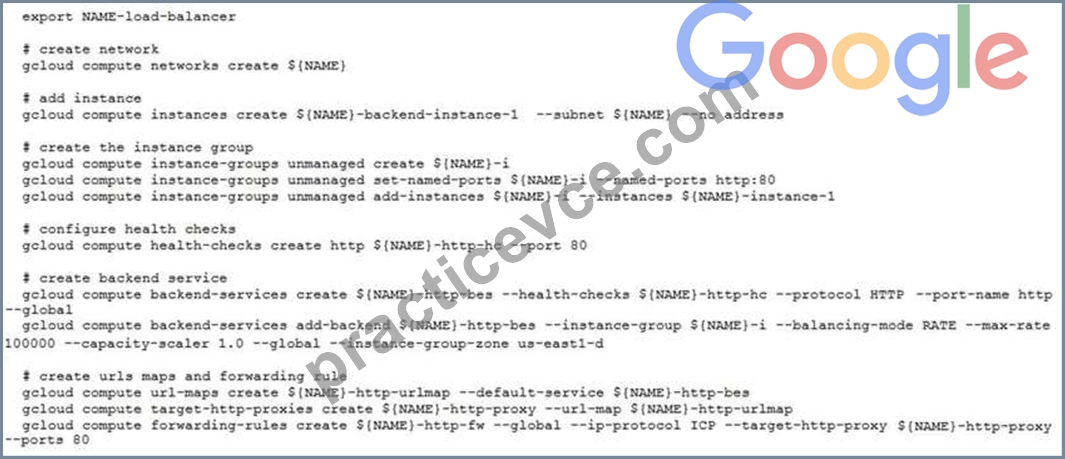
Health checks to port 80 on the Compute Engine virtual machine instance are failing and no traffic is sent to your instances. You want to resolve the problem.
Which commands should you run?
gcloud compute instances add-access-config ${NAME}-backend-instance-1
- A. server
gcloud compute firewall-rules create allow-lb --network load-balancer --allow - B. tcp --destination-ranges 130.211.0.0/22,35.191.0.0/16 --direction EGRESS
- C. gcloud compute instances add-tags ${NAME}-backend-instance-1 --tags http-
- D. tcp --source-ranges 130.211.0.0/22,35.191.0.0/16 --direction INGRESS
gcloud compute firewall-rules create allow-lb --network load-balancer --allow
Answer: D
Explanation:
Explanation/Reference: https://cloud.google.com/vpc/docs/special-configurations
NEW QUESTION 145
Your team detected a spike of errors in an application running on Cloud Run in your production project. The application is configured to read messages from Pub/Sub topic A, process the messages, and write the messages to topic B.
You want to conduct tests to identify the cause of the errors. You can use a set of mock messages for testing. What should you do?
- A. Use the Google Cloud console to write mock messages to topic A. Change the logging level in the application to DEBUG or INFO, and then analyze the logs.
- B. Deploy the Pub/Sub emulator on your local machine. Point the production application to your local Pub/Sub topics. Write mock messages to topic A, and then analyze the logs.
- C. Deploy the Pub/Sub and Cloud Run emulators on your local machine. Deploy the application locally, and change the logging level in the application to DEBUG or INFO. Write mock messages to topic A, and then analyze the logs.
- D. Use the gcloud CLI to write mock messages to topic A. Change the logging level in the application to DEBUG or INFO, and then analyze the logs.
Answer: C
NEW QUESTION 146
You are a developer at a large organization. You have an application written in Go running in a production Google Kubernetes Engine (GKE) cluster. You need to add a new feature that requires access to BigQuery.
You want to grant BigQuery access to your GKE cluster following Google-recommended best practices. What should you do?
- A. Create a Google service account with BigQuery access. Add the Google service account JSON key as a Kubernetes secret, and configure the application to use this secret.
- B. Create a Google service account with BigQuery access. Add the Google service account JSON key to Secret Manager, and use an init container to access the secret for the application to use.
- C. Create a Google service account with BigQuery access. Add the JSON key to Secret Manager, and use the Go client library to access the JSON key.
- D. Create a Google service account and a Kubernetes service account. Configure Workload Identity on the GKE cluster, and reference the Kubernetes service account on the application Deployment.
Answer: D
Explanation:
Explanation
https://cloud.google.com/kubernetes-engine/docs/concepts/workload-identity#what_is Applications running on GKE might need access to Google Cloud APIs such as Compute Engine API, BigQuery Storage API, or Machine Learning APIs.
Workload Identity allows a Kubernetes service account in your GKE cluster to act as an IAM service account.
Pods that use the configured Kubernetes service account automatically authenticate as the IAM service account when accessing Google Cloud APIs. Using Workload Identity allows you to assign distinct, fine-grained identities and authorization for each application in your cluster.
NEW QUESTION 147
You are developing a JPEG image-resizing API hosted on Google Kubernetes Engine (GKE). Callers of the service will exist within the same GKE cluster. You want clients to be able to get the IP address of the service.
What should you do?
- A. Define a GKE Endpoint. Clients should get the endpoint name from the appropriate environment variable in the client container.
- B. Define a GKE Service. Clients should use the name of the A record in Cloud DNS to find the service's cluster IP address.
- C. Define a GKE Endpoint. Clients should get the endpoint name from Cloud DNS.
- D. Define a GKE Service. Clients should use the service name in the URL to connect to the service.
Answer: A
Explanation:
Explanation
NEW QUESTION 148
You are developing an application that needs to store files belonging to users in Cloud Storage. You want each user to have their own subdirectory in Cloud Storage. When a new user is created, the corresponding empty subdirectory should also be created. What should you do?
- A. Create an object with the name of the subdirectory that is zero bytes in length. Set the Content-Type metadata to CLOUDSTORAGE_FOLDER.
- B. Create an object with the name of the subdirectory ending with a trailing slash ('/') that is zero bytes in length.
- C. Create an object with the name of the subdirectory, and then immediately delete the object within that subdirectory.
- D. Create an object with the name of the subdirectory that is zero bytes in length and has WRITER access control list permission.
Answer: B
Explanation:
Explanation
https://cloud.google.com/storage/docs/folders
If you create an empty folder using the Google Cloud console, Cloud Storage creates a zero-byte object as a placeholder. For example, if you create a folder called folder in a bucket called my-bucket, a zero- byte object called gs://my-bucket/folder/ is created. This placeholder is discoverable by other tools when listing the objects in the bucket, for example when using the gsutil ls command.
NEW QUESTION 149
......
For more info visit:
Security & Identity Fundamentals Kubernetes in the Google Cloud Google Cloud documentation Google Cloud solutions
Authentic Best resources for Professional-Cloud-Developer Online Practice Exam: https://www.practicevce.com/Google/Professional-Cloud-Developer-practice-exam-dumps.html
Get the superior quality Professional-Cloud-Developer Dumps Questions from PracticeVCE: https://drive.google.com/open?id=17ByBTfNfw3pMWC4o2mZNg3L7YwJUjNdY