

Get Special Discount Offer on SC-300 Dumps PDF [UPDATED Oct-2026]
PDF Download Microsoft Test To Gain Brilliante Result!
What is the Microsoft SC-300 Exam?
The Microsoft Identity and Access Administrator certification validates your ability to manage identities and access control in large, enterprise environments. You could be a Windows Server administrator who manages Active Directory or an enterprise requirements engineer who needs to design access control solutions for business partners. Microsoft SC-300 is an exam associated with the Microsoft Identity and Access Administrator certification. The exam is designed to validate your ability to plan, manage, configure, and troubleshoot identity and access solutions in Microsoft technologies - with a focus on Windows Server 2012 R2. Microsoft SC-300 Dumps certifies you to administer Microsoft Identity and Access solution. Nevertheless, it is not only limited to that particular product. The credential is highly regarded in the IT industry. It is awarded by Microsoft to candidates who successfully pass the exam.
NEW QUESTION # 62
You have a Microsoft 365 E5 subscription that contains two groups named Group1 and Group2 and the users shown in the following table.
The subscription contains a Conditional Access policy that has the following settings:
* Name: Policy1
Target resources
* Include
* All cloud apps
* Access controls
* Grant
* Requite multifactor authentication
For each of the following statements, select Yes if the statement is true. Otherwise, select No.
NOTE: Each correct selection is worth one point.
Answer:
Explanation: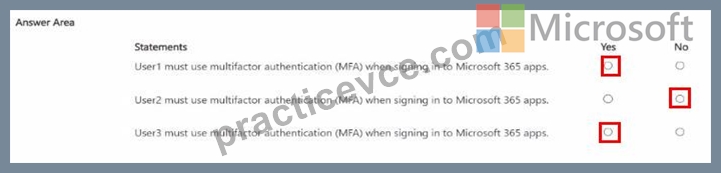
NEW QUESTION # 63
You have an Azure subscription that contains the resources shown in the following table.
For which resources can you create an access review?
- A. Group1 only
- B. Group1, Role1, and Contributor only
- C. Group1, App1, Contributor, and Role1
- D. Hotel and Contributor only
Answer: C
Explanation:
Access reviews require an Azure AD Premium P2 license.
Access reviews for Group1 and App1 can be configured in Azure AD Access Reviews.
Access reviews for the Contributor role and Role1 would need to be configured in Privileged Identity Management (PIM). PIM is included in Azure AD Premium P2.
Reference:
https://docs.microsoft.com/en-us/azure/active-directory/privileged-identity-management/pim-how-to-start- security-review?toc=/azure/active-directory/governance/toc.json
https://docs.microsoft.com/en-us/azure/active-directory/governance/access-reviews-overview
NEW QUESTION # 64
Your company purchases a Microsoft 565 ES subscription.
A user named User1 is assigned the Security Administrator role.
You need to ensure that User1 can create Microsoft Defender for Cloud Apps session policies.
What should you do first?
- A. Assign the Cloud Application Administrator role to Used.
- B. Create a Conditional Access policy and select Use Conditional Access App Control.
- C. Assign the Cloud App Security Administrator role to User1.
- D. Create a Conditional Access policy and select Require app protection policy.
Answer: A
NEW QUESTION # 65
You have a Microsoft 365 E5 subscription that contains a Microsoft SharePoint Online site named Site1 and the users shown in the following table.
The users have the devices shown in the following table.
You create the following two Conditional Access policies:
* Name: CAPolicy1
* Assignments
o Users or workload identities: Group 1
o Cloud apps or actions: Office 365 SharePoint Online
o Conditions
Filter for devices: Exclude filtered devices from the policy
Rule syntax: device.displayName -starts With "Device*"
o Access controls
Grant: Block access
Session: 0 controls selected
o Enable policy: On
* Name: CAPolicy2
* Assignments
o Users or workload identities: Group2
o Cloud apps or actions: Office 365 SharePoint Online
o Conditions: 0 conditions selected
* Access controls
o Grant: Grant access
Require multifactor authentication
o Session:
0 controls selected
* Enable policy: On
All users confirm that they can successfully authenticate using MFA.
For each of the following statements, select Yes if the statement is true. Otherwise, select No.
NOTE: Each correct selection is worth one point.
Answer:
Explanation:
Explanation:
A screenshot of a computer Description automatically generated
NEW QUESTION # 66
Your company has an Azure Active Directory (Azure AD) tenant named contosri.com. The company has the business partners shown in the following table.
users can request access by using package 1.
Users at Fabrikam and Litware use ail then respective domain names for email addresses.
You plan to create an access package named packaqe1 that will be accessible only to the Fabrikam and Litware users.
You need to configure connected organizations for Fabrikam and litware so that any of their users can request access by using package1.
What is the minimum of connected organization that you should create.
- A. 0
- B. 1
- C. 2
- D. 3
Answer: B
NEW QUESTION # 67
You have a Microsoft 365 E5 subscription that contains the users shown in the following table.
The users are assigned the roles shown in the following table.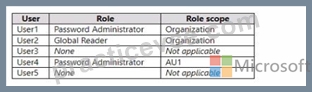
For which users can User1 and User4 reset passwords? To answer, select the appropriate options in the answer area.
NOTE: Each correct selection is worth one point.
Answer:
Explanation:
Explanation:
NEW QUESTION # 68
You have a Microsoft 365 E5 subscription that contains three users named User1, User2, and User3.
You have two Azure AD roles that have the Activation settings shown in the following table.
The Azure AD roles have the Assignment settings shown in the following table.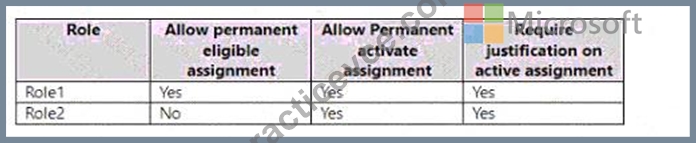
The Azure AD roles have the eligible users shown in the following table.
For each of the following statements, select Yes if the statement is true. Otherwise, select No.
NOTE: Each correct selection is worth one point.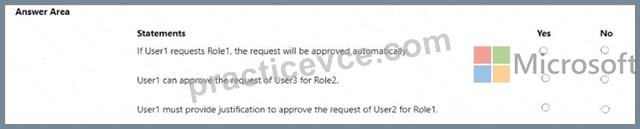
Answer:
Explanation: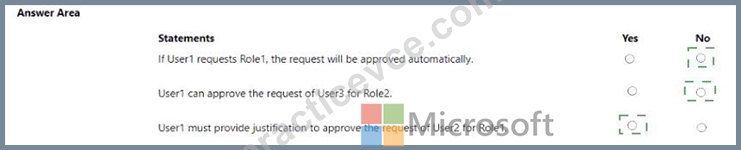
Explanation:
NEW QUESTION # 69
You have a Microsoft 36S tenant.
You create a named location named HighRiskCountries that contains a list of high-risk countries.
You need to limit the amount of time a user can stay authenticated when connecting from a high-risk country.
What should you configure in a conditional access policy? To answer, select the appropriate options in the answer area.
NOTE: Each correct selection is worth one point.
Answer:
Explanation:
Explanation:
Reference:
https://docs.microsoft.com/en-us/azure/active-directory/conditional-access/location-condition
https://docs.microsoft.com/en-us/azure/active-directory/conditional-access/concept-conditional-access-session
NEW QUESTION # 70
SIMULATION
Use the following login credentials as needed:
To enter your username, place your cursor in the Sign in box and click on the username below.
To enter your password, place your cursor in the Enter password box and click on the password below.
Microsoft 365 Username:[email protected]
Microsoft 365 Password: =1122334455667788
If the Microsoft 365 portal does not load successfully in the browser, press CTRL-K to reload the portal in a new browser tab.
The following information is for technical support purposes only:
Lab Instance: 99999999
You need to create a group named Audit. The solution must ensure that the members of Audit can activate the Security Reader role.
To complete this task, sign in to the appropriate admin center.
Answer:
Explanation:
NEW QUESTION # 71
You have a Microsoft 365 tenant.
You need to Identity users who have leaked credentials. The solution must meet the following requirements:
* Identity sign-ms by users who are suspected of having leaked credentials.
* Flag the sign-ins as a high-risk event.
* Immediately enforce a control to mitigate the risk, while still allowing the user to access applications.
What should you use? To answer, select the appropriate options m the answer area.
Answer:
Explanation:
Explanation:
NEW QUESTION # 72
You have a Microsoft 365 tenant.
Sometimes, users use external, third-party applications that require limited access to the Microsoft 365 data of the respective user. The users register the applications in Azure Active Directory (Azure AD).
You need to receive an alert if a registered application gains read and write access to the users' email.
What should you do? To answer, select the appropriate options in the answer area.
NOTE: Each correct selection is worth one point.
Answer:
Explanation:
Explanation:
Reference:
https://docs.microsoft.com/en-us/cloud-app-security/app-permission-policy
NEW QUESTION # 73
You have a Microsoft 365 tenant.
Sometimes, users use external, third-party applications that require limited access to the Microsoft 365 data of the respective user. The users register the applications in Azure Active Directory (Azure AD).
You need to receive an alert if a registered application gains read and write access to the users' email.
What should you do? To answer, select the appropriate options in the answer area.
NOTE: Each correct selection is worth one point.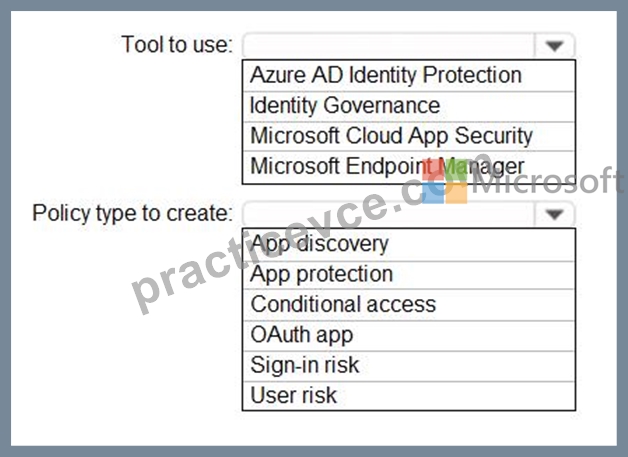
Answer:
Explanation:
Reference:
https://docs.microsoft.com/en-us/cloud-app-security/app-permission-policy
NEW QUESTION # 74
You have an Azure AD tenant that uses Azure AD Identity Protection and contains the resources shown in the following table.
Azure Multi-Factor Authentication (MFA) is enabled for all users.
User1 triggers a medium severity alert that requires additional investigation.
You need to force User1 to reset his password the next time he signs in. the solution must minimize administrative effort.
What should you do?
- A. Reset the Azure MFA registration for User1.
- B. Configure a sign-in risk policy.
- C. Reconfigure the user risk policy to trigger on medium or low severity.
- D. Mark User1 as compromised.
Answer: D
NEW QUESTION # 75
You have a Microsoft 365 tenant.
Sometimes, users use external, third-party applications that require limited access to the Microsoft 365 data of the respective user. The users register the applications in Azure Active Directory (Azure AD).
You need to receive an alert if a registered application gains read and write access to the users' email.
What should you do? To answer, select the appropriate options in the answer area.
NOTE: Each correct selection is worth one point.
Answer:
Explanation: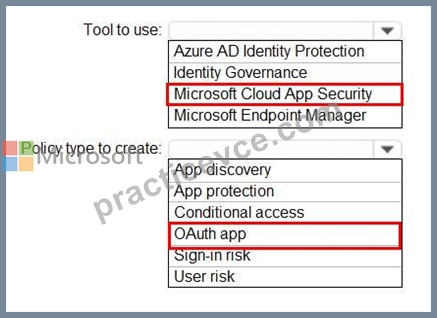
Reference:
https://docs.microsoft.com/en-us/cloud-app-security/app-permission-policy
NEW QUESTION # 76
You need to configure the assignment of Azure AD licenses to the Litware users. The solution must meet the licensing requirements.
What should you do? To answer, select the appropriate options in the answer area.
NOTE: Each correct selection is worth one point.
Answer:
Explanation:
Explanation
Litware recently added a custom user attribute named LWLicenses to the litware.com Active Directory forest.
Litware wants to manage the assignment of Azure AD licenses by modifying the value of the LWLicenses attribute. Users who have the appropriate value for LWLicenses must be added automatically to a Microsoft
365 group that has the appropriate licenses assigned.
NEW QUESTION # 77
You have an Azure AD tenant that contains the users shown in the following table.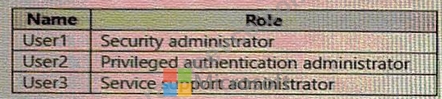
User2 reports that he can only configure multi-factor authenticating (MFA) to use the Microsoft Authenticator app.
You need to ensure that User2 can configure alternate MFA methods.
Which configuration is required, and which user should perform the configuration? To answer, select the appropriate options in the answer area.
Answer:
Explanation:
Explanation:
In Microsoft Entra ID (Azure AD), Security Defaults is a built-in baseline security configuration that enforces basic identity protection, such as requiring all users to register for multi-factor authentication (MFA) using the Microsoft Authenticator app. When security defaults are enabled, users cannot select alternate MFA methods (like SMS or phone call).
According to the Microsoft SC-300 Official Study Guide and Azure AD Identity Protection documentation, only administrators with elevated security roles-specifically the Security Administrator, Global Administrator, or Conditional Access Administrator-can enable or disable security defaults.
Here's the detailed reasoning:
* User1 (Security Administrator): This role can manage identity security settings, including modifying MFA configurations and security defaults.
* User2 (Privileged Authentication Administrator): This role can reset MFA details for other users but cannot modify tenant-wide MFA or security default settings.
* User3 (Service Support Administrator): This role is limited to viewing service health and support tickets and has no permissions to modify security configurations.
Since User2 is restricted by security defaults (which enforce Microsoft Authenticator only), the only way to allow alternative MFA methods is to disable or customize security defaults. That configuration must be done by User1 (Security Administrator).
Microsoft Documentation: "To enable or disable security defaults, you must be a Global Administrator, Security Administrator, or Conditional Access Administrator."
NEW QUESTION # 78
Note: This question is part of a series of questions that present the same scenario. Each question in the series contains a unique solution that might meet the stated goals. Some question sets might have more than one correct solution, while others might not have a correct solution.
After you answer a question in this section, you will NOT be able to return to it. As a result, these questions will not appear in the review screen.
You have an Azure Active Directory (Azure AD) tenant that syncs to an Active Directory forest.
You discover that when a user account is disabled in Active Directory, the disabled user can still authenticate to Azure AD for up to 30 minutes.
You need to ensure that when a user account is disabled in Active Directory, the user account is immediately prevented from authenticating to Azure AD.
Solution: You configure password writeback.
Does this meet the goal?
- A. Yes
- B. No
Answer: B
Explanation:
Password writeback is a feature of Azure AD Connect which ensures that when a password changes in Azure AD (password change, self-service password reset, or an administrative change to a user password) it is written back to the local AD - if they meet the on-premises AD password policy.
Technically, a password write-back operation is a password "reset" action. Password writeback removes the need to set up an on-premises solution for users to reset their password. It all happens in real time, and so users are notified immediately if their password could not be reset or changed for any reason.
Reference:
https://docs.microsoft.com/en-us/answers/questions/3221/disable-account-sync.html
NEW QUESTION # 79
You need to implement on-premises application and SharePoint Online restrictions to meet the authentication requirements and the access requirements.
What should you do? To answer, select the appropriate options in the answer area.
NOTE:Each correct selection is worth one point.
Answer:
Explanation:
Explanation:
SC-300 materials stress that to enforce modern controls (like MFA) on on-premises apps, you must front them with Azure AD so Conditional Access can evaluate sign-ins. The documentation states that Azure AD Application Proxy " provides secure remote access to on-premises applications " and that apps published through it can have " Conditional Access policies, including multifactor authentication " applied at sign- in. In other words, once the legacy app is published by Application Proxy, Azure AD sits in the path, enabling you to meet the requirement to enforce MFA when accessing on-premises applications and to combine it with your location-based exemptions.
For SharePoint Online restrictions, SC-300 points to Microsoft Cloud App Security (Defender for Cloud Apps) for real-time governance: you can create session policies that " control and limit activities in real time " and, for SharePoint Online and other Microsoft 365 apps, " monitor user sessions and block download, cut, copy, and print " when conditions (device state, risk, or location) warrant it. Since the scenario already has anomaly detections enabled, configuring Cloud App Security policies aligns directly with the requirement to place access restrictions on SharePoint Online without altering tenant-wide consent settings. Thus, publish on-prem apps with Application Proxy to bring them under Conditional Access (for MFA), and use Cloud App Security policies to enforce SharePoint Online session and download controls.
NEW QUESTION # 80
You have an on-premises datacenter that contains the hosts shown in the following table.
You have an Azure Active Directory (Azure AD) tenant that syncs to the Active Directory forest. Multi-factor authentication (MFA) is enforced for Azure AD.
You need to ensure that you can publish App1 to Azure AD users.
What should you configure on Server and Firewall1? To answer, select the appropriate options in the answer area.
NOTE:Each correct selection is worth one point.
Answer:
Explanation:
Reference:
https://docs.microsoft.com/en-us/azure/active-directory/manage-apps/application-proxy
NEW QUESTION # 81
You have an Azure Active Directory Premium P2 tenant.
You create a Log Analytics workspace.
You need to ensure that you can view Azure Active Directory (Azure AD) audit log information by using Azure Monitor.
What should you do first?
- A. Create an Azure AD workbook.
- B. Run the Set-AzureADTenantDetail cmdlet.
- C. Modify the Diagnostics settings for Azure AD.
- D. Run the Get-AzureADAuditDirectoryLogs cmdlet.
Answer: C
Explanation:
Reference:
https://docs.microsoft.com/en-us/azure/active-directory/reports-monitoring/howto-integrate-activity-logs-with-lo
NEW QUESTION # 82
......
SC-300 Dumps are Available for Instant Access: https://www.practicevce.com/Microsoft/SC-300-practice-exam-dumps.html
Provide Updated Microsoft SC-300 Dumps as Practice Test and PDF: https://drive.google.com/open?id=1CRUyXnf4xR1MX10ZZaO49sRUTYvgE8mQ