

[Apr-2024] Exam 2V0-21.23: New Brain Dump Professional - PracticeVCE
Free 2V0-21.23 Exam Dumps to Improve Exam Score
NEW QUESTION # 56
What are two uses cases for VMware Tools? (Choose two.)
- A. Ability to shut down a virtual machine remotely
- B. Share folders between ESXi hosts and guest OS file systems
- C. Time synchronization with an NTP server
- D. Direct deployment of the Aria Automation Config minion
- E. Support for unsupported network device drivers
Answer: A,D
Explanation:
https://www.stevenbright.com/2022/03/deploy-salt-minions-automatically-using-vmware-tools/ Two use cases for VMware Tools are direct deployment of the Aria Automation Config minion and ability to shut down a virtual machine remotely. Direct deployment of the Aria Automation Config minion is a feature that allows the administrator to deploy a configuration management agent to a virtual machine using VMware Tools. This feature enables automation and orchestration of virtual machine configuration tasks. Ability to shut down a virtual machine remotely is a feature that allows the administrator to gracefully power off a virtual machine from the vSphere Client or other VMware products. This feature requires VMware Tools to be installed and running on the guest operating system. Reference: https://docs.vmware.com/en/VMware-vSphere/7.0/com.vmware.vsphere.vmwaretools.doc/GUID-28C39A00-743B-4E23-9681-66254A15C2A0.html
NEW QUESTION # 57
Refer to the exhibit.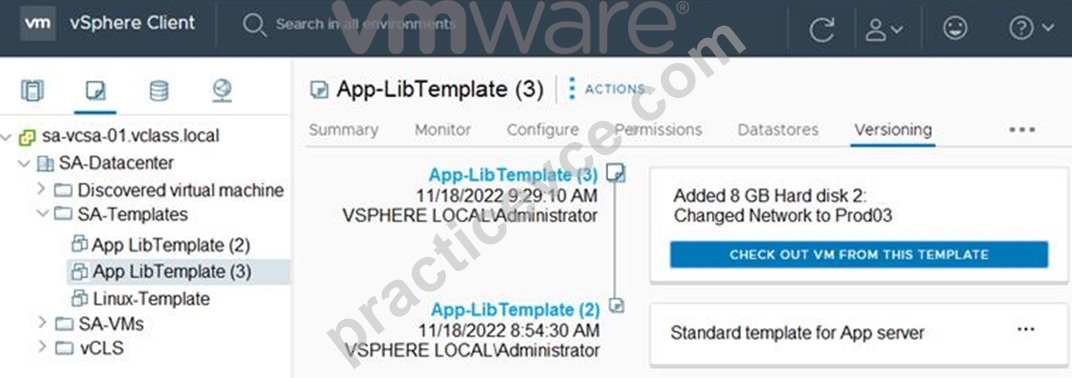
Given the configuration shown in the exhibit, what should the administrator do if the latest VM template contains changes that are no longer needed?
- A. Check out App-LibTemplate (3)
- B. Revert to App-LibTernplate (2)
- C. Delete App-LibTemplate (3)
- D. Delete App-LibTemplate (2)
Answer: B
Explanation:
Deleting App-LibTemplate (3) will remove the changes that are no longer needed and revert to the previous version of the template.
Reference:
https://docs.vmware.com/en/VMware-vSphere/7.0/com.vmware.vsphere.vm_admin.doc/GUID-D69B0279-CC9B-495B-9CA3-AE975AF9C865.html If the latest VM template contains changes that are no longer needed, the administrator should revert to the previous version of the template1.
Here are the steps to revert to a previous version of a template1:
Navigate to the Versioning tab of the VM template.
From the vertical timeline, navigate to the previous state of the VM template.
Click the horizontal ellipsis icon (⋮), and select Revert to This Version.
The Revert to Version dialog box opens. Enter a reason for the revert operation and click Revert.
So, in this case, the correct answer is: B.
Revert to App-LibTemplate (2)
This will make App-LibTemplate (2) the current VM template1.
Please note that this operation will not delete App-LibTemplate (3), it will simply make App-LibTemplate (2) the current version1.
NEW QUESTION # 58
What is the minimum network throughput in Gb/s for vSAN using the Express Storage Architecture (ESA)?
- A. 0
- B. 1
- C. 2
- D. 3
Answer: C
Explanation:
https://core.vmware.com/resource/vmware-vsan-design-guide#:~:text=Summary%20of%20Network%20Design%20Considerations,are%20recommended%20for%20best%20performance.
NEW QUESTION # 59
An administrator is tasked with moving an application and guest operating system (OS) running on top of a physical server to a software-defined data center (SDDC) in a remote secure location.
The following constraints apply:
* The remote secure location has no network connectivity to the outside world.
* The business owner is not concerned if all changes in the application make it to the SDDC in the secure location.
* The application's data is hosted in a database with a high number of transactions.
What could the administrator do to create an image of the guest OS and application that can be moved to this remote data center?
- A. Create a hot clone of the physical server using VMware vCenter Converter.
- B. Create a cold clone of the physical server using VMware vCenter Converter.
- C. Use storage replication to replicate the guest OS and application.
- D. Restore the guest OS from a backup.
Answer: B
Explanation:
Option B is correct because it allows the administrator to create a cold clone of the physical server using VMware vCenter Converter, which will create an image of the guest OS and application that can be moved to this remote data center without requiring network connectivity or affecting the application's data. Option A is incorrect because creating a hot clone of the physical server using VMware vCenter Converter will require network connectivity and may affect the application's data due to changes during conversion. Option C is incorrect because restoring the guest OS from a backup will require network connectivity and may not include the latest changes in the application. Option D is incorrect because using storage replication to replicate the guest OS and application will require network connectivity and may not be feasible for a physical server. Reference: https://docs.vmware.com/en/vCenter-Converter-Standalone/6.2/com.vmware.convsa.guide/GUID-9F9E3F8C-0E2B-4B6A-8C5C-3F8E5F6B4E9D.html
NEW QUESTION # 60
An administrator is tasked with adding two additional hosts into an existing production vSphere cluster to support the need for additional capacity.
The vSphere cluster currently has four identically configured ESXi hosts (esxOT esx02. esx03 and esx04) that utilize Intel Skylake-based CPUs. The two new hosts (esx05 and esx06) are configured identically in terms of memory and storage to the existing hosts: but utilize Intel Ice Lake-based CPUs.
The administrator must ensure that:
* Any virtual machine migrates to any of the six ESXi hosts running in the cluster.
* There is no virtual machine downtime during the process of adding the new hosts.
Which step should the administrator take to meet these requirements?
- A. Create a new vSphere cluster with Enhanced vMotion Compatibility (EVC) enabled and move all hosts into A' the new cluster
- B. Configure Enhanced vMotion Compatibility (EVC) mode on the existing cluster and add the two new hosts into the cluster.
- C. Create a new vSphere cluster with vSphere High Availability (HA) enabled and move all hosts into the new cluster
- D. Create a new vSphere cluster and move only three hosts into the new cluster.
Answer: B
Explanation:
The step that the administrator should take to meet these requirements is to configure Enhanced vMotion Compatibility (EVC) mode on the existing cluster and add the two new hosts into the cluster. EVC mode allows migration of virtual machines between different generations of CPUs by masking unsupported processor features. EVC mode can be enabled on an existing cluster without affecting powered-on virtual machines. Reference: https://docs.vmware.com/en/VMware-vSphere/7.0/com.vmware.vsphere.vcenterhost.doc/GUID-9F444D9B-44A0-4967-8C07-693C6B40278A.html
https://blogs.vmware.com/vsphere/2019/06/enhanced-vmotion-compatibility-evc-explained.html
NEW QUESTION # 61
An administrator is tasked with configuring remote direct memory access (RDMA) over Converged Ethernet v2 (RoCE v2).
Which two types of adapters must the administrator configure? (Choose two.)
- A. Software iSCSi adapter
- B. RDMA network adapter
- C. Paravirtual RDMA adapter
- D. Fibre Channel over Ethernet (FCoE) adapter
- E. Software NVMe over RDMA storage adapter
Answer: B,E
Explanation:
Explanation
ESXi 7 and later supports RoCE v2 technology, which enables RDMA over an Ethernet network. Hosts use an RDMA network adapter installed on the host and a software NVMe over RDMA storage adapter.
https://docs.vmware.com/en/VMware-vSphere/8.0/vsphere-storage/GUID-F4B42510-9E6D-4446-816A-501286
NEW QUESTION # 62
administrator successfully installs VMware ESXi onto the first host of a new vSphere duster but makes no additional configuration changes. When attempting to log into the vSphere Host Client using the Fully Qualified Domain Name (FQDN) of the host, the administrator receives the following error message:
''server Not Found -we can't connect to the server at esxit101.corp.local.''
* Host FQDN: esxi 101. Corp. local
* Management VLAN ID: 10
* DHCP: No
* Management IP Address: 172.16.10.101/24
* Management IP Gateway: 172.16.10.1
* Corporate DNS Servers: 172.16.10.5, 172.16.10.6
* DNS Domain: corp.local
Which three high level tasks should the administrator complete, at a minimum, in order to successfully log into the the vSphsrs Host Client using the FQDN for the exxi101 and complete the configuration (Choose three.)
- A. Set the value of the VMware ESXI Management Network VLAN ID to 10.
- B. Disable IPv6 for the VMware ESXI Management Network.
- C. Update the VMware ESXI Management Network DNS configuration to use the corporate DNS servers for name, resolution,
- D. Update the VMware ESXI Management Network IPv4 configuration to use a static a IPv4 address.
- E. Configure at least two network adapters for the VMware ESXI Management Network.
- F. Ensure a DNS A Record Is created for the VMware ESXI host on the corporate DNS servers,
Answer: C,F
Explanation:
To successfully log into the vSphere Host Client using the FQDN for the ESXi host, the administrator needs to ensure a DNS A Record is created for the VMware ESXi host on the corporate DNS servers, which maps its FQDN to its IP address; and update the VMware ESXi Management Network DNS configuration to use the corporate DNS servers for name resolution, which allows resolving its FQDN.
NEW QUESTION # 63
A vSphere cluster has the following vSphere Distributed Resource Scheduler (DRS) group configuration:
* Virtual machine (VM) group named DB
* Host groups named PROD11 and PROD55
The administrator wants to force the VMs in the DB group to run on the hosts in the PROD11 group. However, if all the hosts in PROD55.
Which VM/Host rule must the administrator create to ensure that these requirements are met?
- A. A preferential rule between the DB group and PROD11 group
- B. A preferential rule between the DB group and the PROD55 group
- C. A preferential rule between the DB group and the PROD55 group
- D. A required rule between the DB group and the PROD11 group
Answer: A
Explanation:
Option A is correct because it allows the administrator to create a preferential rule between the DB group and PROD11 group, which will force the VMs in the DB group to run on the hosts in the PROD11 group if possible, but will allow them to run on the hosts in PROD55 group if necessary. Option B is incorrect because it will create a preferential rule between the DB group and PROD55 group, which will force the VMs in the DB group to run on the hosts in PROD55 group if possible, which is not what the administrator wants.
Option C is incorrect because it is the same as option B.
Option D is incorrect because it will create a required rule between the DB group and PROD11 group, which will force the VMs in the DB group to run only on the hosts in PROD11 group and not allow them to run on the hosts in PROD55 group if needed. Reference: https://docs.vmware.com/en/VMware-vSphere/7.0/com.vmware.vsphere.resmgmt.doc/GUID-60077B40-66FF-4625-934A-641703ED7601.html
NEW QUESTION # 64
An administrator notices a Fibre Channel adapter in an ESXi host has been experiencing inconsistent connectivity states Which trigger can be used to quickly identify the issue and alert the administrator so that the issue can be resolved?
- A. Lost Network Connectivity
- B. Lost Storage Connectivity
- C. Host Connection Lost
- D. Lost Network Path Redundancy
Answer: D
Explanation:
Explanation
Complicated, the question does not comment on whether the path is redundant, if not redundant the correct answer would be D, but if we take into account good practices, the FC would be redundant.
https://kb.vmware.com/s/article/2014553
Book course: 6-23 Fibre Channel SAN Components Using SAN switches, you can set up path redundancy to address any path failures from host server to switch, or from storage array to switch. 6-25 Multipathing with Fibre Channel By default, ESXi hosts use only one path from a host to a given LUN at any one time. If the path actively being used by the ESXi host fails, the server selects another available path.
NEW QUESTION # 65
An administrator is responsible for performing maintenance tasks on a vSphere cluster. The cluster has the following configuration:
. Identically configured vSphere ESXi hosts (esx01, esx02, esx03 and esx04)
* All workloads are deployed into a single VMFS datastore provided by the external storage array
* vSphere High Availability (HA) has not been enabled
* vSphere Distributed Resource Scheduler (DRS) has not been enabled
Currently, a critical production application workload (VM1) is running on esx01.
Given this scenario, which two actions are required to ensure VM1 continues to run when esx01 is placed into maintenance mode? (Choose two.)
- A. VM1 must be manually live migrated to another host within the cluster using vSphere vMotion before esx01 is placed into maintenance mode.
- B. Fully automated DRS must be enabled on the cluster so that VM1 will be automatically migrated to another host within the cluster when esx01 is placed into maintenance mode.
- C. VM1 must be manually shut down and cold migrated to another host within the cluster using vSphere vMotion before esx01 is placed into maintenance mode.
- D. vSphere HA must be enabled on the cluster so that VM1 will be automatically migrated to another host within the cluster when esx01 is placed into maintenance mode.
- E. VM1 must be manually migrated to another host within the cluster using vSphere Storage vMotion before esx01 is placed into maintenance mode.
Answer: A,B
Explanation:
Explanation
Two actions that are required to ensure VM1 continues to run when esx01 is placed into maintenance mode are enabling fully automated DRS on the cluster, which allows balancing the workload across hosts and migrating VMs without user intervention; and manually live migrating VM1 to another host within the cluster using vSphere vMotion, which allows moving a running VM without downtime.
References:
https://docs.vmware.com/en/VMware-vSphere/7.0/com.vmware.vsphere.resmgmt.doc/GUID-F01B2F12-C5BB-
https://docs.vmware.com/en/VMware-vSphere/7.0/com.vmware.vsphere.vcenterhost.doc/GUID-F01B2F12-C5B
NEW QUESTION # 66
An administrator creates a virtual machine that contains the latest company-approved software, tools and security updates. Company policy requires that only full clones are allowed for server workloads.
A combination of which two tasks should the administrator complete to prepare for the deployment of this virtual machine for multiple users? (Choose two.)
- A. Take a snapshot of the virtual machine.
- B. Set appropriate permissions on the virtual machine.
- C. Convert the virtual machine to a template.
- D. Upgrade the virtual hardware.
- E. Create a virtual machine customization specification.
Answer: C,E
Explanation:
Explanation
Option B and D are correct because they allow the administrator to create a virtual machine customization specification, which can be used to customize guest operating system settings for multiple virtual machines, and convert the virtual machine to a template, which can be used to create full clones of server workloads.
Option A is incorrect because assigning appropriate permissions on the virtual machine does not prepare it for deployment for multiple users. Option C is incorrect because upgrading the virtual hardware does not prepare it for deployment for multiple users. Option E is incorrect because taking a snapshot of the virtual machine does not prepare it for deployment for multiple users. References:
https://docs.vmware.com/en/VMware-vSphere/7.0/com.vmware.vsphere.vm_admin.doc/GUID-9F9E3F8C-0E2B
NEW QUESTION # 67
An administrator is tasked with applying updates to a vSphere cluster running vSAN using vSphere Lifecycle Manager. Downtime to the ESXI hosts must be minimal while the work Is completed.
I he administrator has already completed the following steps and no errors have been returned:
* Downloaded all applicable software and created a new Image
* Attached the new Image to the cluster and run a compliance check against the Image for the cluster
* Ran a remediation pre-check for the cluster
Which two series of steps should the administrator perform to start the remediation of the cluster using the new image? (Choose two.)
- A. 1. Place each of the ESXI hosts into maintenance mode manually.
2. Use the Stage option In vSphere Lifecycle Manager to stage the required software on all ESXi hosts one at a time. - B. 1 Use the Remediate Option In vSphere Lifecycle Manager to remediate all of the ESXI hosts In the cluster In sequence.
2. Allow vSphere Lifecycle Manager to automatically control maintenance mode on the ESXI hoy - C. 1. Use the Remediate option In vSphore Lifecycle Manager to remediate all of the ESXI hosts in the cluster In parallel.
2. Allow vSphere Lifecycle Manager to automatically control maintenance mode on the ESXI hosts. - D. l Leave all ESXI hosts In the cluster operational
2. Use the Stage All option In vSphere Lifecycle Manager to stage the required software onto all ESXI hosts In the cluster In parallel. - E. 1. Leave all ESXI hosts In the cluster operational.
2. Use the Stage All option In vSphere Lifecycle Manager to stage the required software onto all ESXI hosts one at a time.
Answer: C,D
Explanation:
Explanation
Option A and D are correct because they allow vSphere Lifecycle Manager to automatically control maintenance mode on the ESXi hosts and remediate them in parallel or in sequence. Option B and C are incorrect because they require manual intervention to place the hosts into maintenance mode or to stage the software on each host, which is not efficient or minimal downtime. References:
https://docs.vmware.com/en/VMware-vSphere/7.0/com.vmware.vsphere-lifecycle-manager.doc/GUID-9F9E3F8
NEW QUESTION # 68
What is the minimum network throughput in Gb/s for vSAN using the Express Storage Architecture (ESA)?
- A. 0
- B. 1
- C. 2
- D. 3
Answer: C
Explanation:
https://core.vmware.com/resource/vmware-vsan-design-guide#:~:text=Summary%20of%20Network%20Design%20Considerations,are%20recommended%20for%20best%20performance.
NEW QUESTION # 69
An administrator is deploying a new all flash vSAN cluster based on the vSAN Original Storage Architecture (OSA).
What is the minimum supported network throughput in Gb/s for each host?
- A. 0
- B. 1
- C. 2
- D. 3
Answer: C
Explanation:
Explanation
The minimum supported network throughput in Gb/s for each host in an all flash vSAN cluster based on the vSAN Original Storage Architecture (OSA) is 10.
References:
https://docs.vmware.com/en/VMware-vSphere/7.0/com.vmware.vsphere.vsan-planning.doc/GUID-FCEA0CDD- vSAN Express Storage Architecture (ESA) are only supported with 25Gbps and higher connection speeds.
ESA ReadyNodes configured for vSAN ESA will be configured with 25/50/100Gbps NICs. vSAN OSA all-flash configurations are only supported with a 10Gb or higher connections. One reason for this is that the improved performance with an all-flash configuration may consume more network bandwidth between the hosts to gain higher throughput. https://core.vmware.com/resource/vmware-vsan-design-guide#sec6815-sub3
NEW QUESTION # 70
An administrator has mapped three vSphere zones to three vSphere clusters.
Which two statements are true for this vSphere with Tanzu zonal Supervisor enablement? (Choose two.)
- A. Individual vSphere Namespaces will be placed into a specific zone.
- B. One Supervisor will be created in a specific zone.
- C. Three Supervisors will be created in Linked Mode.
- D. One Supervisor will be created across all zones.
- E. Individual vSphere Namespaces will be spread across all zones.
Answer: D,E
Explanation:
For a vSphere with Tanzu zonal Supervisor enablement where three vSphere zones are mapped to three vSphere clusters, the following two statements are true:
B) One Supervisor will be created across all zones. In a three-zone deployment, all three vSphere clusters become one Supervisor.
E) Individual vSphere Namespaces will be spread across all zones. You can distribute the nodes of your Tanzu Kubernetes Grid clusters across all three vSphere zones, thus providing HA for your Kubernetes workloads at a vSphere cluster level.
NEW QUESTION # 71
An administrator has mapped three vSphere zones to three vSphere clusters.
Which two statements are true for this vSphere with Tanzu zonal Supervisor enablement? (Choose two.)
- A. One Supervisor will be created across all zones.
- B. One Supervisor will be created in a specific zone.
- C. Three Supervisors will be created in Linked Mode.
- D. Individual vSphere Namespaces will be placed into a specific zone.
- E. Individual vSphere Namespaces will be spread across all zones.
Answer: B,D
Explanation:
When mapping vSphere zones to vSphere clusters, one Supervisor will be created in each zone, and individual vSphere Namespaces will be placed into a specific zone based on their resource requirements and availability constraints.
NEW QUESTION # 72
An administrator plans to bri ng VMware vCenter offline in order to perform hardware mainte-nance on the host where the vCenter Server Appliance is running.
Which vSphere feature must be configured to ensure that vCenter users experience minimal downtime?
- A. Hybrid Linked Mode
- B. Enhanced Linked Mode
- C. vCenter Server High Availability
- D. vSphere Distributed Resource Scheduler
Answer: C
Explanation:
Explanation
https://docs.vmware.com/en/VMware-vSphere/7.0/com.vmware.vsphere.avail.doc/GUID-4A626993-A829-495C
NEW QUESTION # 73
Refer to the exhibit.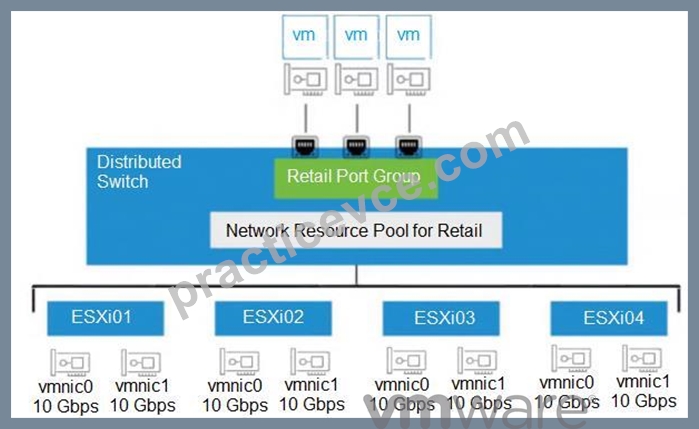
An administrator set up the following configuration:
* The distributed switch has four ESXi hosts, and each host has two 10 Gbps NICs.
* In the Network I/O Control configuration, the amount of bandwidth reserved for virtual machine (VM) traffic if 4 Gbps.
The administrator wants to guarantee that VMs in the Retail distributed port group can access 50 percent of the available reserved bandwidth for VM traffic.
Given this scenario, what should the size (in Gbps) of the Retail network resource pool be?
- A. 0
- B. 1
- C. 2
- D. 3
Answer: D
Explanation:
Explanation
4Gbps*8Nic=32Gbps*50%=16Gbps
NEW QUESTION # 74
What are two use cases for VMware vSphere+? (Choose two.)
- A. Enhance on-premises workloads by managing them through the VMware Cloud Console
- B. Simplify vCenter lifecycle management through cloud-enabled automation
- C. Allow the creation of affinity and anti-affinity rules to be used during failover events
- D. Allow live migration between on-premises and VMware Cloud
- E. Increase the performance of the native vCenter vMotion capability
Answer: A,B
Explanation:
Explanation
https://www.vmware.com/products/vsphere/vsphere-plus.html
https://blogs.vmware.com/vsphere/2022/06/vmware-vsphereplus-introducing-the-multi-cloud-workload-platform
NEW QUESTION # 75
......
Powerful 2V0-21.23 PDF Dumps for 2V0-21.23 Questions: https://www.practicevce.com/VMware/2V0-21.23-practice-exam-dumps.html
2024 Realistic 2V0-21.23 Dumps Exam Tips Test Pdf Exam Material: https://drive.google.com/open?id=1iGVWOecK1mNe8M4N2CRGpChRWqOvM56v