

2V0-21.23 Dumps are Available for Instant Access [2026]
Practice with these 2V0-21.23 dumps Certification Sample Questions
VMware 2V0-21.23 exam covers a wide range of topics, including vSphere architecture and technologies, installation and configuration, networking, storage, security, resource management, and troubleshooting. 2V0-21.23 exam consists of 70 multiple-choice questions, and candidates have 120 minutes to complete the exam. To pass the exam, candidates must score a minimum of 300 out of 500 points.
VMware 2V0-21.23 exam consists of 70 multiple-choice questions that must be completed within 120 minutes. To pass the exam, candidates must achieve a score of at least 300 on a scale of 100-500. 2V0-21.23 exam is available in English and Japanese and can be taken at a Pearson VUE testing center or via online proctoring.
NEW QUESTION # 37
If a distributed switch uses the "Route based on physical NIC load" load balancing algorithm, what does the mean send or receive utilization of an uplink need to exceed for the flow of traffic to move to the second uplink?
- A. 60 percent of the capacity over a 30 second period
- B. 75 percent of the capacity over a 30 second period
- C. 60 percent of the capacity over a 40 second period
- D. 75 percent of the capacity over a 40 second period
Answer: B
Explanation:
The distributed switch calculates uplinks for virtual machines by taking their port ID and the number of uplinks in the NIC team. The distributed switch tests the uplinks every 30 seconds, and if their load exceeds 75 percent of usage, the port ID of the virtual machine with the highest I/O is moved to a different uplink. https://docs.vmware.com/en/VMware-vSphere/8.0/vsphere-networking/GUID-959E1CFE-2AE4-4A67-B4D4-2D2E13765715.html
NEW QUESTION # 38
Refer to the exhibit.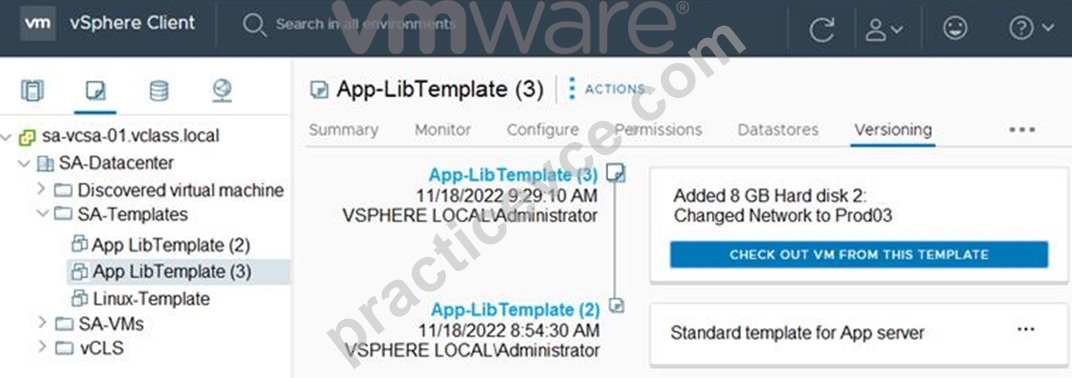
Given the configuration shown in the exhibit, what should the administrator do if the latest VM template contains changes that are no longer needed?
- A. Delete App-LibTemplate (3)
- B. Revert to App-LibTernplate (2)
- C. Delete App-LibTemplate (2)
- D. Check out App-LibTemplate (3)
Answer: B
Explanation:
Deleting App-LibTemplate (3) will remove the changes that are no longer needed and revert to the previous version of the template.
Reference:
https://docs.vmware.com/en/VMware-vSphere/7.0/com.vmware.vsphere.vm_admin.doc/GUID-D69B0279-CC9B-495B-9CA3-AE975AF9C865.html If the latest VM template contains changes that are no longer needed, the administrator should revert to the previous version of the template1.
Here are the steps to revert to a previous version of a template1:
Navigate to the Versioning tab of the VM template.
From the vertical timeline, navigate to the previous state of the VM template.
Click the horizontal ellipsis icon (⋮), and select Revert to This Version.
The Revert to Version dialog box opens. Enter a reason for the revert operation and click Revert.
So, in this case, the correct answer is: B.
Revert to App-LibTemplate (2)
This will make App-LibTemplate (2) the current VM template1.
Please note that this operation will not delete App-LibTemplate (3), it will simply make App-LibTemplate (2) the current version1.
NEW QUESTION # 39
To keep virtual machines (VMs) up and running at all times in a vSphere cluster, an administrator would like VMs to be migrated automatically when the host hardware health status becomes degraded.
Which cluster feature can be used to meet this requirement?
- A. Proactive HA
- B. vSphere HA Orchestrated Restart
- C. Predictive DRS
- D. vSphere Fault Tolerance
Answer: A
Explanation:
Explanation
Proactive HA is a cluster feature that can be used to migrate VMs automatically when the host hardware health status becomes degraded, before a failure occurs.
References:
https://docs.vmware.com/en/VMware-vSphere/7.0/com.vmware.vsphere.avail.doc/GUID-C3FFBF62-D6BF-4A5
NEW QUESTION # 40
An administrator has Windows virtual machines (VMs) and VMware Tools is installed in each VM. The administrator performs a status check of VMware Tools using vSphere Lifecycle Manager.
What is the VMware Tools status for the Windows VMs if the version of VMware Tools has a known problem and must be immediately upgraded?
- A. Unknown
- B. Guest Managed
- C. Upgrade Available
- D. Version Unsupported
Answer: D
Explanation:
If VMware Tools has a known problem, the tools status will be Version Unsupported https://docs.vmware.com/en/VMware-vSphere/7.0/com.vmware.vsphere-lifecycle-manager.doc/GUID-12649CBB-F69A-4199-8957-B4C0170B4E9A.html
NEW QUESTION # 41
To keep virtual machines (VMs) up and running at all times in a vSphere cluster, an administrator would like VMs to be migrated automatically when the host hardware health status becomes degraded.
Which cluster feature can be used to meet this requirement?
- A. Proactive HA
- B. vSphere HA Orchestrated Restart
- C. Predictive DRS
- D. vSphere Fault Tolerance
Answer: A
Explanation:
Proactive HA is a cluster feature that can be used to migrate VMs automatically when the host hardware health status becomes degraded, before a failure occurs.
NEW QUESTION # 42
An administrator has been notified that a number of hosts are not compliant with the company policy for time synchronization.
The relevant portion of the policy states:
* All physical servers must synchronize time with an external time source that is accurate to the microsecond. Which step should the administrator take to ensure compliance with the policy?
- A. Ensure that each ESXi host is configured to use a Precision Time Protocol (PTP) source.
- B. Ensure that each ESXi host is configured to use a Network Time Protocol (NTP) source.
- C. Ensure that each vCenter Server Appliance is configured to use a Precision Time Protocol (PTP) source.
- D. Ensure that each vCenter Server Appliance is configured to use a Network Time Protocol (NTP) source.
Answer: A
Explanation:
To comply with the policy of synchronizing time with an external source that is accurate to the microsecond, the administrator needs to ensure that each ESXi host is configured to use a PTP source, which provides higher accuracy than NTP.
NEW QUESTION # 43
An administrator is tasked with configuring an appropriate Single Sign-On (SSO) solution for VMware vCenter based on the following criteria:
* The solution should support the creation of Enhanced Link Mode groups.
* All user accounts are stored within a single Active Directory domain and the solution must support only this Active Directory domain as the identity source.
* All user account password and account lockout policies must be managed within the Active Directory domain.
* The solution should support token-based authentication.
Which SSO solution should the administrator choose based on the criteria?
- A. vCenter Identity Provider Federation with Active Directory over LDAP as the identity provider
- B. vCenter Identity Provider Federation with Active Directory Federation Services as the identity provider
- C. vCenter Single Sign-On with Active Directory (Windows Integrated Authentication) as the identity source
- D. vCenter Single Sign-On with Active Directory over LDAP as the identity source
Answer: C
Explanation:
Explanation
Option C is correct because it indicates that vCenter Single Sign-On with Active Directory (Windows Integrated Authentication) as the identity source is the best SSO solution for VMware vCenter based on the criteria, as this solution supports Enhanced Link Mode groups, supports only one Active Directory domain as the identity source, delegates password and account lockout policies to Active Directory, and supports token-based authentication. Option A is incorrect because vCenter Identity Provider Federation with Active Directory Federation Services as the identity provider is not necessary for a single Active Directory domain scenario and may introduce additional complexity and overhead. Option B is incorrect because vCenter Single Sign-On with Active Directory over LDAP as the identity source does not support token-based authentication and may require additional configuration for password and account lockout policies. Option D is incorrect because vCenter Identity Provider Federation with Active Directory over LDAP as the identity provider does not support token-based authentication and may introduce additional complexity and overhead. References:
https://docs.vmware.com/en/VMware-vSphere/7.0/com.vmware.vcenter.install.doc/GUID-A2A4371A-B888-404
NEW QUESTION # 44
An administrator is working with VMware Support and Is asked to provide log bundles for the ESXI hosts in an environment. Which three options Joes the administrator have? (Choose three.)
- A. Generate a separate log bundle for each ESXI host using the vCenter Management Interface.
- B. Generate a combined log bundle for all ESXI hosts using the vSphere Client.
- C. Generate a combined log bundle for all ESXi hosts using the vSphere Host Client.
- D. Generate a combined log bundle for all ESXI hosts using the vCenter Management Interface.
- E. Generate a separate log bundle for each ESXI host using the vSphere Host Client.
- F. Generate a separate log bundle for each ESXI host using the vSphere Client.
Answer: B,E,F
Explanation:
Option B, C and D are correct because they are valid methods to generate log bundles for individual or multiple ESXi hosts using different interfaces. Option A and E are incorrect because they are not possible options to generate log bundles for all ESXi hosts using the vCenter Management Interface. Option F is incorrect because it is not possible to generate a combined log bundle for all ESXi hosts using the vSphere Host Client. Reference: https://docs.vmware.com/en/VMware-vSphere/7.0/com.vmware.vsphere.troubleshooting.doc/GUID-9A94C3D1-38A4-4A5F-AFE7-8CDBE8D6D988.html
NEW QUESTION # 45
An administrator Is looking to deploy a new VMware vCenter Instance. The current environment consists of
75 hosts and is expected to grow up to 100 hosts over the next three years.
Which deployment size should the administrator select?
- A. Tiny
- B. Small
- C. Large
- D. Medium
Answer: B
Explanation:
Explanation
VMWare: Small environment (up to 100 hosts or 1,000 virtual machines) Medium environment (up to 400 hosts or 4,000 virtual machine)
https://docs.vmware.com/en/VMware-vSphere/7.0/com.vmware.vcenter.install.doc/GUID-88571D8A-46E1-464 The administrator should select the small deployment size for the new vCenter Server instance, which is suitable for an environment with up to 100 hosts or 1,000 virtual machines. The small deployment size has 4 vCPUs and 19 GB of memory, which can handle the current and expected growth of the environment. The other deployment sizes are either too large or too small for the environment. References:
https://docs.vmware.com/en/VMware-vSphere/7.0/com.vmware.vcenter.install.doc/GUID-88571D8A-46E1-464
NEW QUESTION # 46
An administrator remotely deploys VMware ESXi using an out of band management connection and now needs to complete the configuration of the management network so that the host is accessible through the vSphere Host Client.
The following information has been provided to complete the configuration:
* Host FQDN esxi01corp.local
* Management VLAN ID: 10 DHCP: No
* Management IP Address: 172.16.10.101/24
* Management IP Gateway: 172.16.10.1
. Corporate DNS Servers: 172 16.10.5, 172.16.10..6
* DNS Domain: corp.local
In addition, all host configurations must also meet the following requirements:
* The management network must use only IPv4 network protocols.
* The management network must be fault tolerant
Which four high level tasks should the administrator complete in the Direct Console User Interface (DCUI) in order to meet the requirements and successfully log into the vSphere Host Client? (Choose four.)
- A. Restore the original Management vSphere Standard Switch.
- B. Update the VMware ESXi Management Network DNS configuration to use the corporate DNS servers for ' names resolution
- C. Update the VMware ESXi Management Network IPv4 configuration to use a static IPv4 address
- D. Configure at least two network adapters for the VMware ESXi Management Network
- E. Disable IPv6 for the VMware ESXi Management Network
- F. Set the value of the VMware ESXi Management Network VLAN ID to 10
- G. Create a DNS A Record for the VMware ESXi host on the corporate DNS servers
Answer: C,D,F,G
NEW QUESTION # 47
An administrator Is performing maintenance activities and discovers that a Virtual Machine File System (VMFS) datastore has a lot more used capacity than expected. The datastore contains 10 virtual machines (VMs) and, when the administrator reviews the contents of the associated datastore, discovers that five- virtual machines have a snapshot file (-delta.vmdk flies) that has not been modified In over 12 months. The administrator chei kfl the Snapshot Manager within the vSphere Client and confirms that there are no snapshots visible.
Which task should the administrator complete on the virtual machines to free up datastore space?
- A. Consolidate the snapshots for each VM.
- B. Delete all snapshots for each VM.
- C. Storage vMotion each VM to another datastore.
- D. Inflate the disk files for each VM.
Answer: A
Explanation:
Consolidating snapshots for each VM will merge any snapshot files that are not associated with a snapshot in Snapshot Manager into the base disk file and free up datastore space.
Reference:
The presence of redundant delta disks can adversely affect the virtual machine performance. You can combine such disks without violating a data dependency. After consolidation, redundant disks are removed, which improves the virtual machine performance and saves storage space.
NEW QUESTION # 48
After a recent unexplained peak in virtual machine (VM) CPU usage, an administrator is asked to monitor the VM performance for a recurrence of the issue.
Which two tools can the administrator use? (Choose two.)
- A. ESXi Shell
- B. vCenter Command Line Interface
- C. Direct Console User Interface (DCUI)
- D. vSphere Performance Charts
- E. vCenter Management Interface
Answer: A,D
Explanation:
To monitor the VM performance for a recurrence of the issue, the administrator can use vSphere Performance Charts, which provide graphical views of various performance metrics for VMs and other objects; or ESXi Shell, which provides command-line access to ESXi hosts and allows running various commands to collect performance data.
NEW QUESTION # 49
An administrator has configured Storage I/O Control (SIOC) on a Virtual Machine File System (VMFS) datastore.
* The datastore supports 30,000 IOPS
* Storage I/O Control has been set to manual
* Storage I/O Control is triggered when latency hits 30 ms
* The datastore contains 3 virtual machines (VMs)
* A gold tier VM
* A silver tier VM
* A bronze tier VM
Assuming the datastore latency does not exceed 29ms, what is the maximum number of IOPS the bronze tier VM is entitled to?
- A. 10.000
- B. 30,000
- C. 5,000
- D. 20,000
Answer: B
Explanation:
The bronze tier VM is entitled to 30,000 IOPS, which is the maximum number of IOPS that the datastore supports. Storage I/O Control (SIOC) does not limit the IOPS of any VM unless the datastore latency exceeds the threshold, which is 30 ms in this case. Therefore, as long as the datastore latency is below 29 ms, the bronze tier VM can use up to 30,000 IOPS. Reference: https://docs.vmware.com/en/VMware-vSphere/7.0/com.vmware.vsphere.resmgmt.doc/GUID-7686FEC3-1FAC-4DA7-B698-B808C44E5E96.html
NEW QUESTION # 50
An administrator is tasked with implementing a backup solution capable of backing up the Su-pervisor cluster, vSphere Pods, and persistent volumes.
Which two solutions must be used to meet this requirement? (Choose two.)
- A. NSX-T Manager
- B. VMware vCenter
- C. Velero Plugin for vSphere
- D. vSphere Host Client
- E. Standalone Velero and Restic
Answer: C,E
Explanation:
https://docs.vmware.com/en/VMware-vSphere/7.0/vmware-vsphere-with-tanzu/GUID-9816E07A-466C-451D-A43B-D415B2FAB7D6.html
NEW QUESTION # 51
Which VMware offering will allow an administrator to manage the lifecycle of multiple vCenter Server instances in a single software as a service (SaaS)-based solution to help drive operational efficiency?
- A. VMware vSphere+
- B. VMware vSphere with Tanzu
- C. VMware Cloud Foundation
- D. VMware Aria Suite Lifecycle
Answer: D
Explanation:
Explanation
VMware Aria Suite Lifecycle is a SaaS-based solution that allows an administrator to manage the lifecycle of multiple vCenter Server instances, as well as other VMware products and solutions, from a single console.
References: https://www.vmware.com/products/vrealize-suite-lifecycle-manager.html
NEW QUESTION # 52
f\n administrator needs to provide encryption for workloads within an existing vSphere cluster. The following requirements must be met:
* Workloads should be encrypted at rest.
* Encrypted workloads must automatically be encrypted during transit.
* Encryption should not require any specific hardware.
What should the administrator configure to meet these requirements?
- A. Unified Extensible Firmware Interface (UEFI) Secure Boot
- B. VM Encryption
- C. Encrypted vSphere vMotion
- D. Host Encryption
Answer: B
Explanation:
The feature that should be configured to provide encryption for workloads within an existing vSphere cluster without requiring any specific hardware is VM Encryption, which allows encrypting VMs at rest and during vMotion.
NEW QUESTION # 53
An administrator is tasked with deploying a new on-premises software-defined data center (SDDC) that will contain a total of eight VMware vCenter instances.
The following requirements must be met:
* All vCenter instances should be visible in a single vSphere Client session.
* All vCenter inventory should be searchable from a single vSphere Client session.
* Any administrator must be able to complete operations on any vCenter instance using a single set of credentials.
What should the administrator configure to meet these requirements?
- A. A single Enhanced Linked Mode group consisting of eight vCenter instances in one Single Sign-On domain.
- B. Two Enhanced Linked Mode groups consisting of four vCenter instances each in a Single Sign-On domain.
- C. A single Hybrid Linked Mode group consisting of eight vCenter instances in one Single Sign-On domain.
- D. A single Hybrid Linked Mode group consisting of four vCenter instances each in a Single Sign-On domain.
Answer: A
Explanation:
Explanation
To meet the requirements of viewing and searching all vCenter instances and inventory with a single vSphere Client session and a single set of credentials, the administrator needs to configure a single Enhanced Linked Mode group consisting of eight vCenter instances in one Single Sign-On domain.
References:
https://docs.vmware.com/en/VMware-vSphere/7.0/com.vmware.vsphere.vcenterhost.doc/GUID-39A8C7F4-8D8
NEW QUESTION # 54
A vSphere cluster has the following vSphere Distributed Resource Scheduler (DRS) group configuration:
* Virtual machine (VM) group named DB
* Host groups named PROD11 and PROD55
The administrator wants to force the VMs in the DB group to run on the hosts in the PROD11 group.
However, if all the hosts in PROD55.
Which VM/Host rule must the administrator create to ensure that these requirements are met?
- A. A preferential rule between the DB group and the PROD55 group
- B. A preferential rule between the DB group and the PROD55 group
- C. A required rule between the DB group and the PROD11 group
- D. A preferential rule between the DB group and PROD11 group
Answer: D
Explanation:
Explanation
Option A is correct because it allows the administrator to create a preferential rule between the DB group and PROD11 group, which will force the VMs in the DB group to run on the hosts in the PROD11 group if possible, but will allow them to run on the hosts in PROD55 group if necessary. Option B is incorrect because it will create a preferential rule between the DB group and PROD55 group, which will force the VMs in the DB group to run on the hosts in PROD55 group if possible, which is not what the administrator wants. Option C is incorrect because it is the same as option B. Option D is incorrect because it will create a required rule between the DB group and PROD11 group, which will force the VMs in the DB group to run only on the hosts in PROD11 group and not allow them to run on the hosts in PROD55 group if needed. References:
https://docs.vmware.com/en/VMware-vSphere/7.0/com.vmware.vsphere.resmgmt.doc/GUID-60077B40-66FF-4
NEW QUESTION # 55
During the staging of a patch on a vCenter Server Appliance, an error was encountered and the process stopped. An administrator resolved the root cause and is ready to continue with the staging of the patch.
From the vCenter Management Interface, which action should the administrator take to continue the process from the point at which the error occurred?
- A. Use the Resume option to resume the staging.
- B. Use the Stage and Install option to resume the staging.
- C. Use the Stage Only option to restart the staging.
- D. Use the Unstage option to restart the staging.
Answer: A
Explanation:
docs.vmware.com/en/VMware-vSphere/7.0/com.vmware.vcenter.upgrade.doc/GUID-FF533442-66F0-4797-976D-1DA99102DD0A.html
NEW QUESTION # 56
An administrator is tasked with looking into the disaster recovery (DR) options for a software-defined data center (SDDC).
The following requirements must be met:
*All virtual machines (VMs) must be protected to a secondary site.
*The source VMs must remain online until the failover.
*When failing over to the secondary site, application downtime is allowed
*The DR failover must be managed from the vSphere Client.
*Costs must remain as low as possible.
How can the administrator accomplish this task?
- A. Configure VMware a Site Recovery Manager and combine it with vSphere Replication.
- B. Configure a subscribed content library on the secondary site.
- C. Configure VMware Cloud Disaster Recovery (VCDR) and combine it with array-based storage replication
- D. Configure VMware Site Recovery Manager and combine it with array-based storage replication.
Answer: A
Explanation:
Explanation
https://blogs.vmware.com/virtualblocks/2017/11/29/vsr-technicaloverview/
NEW QUESTION # 57
......
Get Instant Access REAL 2V0-21.23 DUMP Pass Your Exam Easily: https://www.practicevce.com/VMware/2V0-21.23-practice-exam-dumps.html
2V0-21.23 Free Exam Questions with Quality Guaranteed: https://drive.google.com/open?id=12rqKhv_owvWI7CK4600QHUBq4NG6wxTv