

Latest [Feb 20, 2024] HP HPE2-W09 Exam Practice Test To Gain Brilliante Result
Take a Leap Forward in Your Career by Earning HP HPE2-W09
HPE2-W09 certification exam is comprehensive and covers a wide range of topics, including data center design principles, network topology, virtualization technologies, and storage networking. HPE2-W09 exam also covers advanced topics such as load balancing, network security, and disaster recovery.
The HP HPE2-W09 exam consists of 60 multiple-choice questions that must be completed within 90 minutes. The passing score for the exam is 70%. HPE2-W09 exam is available in multiple languages, including English, Japanese, and Simplified Chinese, and can be taken at any Pearson VUE testing center worldwide.
NEW QUESTION # 18
An ArubaOS-CX is \ssmq DCBX on Interface 1/1/1. You enter this command:
show dcbx interface 1/1/1
Is this where you can see whether the connected converged network adapter (CNA) has accepted the application priorities advertised with DCBX?
Solution: in the Enhanced Transmission Selection (ETS) Local advertisement section
- A. Yes
- B. No
Answer: A
NEW QUESTION # 19
Two ArubaOS-CX switches ate part of a Virtual Switching Extension (V5X) fabric. Is this a guideline for configuring the switches' link-up delay settings?
Solution: Set the link-up delay timer based on the number of MAC forwarding, ARP, and routing table entries.
- A. Yes
- B. No
Answer: B
NEW QUESTION # 20
You are configuring Ethernet Ring Protection Switching (ERPS) on an ArubaOS-CX switch. Is this a guideline for configuring timers?
Solution: The guard interval is set in units of 10 ms and should exceed the maximum expected delay for forwarding a frame around the complete ring.
- A. Yes
- B. No
Answer: A
Explanation:
ERPS is a feature of ArubaOS-CX that prevents loops at layer 2 on ring networks1. ERPS uses a protocol called Ring Auto Protection Switching (RAPS) to detect link failures and perform fast traffic switchover1. ERPS has two timers that control the protection switching mechanism: guard timer and hold off timer1. The guard timer prevents false switching caused by delayed or lost RAPS PDUs1. The guard interval is set in units of 10 ms and should exceed the maximum expected delay for forwarding a frame around the complete ring1. This ensures that all switches on the ring receive the RAPS PDUs before the guard timer expires1. Therefore, this is a guideline for configuring timers for ERPS, and the correct answer is yes. For more information on ERPS and timers, refer to the Aruba Data Center Network Specialist (ADCNS) certification datasheet2 and the ERPS Guide for your switch model1.
NEW QUESTION # 21
Refer to the exhibit.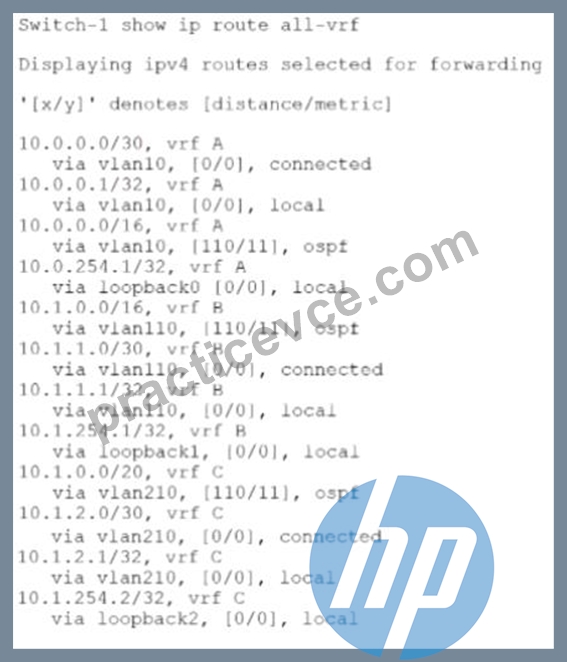
You want to enable devices in VRF B and VRF C to reach shared resources in VRFA.
is this a valid strategy for meeting this goal?
Solution: Create a separate OSPF process for each VRF on Switch-1. Then redistribute each process into the other VRFs' processes.
- A. Yes
- B. No
Answer: B
NEW QUESTION # 22
You need to integrate Aruba Fabric Composer (AFC) with customer datacenter software. Is this integration possible?
Solution: Aruba Fabric Composer (AFC) with Nutanix Hypervisor (AHV)
- A. Yes
- B. No
Answer: A
Explanation:
Aruba Fabric Composer (AFC) with Nutanix Hypervisor (AHV) integration is possible. AFC is a tool that provides automation and orchestration for managing data center networks composed of ArubaOS-CX switches. AFC can integrate with various data center software such as VMware vSphere, Nutanix AHV, Microsoft Hyper-V, etc. AFC can discover, monitor, and configure Nutanix AHV clusters and hosts using REST APIs1.
NEW QUESTION # 23
Is this a use case for deploying Ethernet Ring Protection Switching (ERPS)?
Solution: extending Layer 2 communications between data centers that connect over Layer 3 MPLS links
- A. Yes
- B. No
Answer: B
NEW QUESTION # 24
Refer to the exhibit.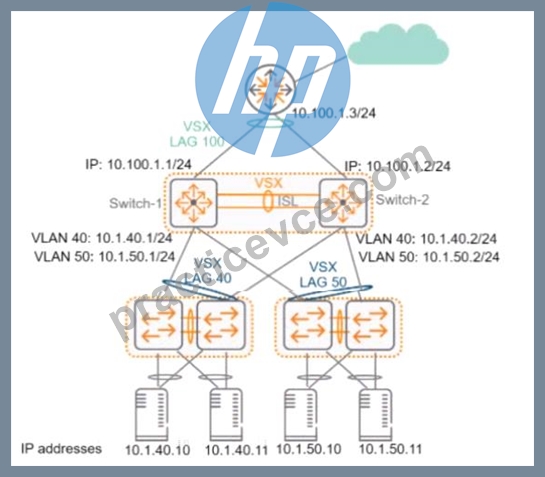
Switch-1, Switch-2, and the router run OSPF on LAG 100, which is a Layer 3 LAG. Does this correctly explain how to control how core-to-access traffic Is forwarded?
Solution: To reduce the amount of traffic sent over the ISI between Switch-1 and Swltch-2. enable active forwarding on LAG 100 on both Switch-1 and Switch-2.
- A. Yes
- B. No
Answer: A
NEW QUESTION # 25
The architect designs a spine and leaf network for a single data center that will use multiple leaf switches as Virtual Tunnel End Points (VTEP). The architect needs to select the type of Integrated Routing & Bridging (IRB) for the solution.
Is this statement about the IRB type true?
Solution: Asymmetric IRB routes packets in the ingress VTEP and then routes packets in the egress VTEP.
- A. Yes
- B. No
Answer: B
Explanation:
Asymmetric IRB routes packets in the ingress VTEP and then bridges packets in the egress VTEP1. This means that the ingress VTEP performs both Layer 2 and Layer 3 lookups, while the egress VTEP performs only Layer 2 lookup1. The statement is false because it confuses routing with bridging in the egress VTEP.
NEW QUESTION # 26
Can you attach this type of ArubaOS-CX interface to a VRF?
Solution: A loopback interface
- A. Yes
- B. No
Answer: B
Explanation:
A loopback interface can be attached to a VRF on an ArubaOS-CX switch. A loopback interface is a virtual interface that has an IP address assigned to it and is always up. A loopback interface can be attached to a VRF by using the vrf attach command under its configuration mode1.
NEW QUESTION # 27
Is this something that NetEdit 2.0 does after it discovers a switch?
Solution: It enables the switch REST API Interface, if disabled.
- A. Yes
- B. No
Answer: B
Explanation:
It enables the switch REST API interface, if disabled is not something that NetEdit 2.0 does after it discovers a switch. NetEdit 2.0 is a tool that provides configuration management and validation for ArubaOS-CX and ArubaOS-Switch devices. NetEdit 2.0 can discover switches using various methods such as IP range scan, LLDP scan, CSV import, etc. However, NetEdit 2.0 cannot discover or communicate with switches that have their REST API interface disabled because NetEdit 2.0 relies on REST API calls to interact with switches1.
NEW QUESTION # 28
You are using NetEdit to manage AruDaOS-CX switches. You want to deploy a standard config to the switches, but need the config to include a few device-specific settings such as hostname and IP address.
Is this what you should do?
Solution: omit the device-specific settings from the configuration plan and include them in command scripts instead.
- A. Yes
- B. No
Answer: B
NEW QUESTION # 29
Does this correctly describe how the Virtual Switching Extension (VSX) fabric reacts to various component failure scenarios?
Solution: The ISL and keepalive goes down, and after a few seconds, the keepalive link restores. Switch-l and Switch-2 remains up. The Split-recovery mode is enabled. In this case the secondary switch shutdowns SVls when keepalive is restored.
- A. Yes
- B. No
Answer: A
Explanation:
The ISL and keepalive goes down, and after a few seconds, the keepalive link restores. Switch-1 and Switch-2 remains up. The Split-recovery mode is enabled. In this case the secondary switch shutdowns SVIs when keepalive is restored is a correct description of how the Virtual Switching Extension (VSX) fabric reacts to various component failure scenarios. VSX is a feature that provides active-active forwarding and redundancy for ArubaOS-CX switches. The ISL is the inter-switch link that connects two VSX nodes and carries data traffic. The keepalive link is a separate link that carries control traffic between two VSX nodes. The split-recovery mode is a feature that prevents split-brain scenarios when both VSX nodes lose connectivity with each other but remain up. When the ISL and keepalive goes down, both VSX nodes continue to forward traffic independently. When the keepalive link restores, the secondary switch detects that it has lost synchronization with the primary switch and shuts down its SVIs to prevent traffic loops1.
NEW QUESTION # 30
Is this a difference between a typical data center network's requirements and a typical campus network's requirements?
Solution: Data center network traffic flows are typically east-west whereas while campus networks experience more north-south traffic.
- A. Yes
- B. No
Answer: A
Explanation:
A data center network is a network that connects servers, storage devices, and other devices within a data center. A campus network is a network that connects buildings and users within a campus area, such as a university or an enterprise. Data center network traffic flows are typically east-west, which means they are between servers or devices within the data center. This is because data center applications often require high-speed communication and data exchange between servers for processing, analysis, or backup. Campus network traffic flows are typically north-south, which means they are between users or devices and external networks, such as the Internet or a wide area network (WAN). This is because campus users often access online services or resources that are hosted outside the campus network12. Therefore, this is a valid difference between a typical data center network's requirements and a typical campus network's requirements.
NEW QUESTION # 31
The architect designs a spine and leaf network for a single data center that will use multiple leaf switches as Virtual Tunnel End Points (VTEP). The architect needs to select the type of Integrated Routing & Bridging (IRB) for the solution.
Is this statement about the IRB type true?
Solution: In the Asymmetric IRB egress VTEPs bridge the traffic to the destination networks.
- A. Yes
- B. No
Answer: B
NEW QUESTION # 32
Does this correctly describe how Network Analytics Engine (NAE) agents work?
Solution: Agents write data to the switch's current state database.
- A. Yes
- B. No
Answer: A
Explanation:
Agents write data to the switch's current state database is a correct description of how Network Analytics Engine (NAE) agents work. NAE agents are scripts that run on ArubaOS-CX switches and collect data from various sources such as CLI commands, REST APIs, SNMP queries, etc. The agents write the collected data to the switch's current state database (CSDB), which stores information about the switch's configuration, status, and performance1.
NEW QUESTION # 33
Refer to the exhibit.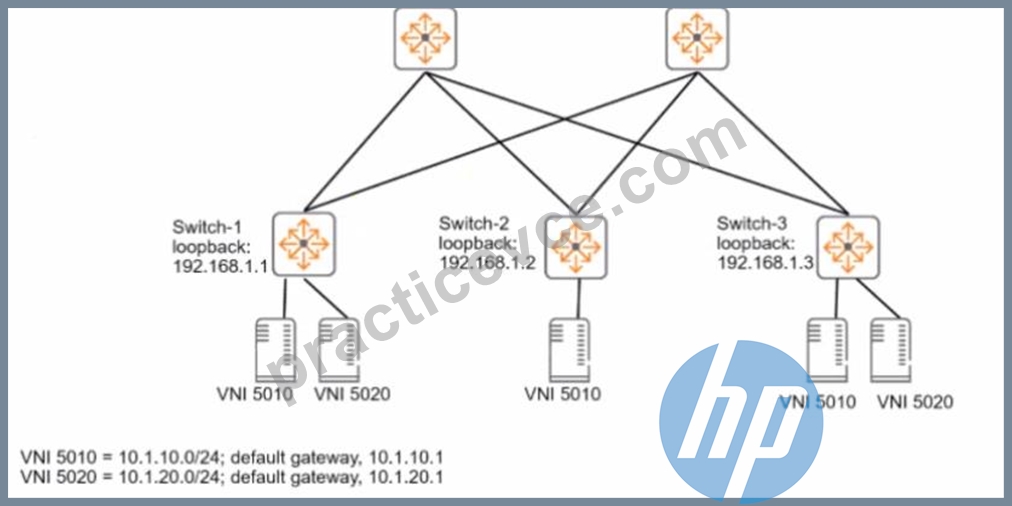
You need to set up an ArubaOS-CX switch to implement Virtual Extensible LAN (VXLAN) WITHOUT Ethernet VPN (EVPN). The exhibit Indicates which servers should be part of the same VXLANs and the desired VNls for the VXLANs. Assume that the network is already configured to permit each ArubaOS-CX switch to reach each other switch's loopback interface.
Is this part of the process for setting up VXLAN to meet the requirements?
Solution: On Switch-1, add VNIs 5010 and 5020 to the same VXLAN interface.
- A. Yes
- B. No
Answer: B
Explanation:
VXLAN is a feature of ArubaOS-CX that provides layer 2 connectivity between networks across an IP network1. VXLAN uses a 24-bit identifier called VXLAN Network Identifier (VNI) to segment the layer 2 domain1. VXLAN also uses a tunnel endpoint (VTEP) to encapsulate and decapsulate VXLAN packets1. A VXLAN interface is a logical interface that represents a VNI and is associated with a source IP address and a VRF1. To set up VXLAN without EVPN, you need to create VXLAN interfaces on each switch and configure static VTEP peers1. Based on the exhibit, Switch-1 needs to create two VXLAN interfaces, one with ID 5010 and one with ID 5020, to match the VNIs of the servers connected to it. However, you cannot add multiple VNIs to the same VXLAN interface1. Each VNI must have its own VXLAN interface with a unique source IP address and VRF1. Therefore, this is not part of the process for setting up VXLAN to meet the requirements, and the correct answer is no. For more information on VXLAN and EVPN, refer to the Aruba Data Center Network Specialist (ADCNS) certification datasheet2 and the EVPN VXLAN Guide for your switch model1.
NEW QUESTION # 34
AtubaOS-CX switches are acting as Virtual Extensible LAN (VXLAN) Tunnel Endpoints (VTEPs) WITHOUT Ethernet VPN (EVPN).
Does this correctly describe how the VTEPs handle VXLAN traffic forwarding?
Solution: VTEPs that use headend replication forward broadcast as multicast to each VTEP in the same VNI.
- A. Yes
- B. No
Answer: A
Explanation:
VXLAN is a tunneling protocol that encapsulates layer 2 traffic over an IP network using VXLAN Network Identifiers (VNIs) to identify different layer 2 segments. VXLAN Tunnel Endpoints (VTEPs) are devices that perform the encapsulation and decapsulation of VXLAN packets. VTEPs can use different methods to handle broadcast, unknown unicast, and multicast (BUM) traffic within a VNI. One of these methods is headend replication, which means that the VTEP that receives a BUM packet replicates it and sends it as a unicast to each remote VTEP in the same VNI1. This method does not require multicast routing in the underlay network, but it can increase the load on the ingress VTEP. Therefore, this correctly describes how the VTEPs handle VXLAN traffic forwarding without EVPN.
NEW QUESTION # 35
Your task is to configure an EVPN solution for a dual-stack IPv4 and IPv6 protocol in the overlay networks. Is this statement about EVPN and IPv6 correct?
Solution: IPv6 protocol can be encapsulated in the underlay network's IPv4 packets.
- A. Yes
- B. No
Answer: B
Explanation:
IPv6 protocol cannot be encapsulated in the underlay network's IPv4 packets. EVPN is a protocol that provides layer 2 and layer 3 services over an IP network1. It uses VXLAN tunnels to encapsulate Ethernet frames in UDP packets and transport them across the underlay network1. The underlay network can use either IPv4 or IPv6 protocol, but it must match the protocol used by the VXLAN tunnels1. The statement is false because it implies that IPv6 protocol can be encapsulated in IPv4 packets, which is not possible.
NEW QUESTION # 36
Refer to the exhibit.
You want to enable devices in VRF B and VRF C to reach shared resources in VRFA.
is this a valid strategy for meeting this goal?
Solution: Place ad three VRF$ in the same OSPF process on Switch-1.
- A. Yes
- B. No
Answer: B
NEW QUESTION # 37
You need to integrate Aruba Fabric Composer (AFC) with customer datacenter software. Is this integration possible?
Solution: Aruba Fabric Composer (AFC) with Nutanix Hypervisor (AHV)
- A. Yes
- B. No
Answer: B
NEW QUESTION # 38
Is this a use case for disabling split-recovery mode on ArubaOS-CX switches in a Virtual Switching Extension (VSX) fabric?
Solution: In situations in which the primary switch fails and then reboots, you want to make the primary switch take over again as the primary switch.
- A. Yes
- B. No
Answer: B
NEW QUESTION # 39
Refer to the exhibit.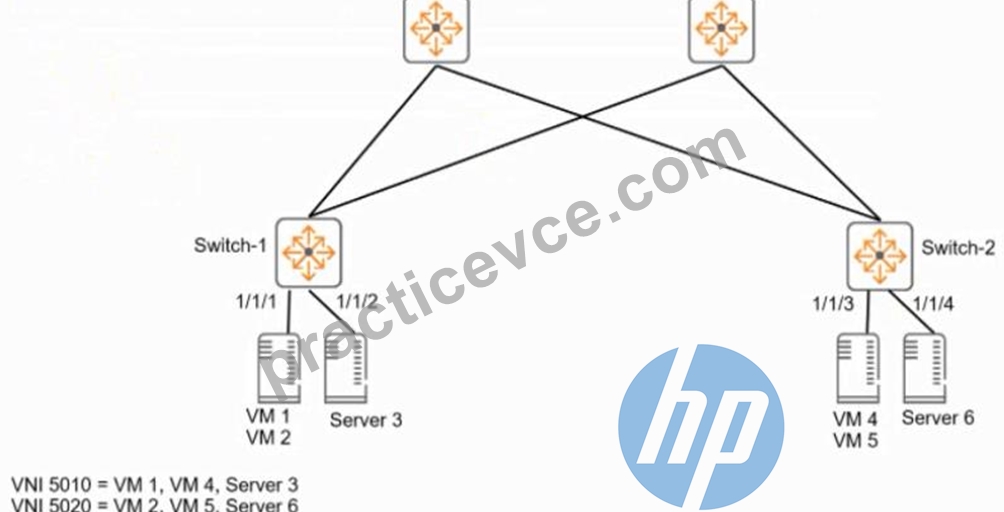
The company wants AtubaOS-CX switches to provide VXLAN services for several VMs and servers, as shown in the exhibit. Hypervisors will not run VXLAN for this solution. Is this part of a valid configuration to meet the requirements?
Solution: Attach VNIs 5010 and 5020 to interface 1/1/3 on Switch-2.
- A. Yes
- B. No
Answer: B
Explanation:
Attach VNIs 5010 and 5020 to interface 1/1/3 on Switch-2 is not part of a valid configuration to meet the requirements for providing VXLAN services for several VMs and servers using ArubaOS-CX switches. VNIs are virtual network identifiers that are used to identify VXLAN segments. A VNI can only be attached to a VLAN interface, not a physical interface, on an ArubaOS-CX switch1.
NEW QUESTION # 40
Refer to the exhibits.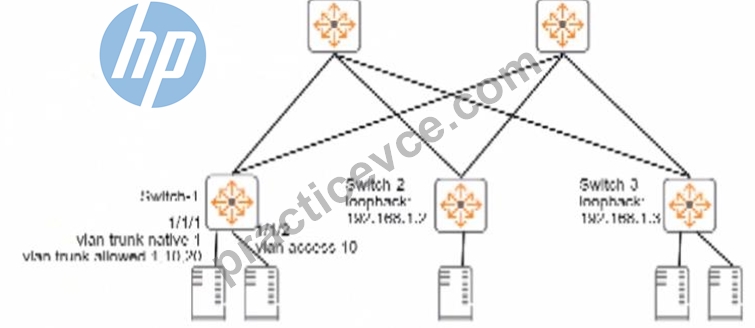
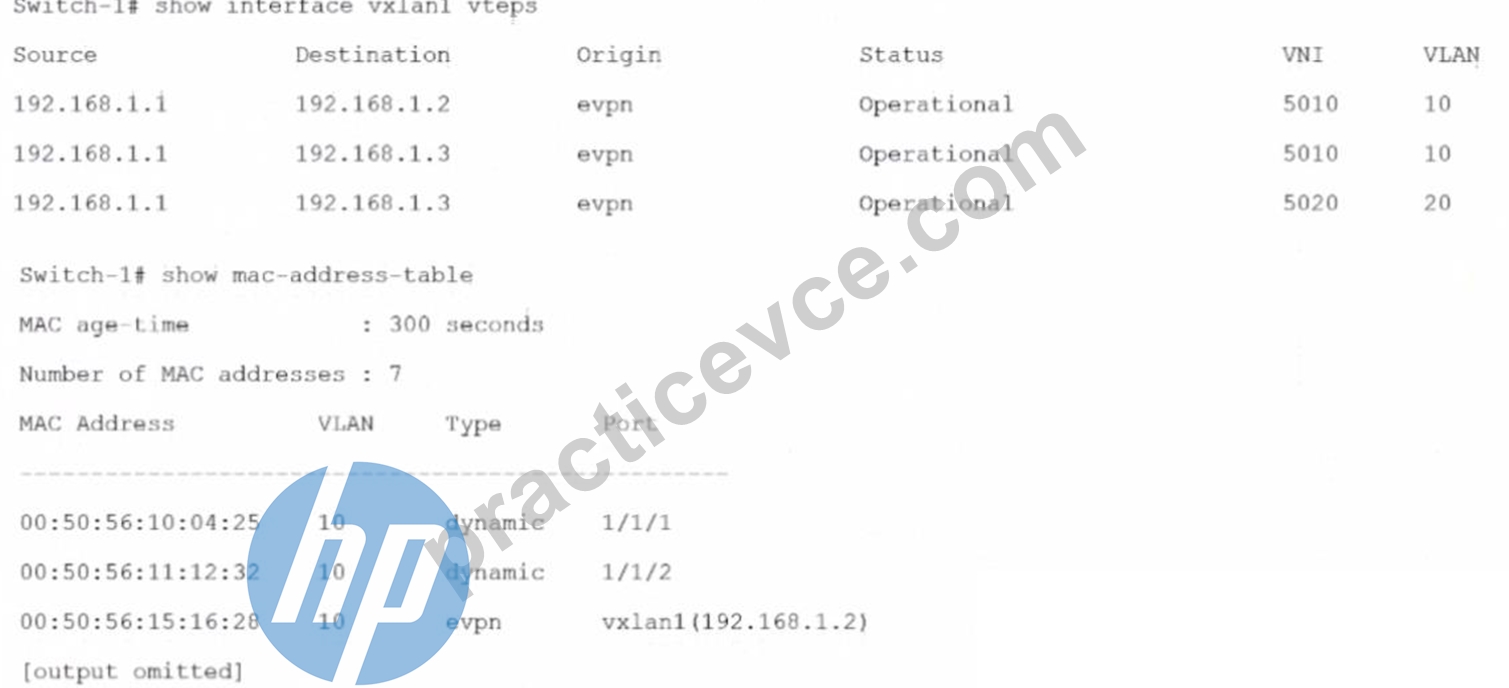
Is this how the switch handles the traffic?
Solution: A broadcast arrives in VLAN 10 on Switch-1. Switch 1 forwards the frame on all interfaces assigned to VLAN10, except the incoming interface. It encapsulates the broadcast with VXIAN and sends it to 192.168.1.2. but not 192.168.1.3.
- A. Yes
- B. No
Answer: B
Explanation:
A broadcast arrives in VLAN 10 on Switch-1. Switch 1 forwards the frame on all interfaces assigned to VLAN10, except the incoming interface. It encapsulates the broadcast with VXLAN and sends it to 192.168.1.2, but not 192.168.1.3 is not a correct explanation of how the switch handles the traffic. Switch-1, Switch-2, and Switch-3 are ArubaOS-CX switches that use VXLAN and EVPN to provide Layer 2 extension over Layer 3 networks. VXLAN is a feature that uses UDP encapsulation to tunnel Layer 2 frames over Layer 3 networks using VNIs. EVPN is a feature that uses BGP to advertise multicast information for VXLAN networks using IMET routes. Switch-1 receives a broadcast in VLAN 10, which belongs to VNI 5010. Switch-1 forwards the frame on all interfaces assigned to VLAN 10, except the incoming interface, as per normal Layer 2 switching behavior. However, Switch-1 does not encapsulate the broadcast with VXLAN and send it only to 192.168.1.2, which is Switch-3's loopback interface, but rather replicates the broadcast, encapsulates each broadcast with VXLAN, and sends the VXLAN traffic to both 192.168.1.2 and 192.168.1.3, which are Switch-3's and Switch-2's loopback interfaces respectively1.
NEW QUESTION # 41
Refer to the exhibit.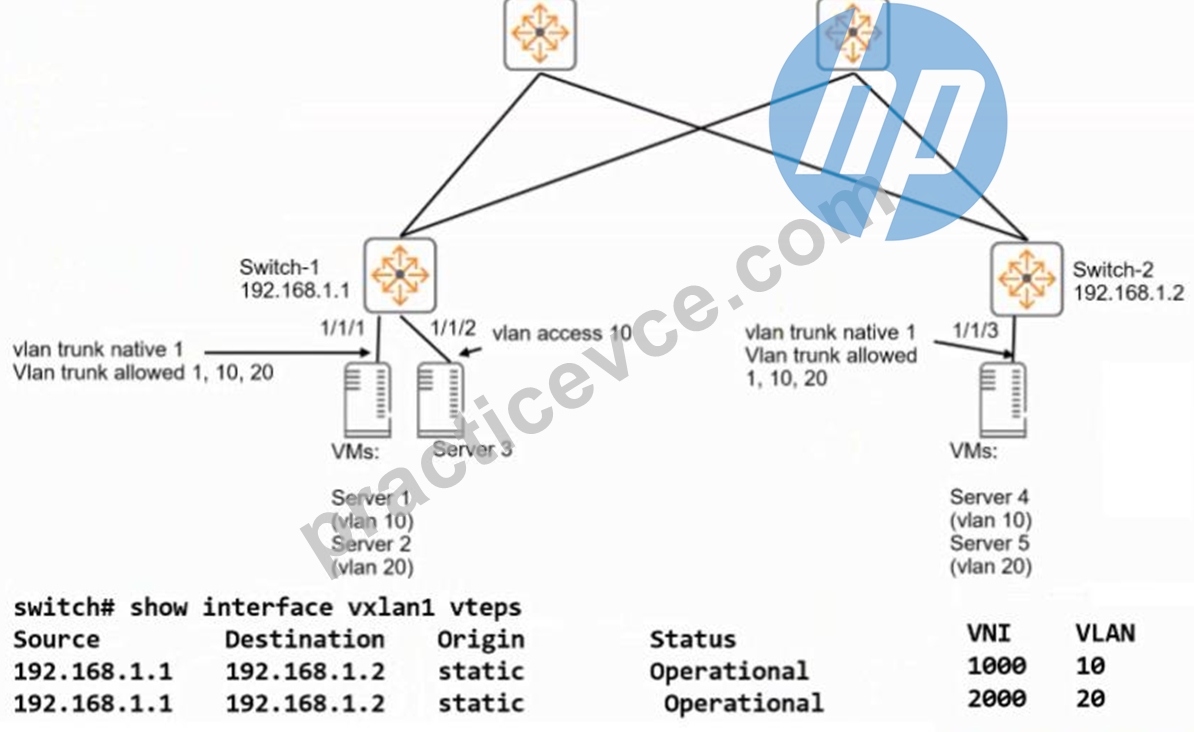
Switch-1 and Switch-2 ate ArubaOS-CX switches that implement VXLAN WITHOUT Ethernet VPN (EVPN). Switch-2 uses the same VNI-to-VLAN mappings as Switch-1. Is this how the specified servers communicate?
Solution: Server 1 and Server 4 require routing services within the VXLANs to communicate with each other.
- A. Yes
- B. No
Answer: B
Explanation:
The exhibit shows a network topology where Switch-1 and Switch-2 are ArubaOS-CX switches that implement VXLAN without Ethernet VPN (EVPN). Switch-2 uses the same VNI-to-VLAN mappings as Switch-1. The question asks how the specified servers communicate, which means Server 1 and Server 4. Server 1 and Server 4 are in different VLANs and different VNIs, which means they are in different layer 2 segments. To communicate with each other, they require routing services between the VXLANs. However, using Virtual Routing and Forwarding (VRF) to tunnel iSCSI traffic through the network spine on the same links that data traffic uses is not the correct way to provide routing services. VRF is a technology that creates multiple isolated Layer 3 domains on a physical network, each with its own routing table. VRF does not provide any benefits for iSCSI traffic, as it does not guarantee bandwidth, priority, or quality of service. VRF also adds overhead and complexity to the network configuration1. To provide routing services between the VXLANs, the correct way is to use VXLAN routing with EVPN or distributed anycast gateway (DAG). VXLAN routing with EVPN allows the switches to exchange MAC and IP information using BGP EVPN control plane, and to perform routing between different VNIs using a centralized or distributed model2. DAG allows the switches to act as anycast gateways for their local hosts, and to route traffic between different VNIs using a symmetric or asymmetric model3. Therefore, this does not correctly describe how the specified servers communicate.
NEW QUESTION # 42
Refer to the exhibits.
Is this how the switch handles the traffic?
Solution: A frame with destination MAC address, 00:50:56:15:16:28, arrives with a VLAN 10 tag on 1/1/1 on Switch-1. Switch-1 encapsulates the frame with VXLAN and an IP header destined to 192.168.1.2.
- A. Yes
- B. No
Answer: A
Explanation:
A frame with destination MAC address, 00:50:56:15:16:28, arrives with a VLAN 10 tag on 1/1/1 on Switch-1. Switch-1 encapsulates the frame with VXLAN and an IP header destined to 192.168.1.2 is a correct explanation of how the switch handles the traffic. Switch-1, Switch-2, and Switch-3 are ArubaOS-CX switches that use VXLAN and EVPN to provide Layer 2 extension over Layer 3 networks. VXLAN is a feature that uses UDP encapsulation to tunnel Layer 2 frames over Layer 3 networks using VNIs. EVPN is a feature that uses BGP to advertise MAC and IP addresses of hosts connected to VTEPs. Switch-1 receives a frame with destination MAC address, 00:50:56:15:16:28, which belongs to VM-2 on Switch-3. Switch-1 learns from EVPN that VM-2 is reachable through VTEP 192.168.1.2, which is Switch-3's loopback interface. Switch-1 encapsulates the frame with VXLAN and an IP header destined to 192.168.1.2 and sends it over the underlay network1.
NEW QUESTION # 43
......
HP HPE2-W09 (Aruba Data Center Network Specialist) Exam is designed to test your knowledge and skills in planning, designing, and managing Aruba data center networks. HPE2-W09 exam is intended for IT professionals who have experience in configuring and managing data center networks and are looking to enhance their knowledge and expertise in Aruba technologies. By passing HPE2-W09 exam, you will earn the Aruba Certified Data Center Network Specialist (ACDCNS) certification.
Authentic Best resources for HPE2-W09 Online Practice Exam: https://www.practicevce.com/HP/HPE2-W09-practice-exam-dumps.html
Updates Up to 365 days On Developing HPE2-W09 Braindumps: https://drive.google.com/open?id=1vW5460w5gdilVgYDx1SwusKfmOOW1MFo