

2025 The Most Effective D-ISM-FN-01 with 63 Questions Answers
Try Free and Start Using Realistic Verified D-ISM-FN-01 Dumps Instantly.
NEW QUESTION # 36
Question:
A company is experiencing slow write performance on its RAID 6 array. What is the most likely cause of this performance bottleneck?
- A. Insufficient storage on the RAID controller
- B. Write penalty associated with dual parity calculations
- C. Increased network latency between the server and the storage array
- D. High read I/O load on the array
Answer: B
Explanation:
RAID 6 uses dual parity to provide fault tolerance, which requires additional calculations during write operations. This introduces a write penalty, as the system must compute and write two sets of parity data for each write operation, leading to slower write performance compared to other RAID levels.
* Insufficient storage on the RAID controller:Would affect storage capacity, not write performance.
* High read I/O load on the array:Impacts read performance, not write performance.
* Increased network latency:Affects data transfer times but not the internal write operations of the RAID array.
* Write penalty associated with dual parity calculations:The most likely cause of slow write performance in RAID 6.
Reference:Dell Information Storage and Management Foundations 2023 Study Guide, Section: RAID.
NEW QUESTION # 37
Question:
An organization is planning to adopt pre-integrated systems to deploy compute, network, storage, and management functions as a single engineered solution. Which approach should they adopt?
- A. DIY approach
- B. DCaaS solution
- C. Vendor ready solutions
- D. Service based approach
Answer: C
Explanation:
Vendor ready solutions(like Dell VxRail or HCI appliances) are pre-integrated and pre-tested by the vendor, providing:
Faster deployment.
Simplified management.
Reduced integration effort compared to DIY solutions.
* DCaaS(Data Center as a Service) is a managed service, not an on-prem solution.
* DIYinvolves separate purchases and integrations by IT teams.
* Service-based approachrefers to cloud models or managed services.
Reference:Dell Information Storage and Management Foundations 2023 Study Guide, Section: Modern Data Center Architectures and Pre-integrated Systems.
NEW QUESTION # 38
Question:
What is a key advantage of cloning a VM?
- A. Improves the performance of existing and new VMs
- B. Saves time when creating multiple identical copies of a VM
- C. Eliminates the need to create multiple snapshots for a VM
- D. Ability to run new VMs simultaneously with the same IP address
Answer: B
Explanation:
VM cloningallows administrators to createexact copiesof a virtual machine quickly.
Saves time compared to manually configuring new VMs.
Useful for testing, development, and scaling environments.
Each clone can be independently modified after creation.
* Same IP addressis typically not the case (clones get unique addresses).
* Snapshotsprovide rollback points, not full VM clones.
* Performancedoes not improve because of cloning itself.
Reference:Dell Information Storage and Management Foundations 2023 Study Guide, Section: Virtualization and Cloning Benefits.
NEW QUESTION # 39
Question:
Which statement defines the limitation of Native NVMe?
- A. It cannot connect to NVM storage devices outside of the server.
- B. It can only deliver high shared storage performance through Fibre Channel.
- C. It requires a 32 Gb/s Fibre Channel to work.
- D. It requires 10 Gigabit or greater Ethernet LANs with TCP.
Answer: A
Explanation:
Native NVMeis a protocol designed for direct-attached storage (DAS) environments. It allows a host to communicate with NVM storage devices (like NVMe SSDs) within the same server.
Limitation:Native NVMedoes notsupport external NVMe storage connectivity beyond the server.
To connect to external shared NVMe storage, protocols likeNVMe over Fabrics (NVMe-oF)are used.
Reference:Dell Information Storage and Management Foundations 2023 Study Guide, Section: NVMe and NVMe-oF.
NEW QUESTION # 40
Question:
A company is planning to implement an FC-NVMe SAN. Other than servers with NVMe HBAs, which two other components are required to build this type of SAN?
- A. A dedicated 100 Gb/s Ethernet network
- B. Specialized NVMe-oF drivers on all servers
- C. FC-NVMe switches
- D. NVMe storage systems
- E. Only NVMe SSDs in servers
Answer: C,D
Explanation:
To implement anFC-NVMe SAN(NVMe over Fibre Channel), you need:
NVMe storage systemsthat expose NVMe namespaces.
FC-NVMe capable switchesthat support the new NVMe protocol over Fibre Channel.
Servers with NVMe HBAs(already mentioned in the question).
* Option B:Ethernet networks are for NVMe-oF over TCP/RoCE, not FC-NVMe.
* Option E:These drivers are for TCP/RoCE, not FC transports.
Reference:Dell Information Storage and Management Foundations 2023 Study Guide, Section: NVMe over Fabrics.
NEW QUESTION # 41
Question:
A company is concerned about unauthorized access to its sensitive data. They want to implement security measures to ensure that only authorized users can access the data. Which goal of information security are they primarily addressing?
- A. Confidentiality
- B. Integrity
- C. Availability
- D. Accountability
Answer: A
Explanation:
Confidentialityensures that sensitive data is only accessible to authorized users. This is a primary goal of information security, achieved by:
* Access controls(authentication, authorization)
* Encryptionto protect data in transit and at rest
* Monitoring and auditingto detect unauthorized access
* Availability:Ensuring data/services are accessible when needed.
* Accountability:Tracking actions of users (audit trails).
* Integrity:Protecting data from unauthorized modification.
Reference:Dell Information Storage and Management Foundations 2023 Study Guide, Section: Security Controls and Principles.
NEW QUESTION # 42
Question:
Which RAID level consists of two disk drives and every write is written to both disks?
- A. RAID 5
- B. RAID 6
- C. RAID 1
- D. RAID 1+0
Answer: C
Explanation:
RAID 1isdisk mirroring. It writes identical copies of data to two disks simultaneously, providing redundancy.
* Minimum of 2 disks (no parity, no striping).
* Excellent read performance, write performance equivalent to a single disk.
* Providesfault tolerancebecause data is duplicated.
Reference:Dell Information Storage and Management Foundations 2023 Study Guide, Section: RAID Levels.
NEW QUESTION # 43
Question:
A company needs to rebuild a failed disk in its RAID 5 array. Which two factors would significantly impact the rebuild time?
- A. Write performance of the remaining disks
- B. Capacity of the failed disk
- C. Capacity of the cache memory
- D. Network bandwidth between the server and the storage array
Answer: A,B
Explanation:
Rebuilding a RAID 5 array after a disk failure depends on:
Capacity of the failed disk (C)- More data means longer rebuild time.
Write performance of the remaining disks (B)- Rebuild involves recalculating parity and writing data to the replacement disk, which stresses the surviving disks.
* Network bandwidth (A)is only relevant for accessing the array, not for internal rebuild operations.
* Cache capacity (D)helps performance in some scenarios, but the direct factors are disk size and performance.
Reference:Dell Information Storage and Management Foundations 2023 Study Guide, Section: RAID Rebuild Processes.
NEW QUESTION # 44
Question:
A company is looking for a backup solution that can reduce its IT management overhead and offer scalability and flexibility. Which type of backup solution would meet these requirements?
- A. Image-based backup
- B. Tape-based backup
- C. Cloud-based backup
- D. Agent-based backup
Answer: C
Explanation:
Cloud-based backupsolutions are managed by third-party providers and offer easy scalability, flexibility, and reduced IT management overhead. They allow businesses to focus on operations while the provider manages infrastructure, updates, and capacity.
* Image-based backup:Captures entire system images but may still require local storage and management.
* Agent-based backup:Deploys agents to servers, requiring management of the agents.
* Tape-based backup:Involves hardware and manual processes for storage, increasing management burden.
Reference:Dell Information Storage and Management Foundations 2023 Study Guide, Section: Backup and Cloud Integration.
NEW QUESTION # 45
Question:
How does Storage Class Memory (SCM) compare to DRAM and flash memory in terms of speed?
- A. SCM is slower than DRAM but faster than flash
- B. SCM is as fast as DRAM
- C. SCM is slower than flash but faster than HDDs
- D. SCM is faster than both DRAM and flash
Answer: A
Explanation:
Storage Class Memory (SCM) bridges the gap between DRAM and NAND flash memory. It offers faster access times than flash memory but is still slower than DRAM. SCM provides non-volatile storage with performance characteristics closer to DRAM, making it suitable for applications requiring high-speed data access.
Reference:Dell Information Storage and Management Foundations 2023 Study Guide, Section: Storage Technologies.
NEW QUESTION # 46
Question:
What is the function of a continuous data protection (CDP) appliance?
- A. Migrates deduplicated data from the source volume to the target volume during replication
- B. Stores all data that has changed from the time the replication session started
- C. Runs data protection software and manages replications within and across data centers
- D. Intercepts writes to the production volume and splits each write into two copies
Answer: D
Explanation:
ACDP appliancesits in the data path and:
Intercepts all writesto the production volume.
Splits each write into two copies: one goes to the production volume, the other to the replica volume.
Maintains a journal for point-in-time recovery.
* Option A/B/C: These are aspects of replication, but CDP's primary function is real-time interception and splitting of writes.
Reference:Dell Information Storage and Management Foundations 2023 Study Guide, Section: Continuous Data Protection Technologies.
NEW QUESTION # 47
Question:
What type of disk devices are the highest performing and most expensive of all disk devices?
- A. SAS
- B. SSD
- C. SCM
- D. SATA
- E. FC
Answer: C
Explanation:
Storage Class Memory (SCM) represents a new class of storage technology that bridges the gap between traditional DRAM and NAND flash memory. SCM offers significantly lower latency and higher endurance compared to NAND flash, making it the highest-performing storage medium currently available. Due to its advanced technology and performance characteristics, SCM is also the most expensive among the listed options.
* FC (Fibre Channel):A network protocol used for high-speed data transfer, not a type of disk device.
* SATA (Serial ATA):Commonly used in consumer-grade storage; offers lower performance and cost.
* SAS (Serial Attached SCSI):Offers better performance than SATA but still lags behind SSDs and SCM.
* SSD (Solid State Drive):Provides faster data access than HDDs but is outperformed by SCM.
* SCM (Storage Class Memory):Combines the speed of DRAM with the persistence of NAND, offering unparalleled performance.
Reference:Dell Information Storage and Management Foundations 2023 Study Guide, Section: Storage Technologies.
NEW QUESTION # 48
Question:
What is the main advantage of Network Attached Storage (NAS) systems over general-purpose servers?
- A. Centralizes and optimizes file sharing operations
- B. Supports FC protocols to access files over FC-SAN
- C. Increases data transfer speed
- D. Reduces the size of the object ID
Answer: A
Explanation:
NAS systemsare purpose-built to handle file sharing and provide:
* Centralized file accessfor multiple clients.
* Optimized file sharingthrough dedicated hardware and software.
* Efficient managementwith file-level protocols (NFS, CIFS/SMB).
* FC protocols(Option B) are for block storage, not NAS.
* Object ID(Option C) relates to object storage, not NAS.
* Speed (Option D): While NAS can offer good speed, its main advantage is shared file access.
Reference:Dell Information Storage and Management Foundations 2023 Study Guide, Section: NAS Architecture and Benefits.
NEW QUESTION # 49
Question:
Which operations management process is responsible for maintaining information about configuration items (CIs)?
- A. Capacity management
- B. Performance management
- C. Configuration management
- D. Change management
Answer: C
Explanation:
Configuration Management is the process that ensures all configuration items (CIs) are identified, tracked, and maintained throughout their lifecycle. It maintains a Configuration Management Database (CMDB) that records the relationships and configurations of various components in the IT environment.
Reference:Dell Information Storage and Management Foundations 2023 Study Guide, Section: Storage Infrastructure Management Functions.
NEW QUESTION # 50
Match each OSD (Object Storage Device) feature with its description: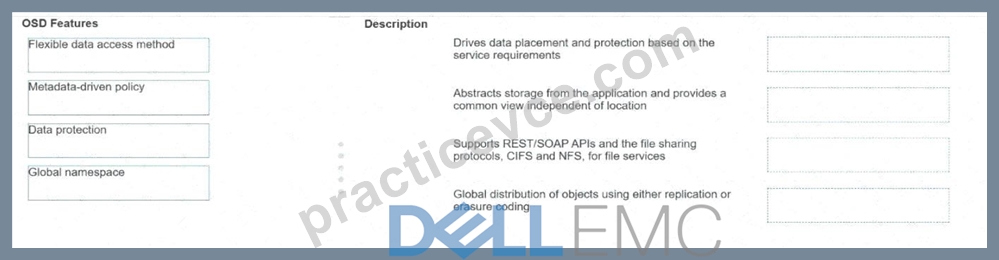
Answer:
Explanation: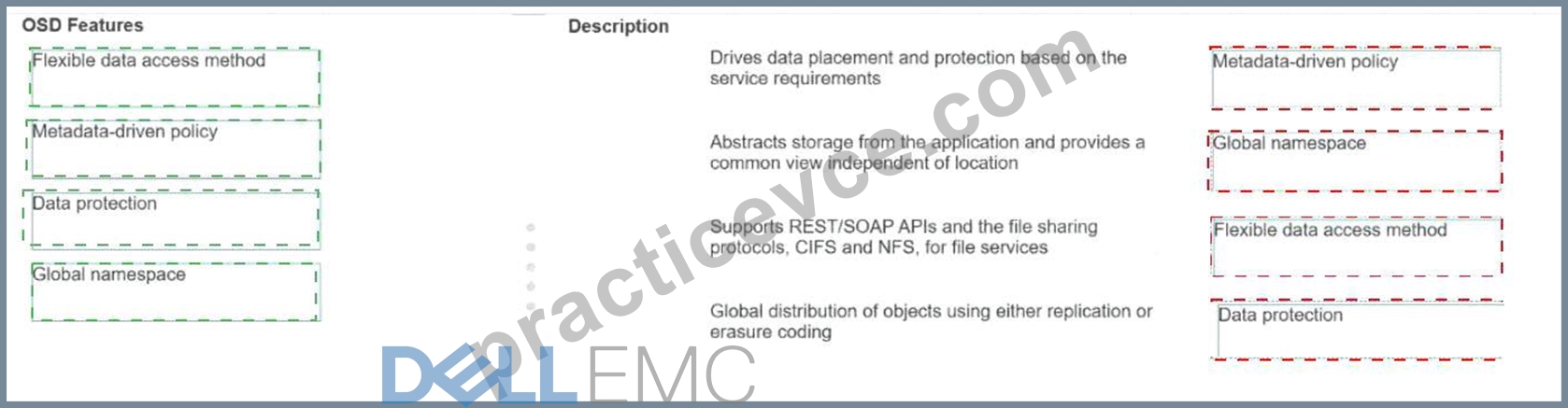
Explanation:
A screenshot of a computer AI-generated content may be incorrect.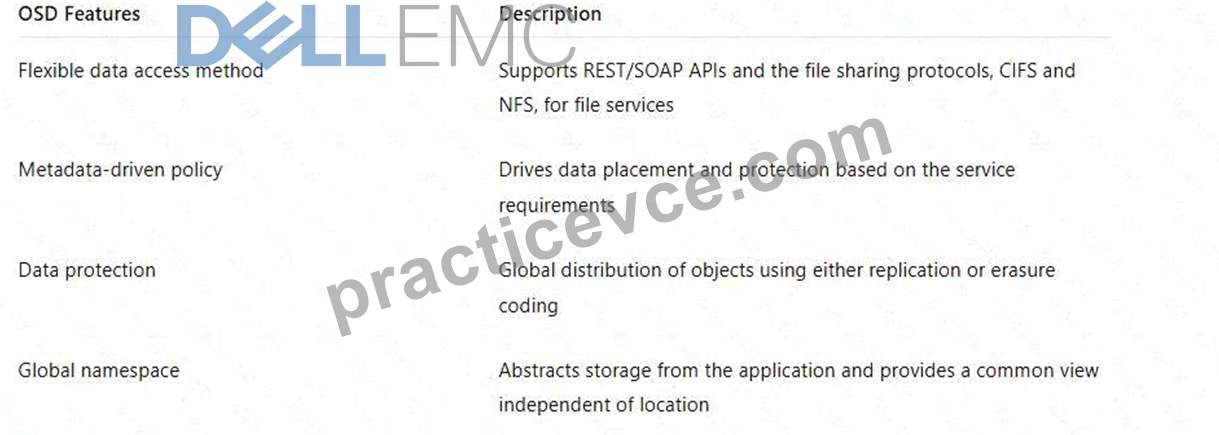
#Flexible data access method:Object storage can offer multiple ways to access and interact with stored data, such as REST/SOAP APIs (for object-based access) and file-sharing protocols (CIFS, NFS) for file-level access.
#Metadata-driven policy:Object storage uses rich metadata to define how objects are placed, protected, and managed, driven by policies that respond to service-level requirements.
#Data protection:Object storage systems implement data protection at a global scale through replication or erasure coding to ensure data durability and availability.
#Global namespace:Object storage abstracts physical locations, providing a single namespace (a unified view) so that applications can seamlessly access data regardless of where it physically resides.
Reference:Dell Information Storage and Management Foundations 2023 Study Guide, Section: Object-Based Storage - Key Features.
NEW QUESTION # 51
Question:
What is the role of the storage node in a backup architecture?
- A. To organize and write data to the backup device
- B. To manage the backup
- C. To perform data deduplication and compression
- D. To monitor the health of the backup infrastructure
Answer: A
Explanation:
Astorage nodeis a component in a backup architecture that handles the actualdata movementduring the backup process:
Itorganizesthe backup data stream.
Itwritesthe data to the backup target (disk, tape, or cloud).
It does not manage policies or schedules (that's the role of the backup server or management console).
* Option A:Monitoring is done by the backup server or management tools.
* Option C:Backup management (scheduling, policies) is also handled by the backup server.
* Option D:Deduplication may be part of the process but is not theprimary roleof a storage node.
Reference:Dell Information Storage and Management Foundations 2023 Study Guide, Section: Backup Architecture - Components.
NEW QUESTION # 52
Question:
What is an advantage of deploying intelligent storage systems in the data center?
- A. Reduces the complexity of managing information by creating silos of storage
- B. Migrates data from a data center to the cloud at no cost
- C. Reduces the amount of data to replicate, migrate, and back up
- D. Enables efficient and optimized storage and management of information
Answer: D
Explanation:
Intelligent storage systems incorporate advanced features like automated tiering, deduplication, and compression. These features enable efficient storage utilization and optimized management by automating data placement and reducing manual intervention.
* Option A: While intelligent systems may facilitate cloud integration, they do not guarantee cost-free migration.
* Option B: Data reduction features help, but the primary advantage is broader efficiency and optimization.
* Option C: Creating silos increases complexity; intelligent systems aim to unify and simplify storage management.
Reference:Dell Information Storage and Management Foundations 2023 Study Guide, Section: Intelligent Storage Systems.
NEW QUESTION # 53
......
Download Free Latest Exam D-ISM-FN-01 Certified Sample Questions: https://www.practicevce.com/EMC/D-ISM-FN-01-practice-exam-dumps.html
D-ISM-FN-01 Actual Questions - Instant Download 63 Questions: https://drive.google.com/open?id=1MrfDMAeOqy_BCXwxRL2lokySXbUHCpsZ