

Easily To Pass New ISO-45001-Lead-Auditor Premium Exam Updated [Mar 20, 2026]
ISO-45001-Lead-Auditor Certification All-in-One Exam Guide Mar-2026
PECB ISO-45001-Lead-Auditor Exam Syllabus Topics:
| Topic | Details |
|---|---|
| Topic 1 |
|
| Topic 2 |
|
| Topic 3 |
|
| Topic 4 |
|
NEW QUESTION # 23
Like many other quality management systems, ISO 45001 uses what is known as a 'PDCA' circle. What do those initials stand for?
- A. Plan, Do, Check, Ask
- B. Plan, Do, Check, Act
- C. Prepare, Deliver, Control, Assess
- D. Plan, Deliver, Control, Achieve
Answer: B
Explanation:
The PDCA (Plan-Do-Check-Act) model is a continuous improvement framework used in ISO 45001 and other management systems.
Plan: Establish objectives and processes to deliver results in line with the OH&S policy.
Do: Implement the processes.
Check: Monitor and measure processes against the policy, objectives, and requirements.
Act: Take actions to continually improve the system's performance.
Analysis of Options:
A . Plan, Do, Check, Act:
Correct. This is the standard PDCA cycle.
B . Plan, Do, Check, Ask:
Incorrect. "Ask" is not part of the cycle.
C . Plan, Deliver, Control, Achieve:
Incorrect. This is not the PDCA cycle.
D . Prepare, Deliver, Control, Assess:
Incorrect. This deviates from the PDCA framework.
ISO Reference:
Clause 0.3: PDCA model.
NEW QUESTION # 24
An audit team leader prepares the audit plan for an initial Stage 2 certification audit. Which two of the following statements are false?
- A. The organisation should cancel at staff leave during the audit.
- B. The audit team leader does not select the OHS audit team members.
- C. The organisation should review the audit plan for agreement.
- D. The audit team leader should present the plan to the auditee before the Stage 2 audit.
- E. The plan does not need to include the names of the senior managers.
- F. The audit team leader should plan to interview each employee.
Answer: B,F
Explanation:
Comprehensive Detailed Explanation along with All ISO 45001 Audit Reference Analysis of Each Option:
A . The organisation should review the audit plan for agreement.
True.
According to ISO 45001 guidelines and ISO 19011 (Guidelines for Auditing Management Systems), it is standard practice for the auditee organization to review and agree to the audit plan to ensure clarity on scope, objectives, and processes.
Reference: ISO 19011:2018, Clause 6.3.2.
B . The audit team leader does not select the OHS audit team members.
False.
The audit team leader is responsible for selecting competent team members with the requisite expertise to evaluate the auditee's Occupational Health & Safety Management System (OHSMS). Selection is based on criteria such as knowledge of ISO 45001, auditing skills, and understanding of the industry.
Reference: ISO 19011:2018, Clause 5.4.2 and 6.3.1.
C . The audit team leader should plan to interview each employee.
False.
While employee interviews are an essential part of gathering evidence during an ISO 45001 audit, interviewing every employee is impractical and unnecessary. A representative sampling strategy is used to assess compliance across various levels and departments.
Reference: ISO 19011:2018, Clause 6.4.6.
D . The audit team leader should present the plan to the auditee before the Stage 2 audit.
True.
Presenting the audit plan to the auditee before the audit is essential to ensure all parties are informed and prepared for the audit. This practice is emphasized in ISO 19011 and supports transparency and effective audit execution.
Reference: ISO 19011:2018, Clause 6.3.3.
E . The organisation should cancel staff leave during the audit.
False.
ISO 45001 and related audit guidelines do not mandate the cancellation of staff leave during audits. While key personnel should be available, the audit team collaborates with the organization to plan around leave schedules to minimize disruption.
Reference: Not explicitly covered in ISO 45001 or ISO 19011; falls under planning discretion.
F . The plan does not need to include the names of the senior managers.
True.
While the audit plan should outline the scope, objectives, and methods, it does not specifically require the inclusion of senior managers' names unless they are directly involved in the audit.
Reference: ISO 19011:2018, Clause 6.3.2.
Key ISO Reference:
ISO 45001:2018, Clause 9.2 (Internal Audit Requirements).
ISO 19011:2018, Clauses 5.4.2, 6.3.1, 6.3.2, and 6.4.6.
NEW QUESTION # 25
Wokrer's participations is a key factor for the success of OHSMS. Which three of the following ISO 45001 activities require workers' participation?
- A. Determining what needs to be communciated
- B. Establishing OHS policy
- C. Determining actions to eliminate hazards
- D. Managing internal audit programme
- E. Establishing OHS objectives
- F. Determining competence requirements
Answer: B,C,E
Explanation:
Worker participation is a fundamental principle of ISO 45001 (Clause 5.4). It ensures workers at all levels are involved in key activities to enhance the OH&S management system's effectiveness.
Analysis of Options:
* A. Determining competence requirements:Incorrect. Determining competence is primarily the responsibility of management, though workers may provide input.
* B. Establishing OHS objectives:Correct. Worker involvement ensures objectives are realistic and relevant to workplace conditions (Clause 6.2).
* C. Managing internal audit programme:Incorrect. Managing audits is typically a managerial responsibility, though workers may participate in audits.
* D. Determining actions to eliminate hazards:Correct. Workers' insights are critical in identifying and implementing actions to eliminate hazards (Clause 8.1.2).
* E. Determining what needs to be communicated:Incorrect. While communication strategies impact workers, their participation in determining communication needs is not explicitly required.
* F. Establishing OHS policy:Correct. Workers should be involved in developing policies to ensure relevance and buy-in (Clause 5.2).
ISO References:
* Clause 5.4: Worker participation.
* Clause 6.2: OHS objectives.
* Clause 8.1.2: Hierarchy of controls and hazard elimination.
NEW QUESTION # 26
In the ISO 45001 health and safety management system, what is 'documented information'? Select the ONE best answer.
- A. Any paperwork generated when the system is in operation
- B. The master copies of the documents used to operate the system, held in any format
- C. Paperwork such as Permits to work and risk assessments
- D. Any information about the system, or generated by it, held in any format
Answer: D
Explanation:
ISO 45001 defines "documented information" as information required to be controlled and maintained by an organization. This can include policies, procedures, records, or other relevant data in any format (Clause 3.19). It encompasses all information used to establish, operate, and demonstrate the effectiveness of the OH&S management system.
Analysis of Options:
A . Any paperwork generated when the system is in operation:
Incorrect. This is too narrow and excludes digital or other formats.
B . Any information about the system, or generated by it, held in any format:
Correct. This aligns with the ISO 45001 definition in Clause 3.19.
C . Paperwork such as Permits to Work and risk assessments:
Incorrect. These are examples of documented information but do not encompass the full scope of the term.
D . The master copies of the documents used to operate the system, held in any format:
Incorrect. This definition is limited to master copies, while documented information includes records as well.
ISO Reference:
Clause 3.19: Definition of documented information.
Clause 7.5: Control of documented information.
NEW QUESTION # 27
Select the two options which describe a disadvantage of using a checklist.
- A. Assisting with starting an interview
- B. Noting down evidence details
- C. Helping with sampling of evidence
- D. Not varying from the checklist when necessary
- E. Ensuring relevant audit trails are followed
- F. Using the same checklist for every audit without review
Answer: B,D
NEW QUESTION # 28
Which two of the following are examples of activities that may occur after the third-party audit has been closed by the individual(s) managing the audit programme?
- A. Conducting a review of opportunities for Improvement.
- B. Updating risks and opportunities to the audit programme.
- C. Writing the audit report.
- D. Addressing any audit complaints.
- E. Conducting a closing meeting.
- F. Revising the audit's objectives.
Answer: A,D
Explanation:
Comprehensive Detailed Explanation along with All ISO 45001 Audit References Activities following the closure of a third-party audit are generally related to improving the audit process and addressing any unresolved issues.
Analysis of Options:
* A. Addressing any audit complaints:Correct. Post-audit, complaints or concerns from stakeholders are addressed to improve the audit process and maintain credibility.
* B. Conducting a closing meeting:Incorrect. The closing meeting occurs before the audit is closed.
* C. Conducting a review of opportunities for improvement:Correct. Reviewing opportunities for improvement post-audit helps in refining processes and aligning them with organizational goals.
* D. Revising the audit's objectives:Incorrect. Audit objectives are established during the planning phase, not after the audit has been closed.
* E. Updating risks and opportunities to the audit programme:Incorrect. Updates to risks and opportunities occur during ongoing audits, not specifically post-audit.
* F. Writing the audit report:Incorrect. The audit report is prepared before the audit is officially closed.
ISO References:
* Clause 9.2.2: Audit process review.
* ISO 19011:2018, Clause 6.7: Managing complaints and follow-up.
NEW QUESTION # 29
When calculating an ISO 45001 third party initial audit duration, which two of the following statements are false?
- A. Think about the complexity of the organization's business
- B. Include the time allocated for lunch breaks
- C. Include outsourced processes
- D. Incorporate the time taken to travel to/from the audit location
- E. Consider the number of functions related to OHS management
- F. Consider the number of sites to be sampled
Answer: B,D
Explanation:
Comprehensive Detailed Explanation along with All ISO 45001 Audit References Analysis of Each Option:
Reference: IAF MD 5:2020, Clause 2.3.1 (factors affecting audit time).
B). Consider the number of sites to be sampled.True.For multi-site organizations, the number of sites to be sampled is critical in calculating audit duration. Sampling requirements are determined using guidelines such as IAF MD 1:2022 and depend on the complexity, size, and risks associated with each site.Reference: IAF MD 1:2022, Clause 4.2.
C). Include outsourced processes.True.Outsourced processes that affect the OHS management system must be evaluated as part of the audit. This includes reviewing the organization's control over such processes.
Auditing these aspects impacts the audit duration.Reference: ISO 45001:2018, Clause 8.1.4 and IAF MD 5:
2020, Clause 2.3.1.
D). Include the time allocated for lunch breaks.False.Lunch breaks are not considered part of the audit duration as they do not contribute to the assessment of the management system. Audit time calculations exclude non-working hours, including breaks.Reference: IAF MD 5:2020, Clause 2.5.
E). Incorporate the time taken to travel to/from the audit location.False.Travel time is excluded when calculating the audit duration. While travel logistics are considered in audit planning, they do not count towards the total audit time.Reference: IAF MD 5:2020, Clause 2.5.
F). Think about the complexity of the organization's business.True.The complexity of the organization's business, including the nature of hazards, risks, and legal obligations, significantly affects the audit duration.
More complex operations typically require longer audit times.Reference: IAF MD 5:2020, Clause 2.3.1.
Key ISO and IAF References:
ISO 45001:2018: Clause 9.2.2 (Audit Program).
IAF MD 5:2020: "Determination of Audit Time of Quality and Environmental Management Systems." IAF MD 1:2022: "Audit and Certification of Multiple Sites Based on Sampling."
NEW QUESTION # 30
Like many other quality management systems, ISO 45001 uses what is known as a 'PDCA' circle. What do those initials stand for?
- A. Plan, Do, Check, Ask
- B. Plan, Do, Check, Act
- C. Prepare, Deliver, Control, Assess
- D. Plan, Deliver, Control, Achieve
Answer: B
Explanation:
The PDCA (Plan-Do-Check-Act) model is a continuous improvement framework used in ISO 45001 and other management systems.
* Plan: Establish objectives and processes to deliver results in line with the OH&S policy.
* Do: Implement the processes.
* Check: Monitor and measure processes against the policy, objectives, and requirements.
* Act: Take actions to continually improve the system's performance.
Analysis of Options:
* A. Plan, Do, Check, Act:Correct. This is the standard PDCA cycle.
* B. Plan, Do, Check, Ask:Incorrect. "Ask" is not part of the cycle.
* C. Plan, Deliver, Control, Achieve:Incorrect. This is not the PDCA cycle.
* D. Prepare, Deliver, Control, Assess:Incorrect. This deviates from the PDCA framework.
ISO Reference:
* Clause 0.3: PDCA model.
NEW QUESTION # 31
During a second-party audit at a sawmill, you find that the OHSMS Manager conducted the hazard identification process. In the risk assessment report, hazards were listed as physical hazards, chemical hazards, biological hazards, and psychosocial hazards, with the hazards categorized as low, medium, and high risk to be addressed. The OHSMS Manager did not have an action plan for low and medium risks, saying that they ignored those. He stated that they brought in a health and safety consultant to advise on treatment for the high risks.
When interviewing the OHSMS Manager, the auditor presents a nonconformity relating to potential hazards in the factory if the dust extraction system broke down. The OHSMS Manager said that, if that happened, the agreed planned action is that workers would put masks on.
Select one of the options for how the auditor should respond to this statement.
- A. Advise that the factory should cease its operations if the dust extraction equipment malfunctioned.
- B. Ask the OHSMS Manager to confirm that this action meets regulatory requirements for air purity.
- C. Suggest that they should increase their maintenance checks.
- D. Seek evidence that the response action is both implemented and effective.
Answer: D
NEW QUESTION # 32
In the initial communication by the audit team leader for a certification audit, the OHSMS Manager asks that the audit includes detailed coverage of the OHSMS legislation of the local authority, which has been specified in a recent customer contract.
Which two of the following responses should the audit team leader make?
- A. Advise the OHSMS Manager that the new criteria can be included without any problem.
- B. Suggest that the OHSMS Manager cancels the audit contract and reapplies to include the additional criteria.
- C. Advise the OHSMS Manager that the audit criteria has been set as ISO 45001 and the audit programme for certification will need to proceed as planned.
- D. Inform the OHSMS Manager that an audit against the regulatory criteria may be possible but will require a new audit team.
- E. Ask the individual(s) managing the programme whether the audit criteria can be revised to include the new request.
- F. Add a legal expert to the audit team in order to accept the request.
Answer: C,E
NEW QUESTION # 33
An auditor of a manufacturer of plastic packaging products for the food industry found a nonconformity in an internal audit report raised against section 10.2 of ISO 45001 in Report IA202. The nonconformity (NC3) stated: "The level of reported health and safety incidents has increased by 9.7% over the last 12 months. This included an increase in reported accidents." Against this background, the third-party audit team found more than twenty minor nonconformities during the audit, which they agreed should be combined into one major nonconformity against clause 4.4 of ISO 45001. "The organisation has failed to demonstrate that it is maintaining and continually improving a health and safety management system." Select two options which would represent acceptable corrective actions for the nonconformity.
- A. Union representatives of the workers were invited to attend the OH&S management meetings.
- B. Top management initiated a comprehensive review of the internal and external issues to decide on actions that could lead to improving the performance of the OHSMS.
- C. OH&S champions were appointed in each department to report near misses and incidents in the OHSMS.
- D. External consultants were appointed to conduct a gap analysis of the OHSMS and report on the gaps found.
- E. Staff from departments with nonconformities were given regular OH&S safety training sessions during their daily toolbox talks.
- F. Top Management developed and is leading a programme to promote an effective culture of support for the OHSMS.
Answer: B,F
Explanation:
Clause 4.4 of ISO 45001 requires organizations to establish, implement, maintain, and continually improve an OH&S management system. The corrective actions must address systemic issues, involve leadership commitment, and aim to foster a strong safety culture.
Analysis of Options:
A . Top management initiated a comprehensive review of internal and external issues:
Correct. A review of internal and external issues aligns with Clause 4.1 and demonstrates leadership commitment.
B . Union representatives were invited to attend OH&S management meetings:
Incorrect. While participation is valuable, it is not a systemic corrective action.
C . Top management developed and is leading a programme to promote an effective culture of support:
Correct. Promoting a safety culture is a proactive measure and aligns with Clause 5.1 (Leadership).
D . Staff from departments with nonconformities received regular safety training during toolbox talks:
Incorrect. While training addresses specific gaps, it does not address systemic issues.
E . External consultants conducted a gap analysis of the OHSMS:
Incorrect. While helpful, this action does not demonstrate leadership or address systemic improvement.
F . OH&S champions were appointed in each department to report near misses and incidents:
Incorrect. This is a good practice but does not directly address Clause 4.4's requirement for systemic improvement.
ISO Reference:
Clause 4.4: Maintaining and improving the OH&S management system.
Clause 5.1: Leadership and commitment.
Clause 10.3: Continual improvement.
NEW QUESTION # 34
You are in the closing meeting of a second-party audit to ISO 45001. Which three of the following topics are most likely to come for discussion?
- A. The extent of the auditee's documented information system.
- B. The extent to which the auditee Is conforming to the requirements set out in ISO 45001.
- C. Whether the work instructions for a specify auditee OH&S process are focused on efficiency.
- D. nature of the trading relationship that currently exists between the auditee's and auditor's organisations.
- E. The extent to which the auditee is conforming to the OH&S requirements contained in supply contracts with the auditing organisation.
- F. The names and email address of a attendees at the closing meeting. The question of who should chair the closing meeting.
- G. Whether the audit has correctly performed in current contracts with other customers.
Answer: B,D,E
Explanation:
The closing meeting of a second-party audit focuses on the findings, conformance to agreed requirements, and areas for improvement. ISO 19011:2018 provides guidance on closing meetings, stating that the results of the audit, including conformity with criteria, must be reviewed and agreed upon.
Analysis of Options:
* A. The names and email addresses of attendees at the closing meeting:Irrelevant. Attendance details are not part of the audit discussion.
* B. The extent of the auditee's documented information system:While relevant during the audit, it is not typically a focus in the closing meeting.
* C. The extent to which the auditee is conforming to OH&S requirements in supply contracts:
Correct. Second-party audits often assess compliance with contractual requirements.
* D. The extent to which the auditee conforms to ISO 45001 requirements:Correct. The core purpose of the audit is to evaluate conformity to ISO 45001.
* E. The nature of the trading relationship between the organizations:Correct. The trading relationship often shapes the scope and context of second-party audits.
* F. Whether the audit has correctly performed in current contracts with other customers:
Irrelevant. The focus is on the specific audit, not contracts with other customers.
* G. Whether the work instructions for a specific OH&S process are focused on efficiency:
Irrelevant. Efficiency is not the primary focus of an OH&S audit.
ISO References:
* ISO 19011:2018, Clause 6.6.1: Conducting the closing meeting.
* ISO 45001:2018, Clause 9.2: Internal audit requirements.
NEW QUESTION # 35
According to ISO 45001, who should participate in the continuous improvement of the health and safety management system?
- A. Everyone, at all levels of the company
- B. Top management and senior officers only
- C. Top management only
- D. Top management, senior officers and designated safety representatives only
Answer: A
Explanation:
ISO 45001 emphasizes worker participation and engagement at all levels of the organization to support continuous improvement (Clause 5.4 and Clause 10.3). Continuous improvement requires input from everyone, including workers who identify hazards, report incidents, and contribute to safety enhancements.
Analysis of Options:
A . Everyone, at all levels of the company:
Correct. Clause 5.4 explicitly includes all levels of the organization in consultation and participation, fostering continuous improvement.
B . Top management and senior officers only:
Incorrect. While top management plays a crucial role in leadership, ISO 45001 extends the responsibility for participation to all levels.
C . Top management, senior officers, and designated safety representatives only:
Incorrect. Limiting participation to designated representatives excludes a significant portion of the workforce from the improvement process.
D . Top management only:
Incorrect. While top management must lead and commit to continuous improvement, their involvement alone is insufficient under ISO 45001.
ISO Reference:
Clause 5.4: Worker consultation and participation.
Clause 10.3: Continual improvement.
NEW QUESTION # 36
Showitoff is an organization specialization in the design and production of wall decorating materials for the domestic market.
During an ISO 45001 certification audit of the site, the auditor comes across an open, walled area just outside the maintenance department. It contains various scraps of wood and metal as well as serveral rusty components. Several heavy concrete beams are learning against a thin brick wall in which cracks are available. When asked about it, the OHS Manager states that he presumes that the materials come from maintenance work, so it is the Maintenance Manager's responsibility.
The auditor interview the Maintenance Manager in his department. He asks about the area outside and is told that it contains some excess material that the Manager likes to keep in case they come in handy at some stage. The auditor points out that the wall appears to be unstable and could collapse at any moment. The Maintenance Manager is not aware of such a situation.
Wash-it-up is an organization that provides window cleaning services for the industrial sector. It has been certified to ISO 45001 for some time and has appointed a new OHS Manager. The auditor asks to see the most recent management review meeting minutes.
Which three statement would represent input audit evidence for the management review?
- A. Procurement of new safety harnesses for workers
- B. Decisions on Improvements in the OHSMS
- C. Allocation of a bigger budget for the OHS department
- D. Decisions related to continual Improvement opportunities
- E. Worker feedback of positive and negative comments
- F. Report showing the trend of on increase in safety incidents
- G. Updates to the risk register
- H. Proposal to priorities health and safety issues as a business strategy
Answer: E,F,G
Explanation:
Comprehensive Detailed Explanation along with All ISO 45001 Audit Reference Clause 9.3 of ISO 45001:2018 defines inputs for management review, which must include information on performance trends, feedback, risks, and opportunities for improvement.
Analysis of Options:
A . Allocation of a bigger budget for the OHS department:
This is an output of management review, not an input.
B . Decisions on improvements in the OHSMS:
This is an output, not an input.
C . Decisions related to continual improvement opportunities:
This is an output, not an input.
D . Procurement of new safety harnesses for workers:
This is an operational action, not an input for management review.
E . Proposal to prioritize health and safety issues as a business strategy:
Proposals may be discussed during review, but they are outputs.
F . Report showing the trend of an increase in safety incidents:
Correct. This is a valid input that informs system performance.
G . Updates to the risk register:
Correct. Risk updates are required inputs under Clause 6.1.2.
H . Worker feedback of positive and negative comments:
Correct. Feedback is an essential input per Clause 5.4 and Clause 9.3.
ISO Reference:
Clause 9.3: Management review inputs.
Clause 5.4: Worker consultation and participation.
NEW QUESTION # 37
You are conducting a Stage 2 audit of a steel fabrication works that uses powerful presses to shape steel sheets into various car panels. You note from the accident book that more staff hours have been lost through accidents associated with the presses than those associated with any other equipment.
You question the OH&S manager who tells you, "These big presses are just inherently more dangerous than other equipment. If there is an accident, it's going to be more serious as a result of the forces at work." Which three of the following audit trails would it now be appropriate to pursue?
- A. Determine whether hazard identification had taken place in respect of the pressing process. If it did, what OH&S risks were identified and what actions were instigated to mitigate these risks?
- B. Check whether the organisation has big enough finances to invest in fully automated pressing machines which would not need manual workers.
- C. Check that the workers who had been injured had received appropriate compensation, so they did not suffer financially from their accidents or working hours lost while recovering.
- D. Ensure that the organisation had recorded the reoccurring accidents as an external issue in its determination of context of the organisation. Ensure all interested parties had been informed.
- E. Determine whether the organisation had considered changing the panels to plastic mouldings which would be less likely to cause accidents.
- F. Ask top management to explain how the reoccurring accidents would affect the setting of future OH&S objectives.
- G. Determine whether there were any maintenance issues that resulted in the machines being unsafe to use, such as broken or missing guards or faulty emergency stop buttons.
Answer: A,D,G
NEW QUESTION # 38
You are the audit team leader of an ISO 45001 remote/space certification audit. Which two of the following topics would you need to discuss with the audit OHSMS legislation of the local authority, which has been
- A. Trends in the OHS indicators and associated objectives
- B. Results of the last regulatory audit
- C. OHS management system hazards identification and risks evaluation process
- D. OHS accidents occurred since Stage 1 audit
- E. Any practical obstacles to the audit
- F. Access requirements for the virtual platform
Answer: E,F
NEW QUESTION # 39
During an internal audit of an OHSMS, what evidence would the auditor look for to demonstrate conformity to ISO 45001? Match each item with the correct ISO 45001 clause number.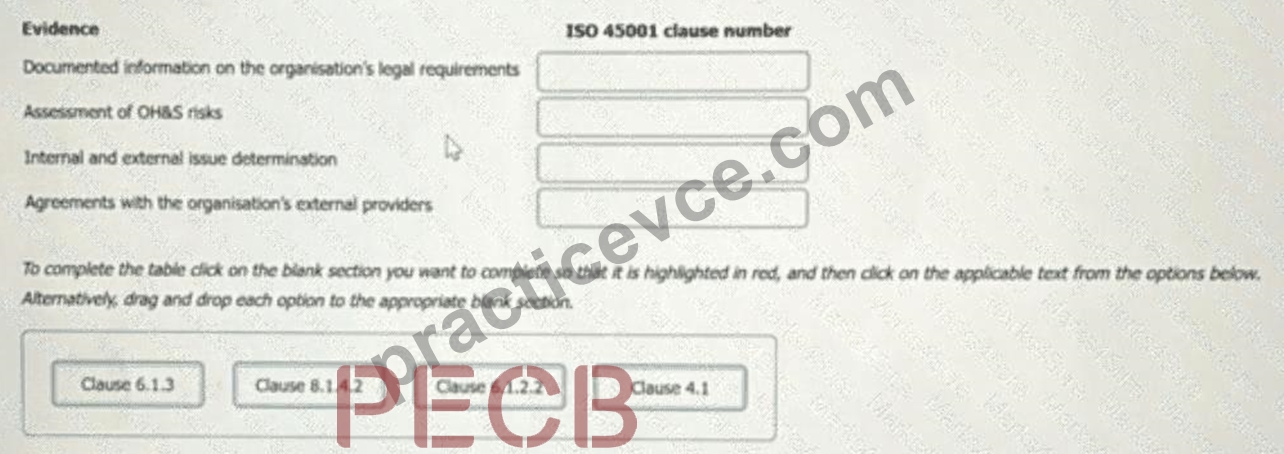
Answer:
Explanation: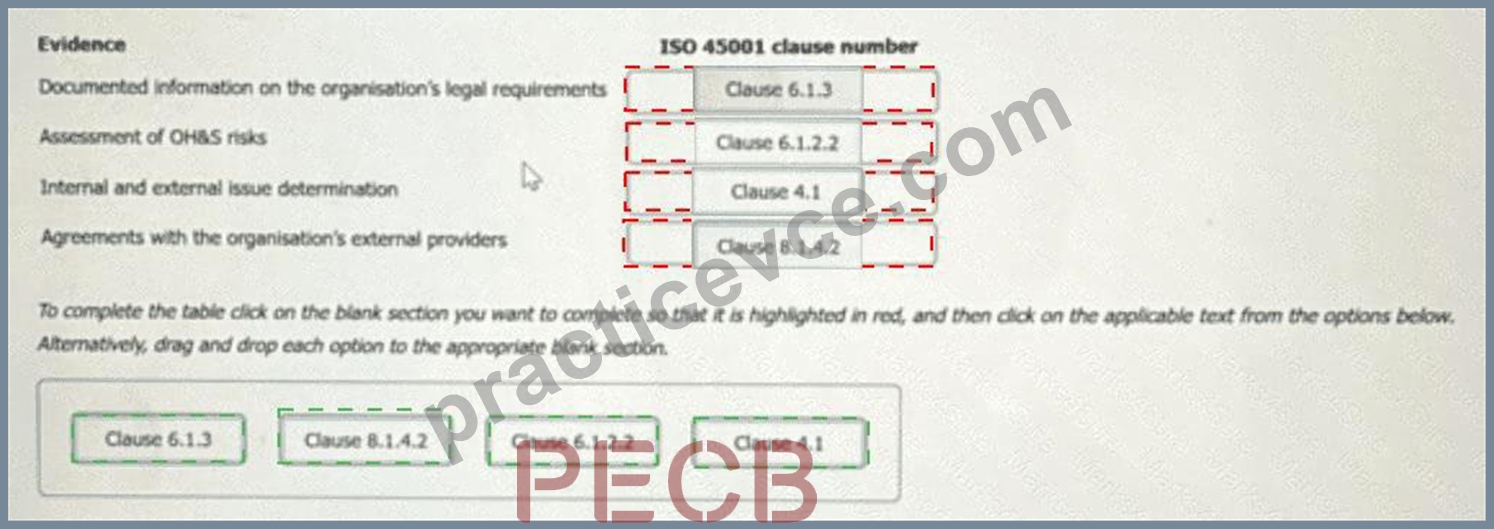
Explanation:
A screenshot of a computer Description automatically generated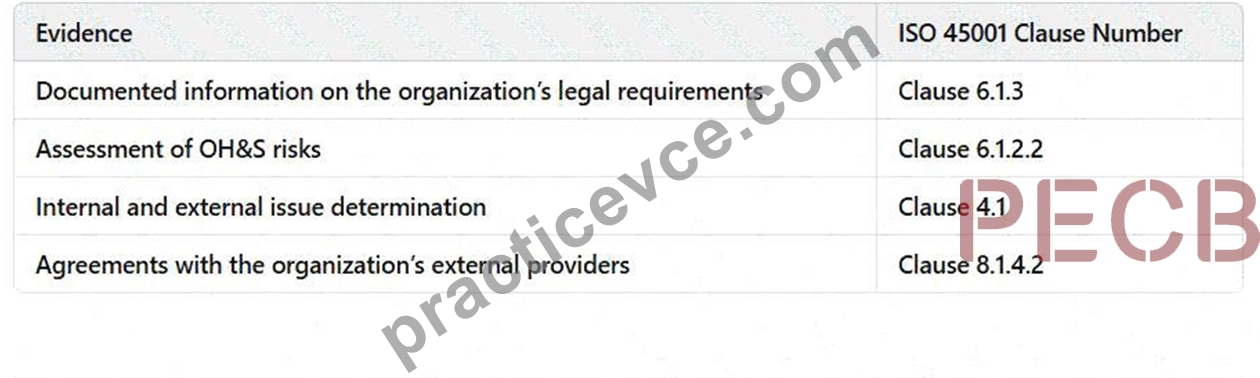
Explanation:
* Documented information on the organization's legal requirements # Clause 6.1.3:Clause 6.1.3 requires the organization to identify, document, and maintain compliance obligations, including legal and other requirements relevant to OH&S.
* Assessment of OH&S risks # Clause 6.1.2.2:Clause 6.1.2.2 mandates the organization to assess OH&S risks associated with its operations, taking into account hazards, controls, and work activities.
* Internal and external issue determination # Clause 4.1:Clause 4.1 requires organizations to determine internal and external issues that affect the OH&S management system and its intended outcomes.
* Agreements with the organization's external providers # Clause 8.1.4.2:Clause 8.1.4.2 pertains to controlling external providers and ensuring their processes align with OH&S requirements, including documented agreements.
References
* Clause 4.1: Understanding the organization and its context.
* Clause 6.1.2.2: Assessment of risks and opportunities related to OH&S.
* Clause 6.1.3: Compliance obligations.
* Clause 8.1.4.2: Control of external providers.
NEW QUESTION # 40
Showitoff is an organisation spcialising in the design and production of wall decorating material for the domestic market. During an ISO 45001 certification audit of the site, the auditor comes across an open, walled area just outside the maintenance department. It contains various scraps of wood and metal as well as several rusty components. Several heavy concrete beams are learning against a thin brick wall in which cracks are visible. When asked about it, the OHS Manager states that he presume that the material come from maintenance work, so it is the Maintenance Manager's responsibility.
The auditor interviews the Maintenance Manager in his department. He asks about the area outside and is told that it contains some excess materials that the Manager likes to keep in case they come in handy at some stage. The auditor points out that the wall appears to be unstable collapse at any moment. The Maintenance Manager is not aware of such a situation.
Which three statement represent good audit practice?
- A. The auditor should check whether the organization has identified the safety hazards associated with the walled area.
- B. The auditor should consider surveying more areas of the site for other potentially unsafe situations.
- C. The audit should refer the organization to the health and safety authorities.
- D. The auditor should advice the organisation to get rid of the walled area.
- E. The audit should raise a nonconformity against ISO 45001.
- F. The audit should demand that the Maintenance Manager deals with the wall.
- G. The audit should ask the Maintenance Manager to conduct a safety survey.
- H. The audit should check the lines of communication between the OHS Manager and maintenance Manager.
Answer: A,B,H
Explanation:
Comprehensive Detailed Explanation along with All ISO 45001 Audit References Clause 6.1.2 of ISO 45001:2018 emphasizes the identification of hazards and assessment of risks, and Clause
5.4 highlights the importance of consultation and communication among roles. The auditor's role includes verifying conformity to these clauses through evidence gathering and observation.
Analysis of Options:
* A. The auditor should advise the organization to get rid of the walled area.This is outside the scope of an auditor's role, which is to observe and report findings, not to dictate specific actions.
* B. The auditor should ask the Maintenance Manager to conduct a safety survey.While safety surveys are useful, asking the Maintenance Manager to conduct one is not the auditor's responsibility.
* C. The auditor should check the lines of communication between the OHS Manager and Maintenance Manager.This aligns with ISO 45001:2018, Clause 5.4, as communication gaps may have contributed to the situation.
* D. The auditor should check whether the organization has identified the safety hazards associated with the walled area.Clause 6.1.2 requires hazard identification. The auditor must determine whether this has been done.
* E. The auditor should consider surveying more areas of the site for other potentially unsafe situations.Broadening the audit scope to identify additional risks is a good practice in line with Clause
9.2.2.
* F. The auditor should demand that the Maintenance Manager deals with the wall.Demanding action is not within the auditor's authority. The auditor should raise findings instead.
* G. The auditor should raise a nonconformity against ISO 45001.While this may be appropriate depending on evidence, raising a nonconformity is not a replacement for good audit practices.
* H. The auditor should refer the organization to health and safety authorities.This step is extreme and should only occur if there is an imminent danger and no action is being taken.
ISO References:
* Clause 6.1.2: Hazard identification and risk assessment.
* Clause 5.4: Worker consultation and participation.
* Clause 9.2.2: Internal audit program and execution.
NEW QUESTION # 41
Which two of these statements about processes are true?
- A. OHS&S processes that are undertaken by external providers must be audited to ensure they are controlled.
- B. The organisation must implement controls to ensure processes are operating in accordance with defined criteria.
- C. OHS&S processes that are undertaken by external providers may or may not form part of the organisation's OHSMS.
- D. All processes needed to meet the requirements of the OHSMS must be documented.
- E. All processes must have a designated process owner who has specific responsibility to ensure the process remains under control.
- F. The organisation must seek to continually improve its OHSMS processes
Answer: A,B
NEW QUESTION # 42
......
Last ISO-45001-Lead-Auditor practice test reviews: Practice Test PECB dumps: https://www.practicevce.com/PECB/ISO-45001-Lead-Auditor-practice-exam-dumps.html
Get Real ISO-45001-Lead-Auditor Exam Dumps [Mar-2026] Practice Tests: https://drive.google.com/open?id=17ub9NLp8QFZAqOueWuAkpPwIJaj8PVL3