

PDF Download Free of Scripting-and-Programming-Foundations Valid Practice Test Questions
Scripting-and-Programming-Foundations Test Engine files, Scripting-and-Programming-Foundations Dumps PDF
NEW QUESTION # 40
Which characteristic distinguishes an object-oriented language from other languages?
- A. It has variables that never change type during execution
- B. It includes custom variable types with methods, information hiding, data abstraction, encapsulation, polymorphism, and inheritance.
- C. lt specifies a series of well-structured steps to compose a program.
- D. It is extremely portable and can be run on any machine that has a program than can read the code.
Answer: B
Explanation:
The defining characteristic of an object-oriented language is its support for objects and classes, which encapsulate data and behavior. This includes the ability to define custom variable types (classes) with their own methods, and the use of key principles such as information hiding, data abstraction, encapsulation, polymorphism, and inheritance. These features distinguish object-oriented languages from procedural languages, which do not typically support these concepts in the same way.
References: The characteristics of object-oriented programming (OOP) are well-documented and recognized in the field of software development. The information provided aligns with standard definitions and explanations of OOP, as found in educational resources and programming literature123.
NEW QUESTION # 41
What is the proper way to declare a student's grade point average throughout the term it this item is needed in several places in a program?
- A. constant float gpa
- B. variable int gpa
- C. constant int gpa
- D. variable float gpa
Answer: D
Explanation:
A student's grade point average (GPA) is a numerical representation that typically includes a decimal to account for the precision of the average (e.g., 3.75). Therefore, it should be declared as a floating-point data type to accommodate the decimal part. Since a student's GPA can change over time with the addition of new grades, it should be declared as a variable rather than a constant.
References:
* The concept of using floating-point variables for numerical data that includes decimals is a standard practice in programming. This is discussed in programming resources such as "Programming: Principles and Practice Using C++" by Bjarne Stroustrup, which explains data types and their uses. Additionally, the concept of variables and constants is covered in "The C Programming Language" by Brian W.
Kernighan and Dennis M. Ritchie.
NEW QUESTION # 42
What does the following algorithm determine?
- A. Whether x r> negative. 0, <x positive
- B. Whether x is even
- C. Whether x is odd
- D. Whether x is evenly divisible by 2 or 3
Answer: C
Explanation:
The algorithm provided in the image performs a modulo operation with 2 (x % 2) and checks if the result is 1.
In programming, the modulo operation gives the remainder of the division of two numbers. For any integer x, if x % 2 equals 1, it means that x is odd because it has a remainder of 1 when divided by 2. Even numbers, when divided by 2, have no remainder and thus would return 0 in a modulo 2 operation.
References: The explanation is based on the standard definition and behavior of the modulo operation in programming and mathematics. For more information on algorithms and their applications, you can refer to resources such as GeeksforGeeks1 and Built In2.
NEW QUESTION # 43
Which statement describes a compiled language?
- A. It is considered fairly safe because it forces the programmer lo declare all variable types ahead of time and commit to those types during runtime.
- B. It has code that is first converted to machine code, which can then only run on a particular type of machine.
- C. It specifies a series of well-structured steps to compose a program.
- D. It allows variables to change from the initial declared types during program execution.
Answer: B
Explanation:
A compiled language is one where the source code is translated into machine code by a compiler. This machine code is specific to the type of machine it is compiled for, meaning the same compiled code cannot be run on different types of machines without being recompiled. This process differs from interpreted languages, where the source code is not directly converted into machine code but is instead read and executed by an interpreter, which allows for cross-platform compatibility. Compiled languages are known for their performance efficiency because the machine code is executed directly by the computer's hardware.
References: The characteristics of compiled languages are well-documented in computer science literature and online resources. For instance, GeeksforGeeks provides a clear distinction between compiled and interpreted languages, explaining that compiled languages are translated into machine instructions of the target machine1. Similarly, Stack Overflow discussions elaborate on the implementation differences between compiled and interpreted languages2. Wikipedia also defines a compiled language as one whose implementations are typically compilers3.
NEW QUESTION # 44
An algorithm to calculate the positive difference in two given values, x and y, uses the steps shown.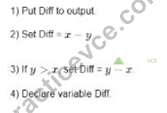
What are the two steps of the algorithm that need to be switched to result in success?
- A. 1 and 4
- B. 3 and 4
- C. 2 and 4
- D. 1 and 2
Answer: A
Explanation:
The algorithm's success depends on the correct sequence of steps. The steps should first declare the variable Diff before attempting to use it in calculations. If the declaration of Diff (step 4) is not done prior to its use (step 1), the algorithm will attempt to use an undeclared variable, which will result in an error.
Therefore, switching steps 1 and 4 ensures that Diff is declared before any operations are performed on it.
References: The importance of the correct sequence of steps in algorithm design is a fundamental concept in programming and can be found in introductory texts on algorithms and programming languages. It is also a standard practice in software development to declare variables before their use to avoid runtime errors.
NEW QUESTION # 45
What is required for all function calls?
- A. Function name
- B. Parameters
- C. Output values
- D. Input arguments
Answer: A
Explanation:
When calling a function in Python, you simply give the name of the function followed by parentheses. Even if the function doesn't take any arguments, you still need to include the parentheses. For example, print("Hello!") is a function call. The function name should describe what it's supposed to do.
Function definitions begin with the def keyword, followed by the function name and parameters (if any). The statements within the function definition are indented and carry out the task the function is supposed to perform2. References:
* Function Calls and Definitions - Real Python
* Function Calls | Microsoft Learn
* Stack Overflow: Find all function calls by a function
NEW QUESTION # 46
A software team has been commissioned to create an animation application. Which event takes place during the analysis phase in the agile approach?
- A. Writing the code for five new capabilities
- B. Sending the application to customers for additional evaluation after new features are added
- C. Deciding to add five new capabilities to the animation application based on customer feedback
- D. Deciding that new capabilities in the animation application will be written as functions without the needs of any new objects
Answer: D
Explanation:
* This is the most likely event during the analysis phase. It involves:
* Understanding the requirements: What specific capabilities are needed?
* Breaking down the problem: How can those capabilities be achieved within the existing codebase, potentially by leveraging functions to organize and reuse code.
* Technical Design: Starting to think about the structure of the solution without diving fully into implementation.
NEW QUESTION # 47
Oder the tasks needed to safely replace a lamp's light bulb from first (1) to last (4).
Select your answer from the pull down list.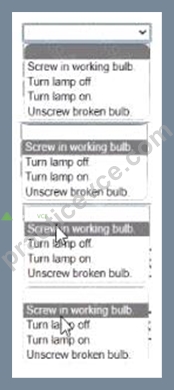
Answer:
Explanation:
Explanation:
Safety and proper procedure are paramount when replacing a light bulb to avoid any electrical hazards or injuries. First, always ensure the lamp is turned off to prevent electrical shock. Next, carefully unscrew the broken or burnt-out bulb from the socket; it might be hot, so caution is advised. After removing the old bulb, screw in the new working bulb securely but without overtightening to avoid damaging the bulb or socket.
Finally, turn the lamp on to verify that the new bulb is functioning properly.
References The answer and explanation are based on general knowledge and common safety practices for handling electrical appliances; specific documents or standards on Scripting and Programming Foundations are not applicable here.
The image displays multiple-choice options for ordering tasks needed to safely replace a lamp's light bulb, providing an interactive learning method for understanding safety procedures in handling electrical items.
NEW QUESTION # 48
What is put to output by the following flowchart, if the input is 305?
- A. interviewBacking
- B. Return
- C. Backlog
- D. Interview
Answer: D
Explanation:
The flowchart provided in the image represents a decision-making process based on the input value. Given the input of 305, we follow the flowchart's decision paths. The first decision checks if the input is less than 200, which 305 is not, so we move to the next decision point. The second decision asks if the input is greater than
300. Since 305 is greater than 300, we follow the path for 'yes' which leads us to the output "Interview".
Therefore, the correct output for the input 305 according to the flowchart is "Interview".
References:
* Understanding flowchart symbols and their usage in representing decision-making processes1.
* Analyzing flowcharts to determine the output based on given input values2.
* General principles of flowchart design and interpretation3.
NEW QUESTION # 49
Consider the given function.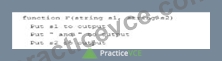
What is the total output when F (sign, horse) is called 2 times?
- A. sign and horse sign and horse
- B. sign and horse sign and horse
- C. sign and horse and sign and horse
- D. sign and horse sign and horse
Answer: D
Explanation:
The provided code defines a function named F that takes two strings si and l2 as input. However, there seems to be a typo in the variable names (si instead of sign and l2 instead of horse).
Inside the function:
* Put sl to output: This line likely has a typo as well. It's intended to print the input strings, but there's a missing space between si and l2. Assuming the correction, this line would concatenate si and l2 with a space and print it.
* Put 2 to output: This line would print the number 2.
* and : This line by itself wouldn't print anything.
Calling the Function Twice:
If F(sign, horse) is called twice:
* First Call:
* It would likely print "sign horse" (assuming the space is added between si and l2) followed by "2".
* Second Call:
* It would likely print "sign horse" (assuming the space is added between si and l2) followed by "2" again.
Total Output:
Therefore, the total output when F(sign, horse) is called twice would be:
sign horse 2
sign horse 2
NEW QUESTION # 50
Which two statement describe advantages to using programming libraries? Choose 2 answers
- A. Using a library minimizes copyright issues in coding.
- B. A program that uses libraries is more portable than one that does not
- C. Using libraries turns procedural code into object-oriented code.
- D. Libraries always make code run faster.
- E. Using a library prevents a programmer from having to code common tasks by hand
- F. The programmer can improve productivity by using libraries.
Answer: E,F
Explanation:
Programming libraries offer a collection of pre-written code that developers can use to perform common tasks, which saves time and effort. This is because:
* B. Libraries provide pre-coded functions and procedures, which means programmers don't need to write code from scratch for tasks that are common across many programs. This reuse of code enhances efficiency and reduces the potential for errors in coding those tasks.
* E. By using libraries, programmers can significantly improve their productivity. Since they are not spending time writing and testing code for tasks that the library already provides, they can focus on the unique aspects of their own projects.
References:
* The benefits of using programming libraries are well-documented in software development literature.
For instance, "Code Complete" by Steve McConnell discusses how libraries can improve programmer productivity. Additionally, "The Pragmatic Programmer" by Andrew Hunt and David Thomas emphasizes the importance of reusing code to increase efficiency and reduce errors.
NEW QUESTION # 51
Which problem is solved by DijkStra's shortest path algorithm?
- A. Given an alphabetized list of face entrants and a person's name, is the person entered in the race?
- B. Given the coordinates of five positions, what is the most fuel-efficient flight pain?
- C. Given an increasing array of numbers is the number 19 in the array?
- D. Given two newspaper articles what is the greatest sequence of words shared by both articles?
Answer: B
Explanation:
Dijkstra's shortest path algorithm is designed to find the shortest path between nodes in a graph. This can be applied to various scenarios, such as routing problems, network optimization, and in this case, determining the most fuel-efficient flight plan. The algorithm works by iteratively selecting the unvisited vertex with the smallest tentative distance from the source, then visiting the neighbors of this vertex and updating their tentative distances if a shorter path is found. This process continues until the destination vertex is reached or all reachable vertices have been visited.
In the context of the given options, Dijkstra's algorithm is best suited for option B, where the goal is to find the most fuel-efficient path (i.e., the shortest path) between multiple points (coordinates of five positions). The algorithm is not designed to solve problems like searching for an element in an array (option A), finding the longest common subsequence (option C), or searching for a name in a list (option D).
References:
* GeeksforGeeks article on Dijkstra's Algorithm1
* Wikipedia page on Dijkstra's Algorithm2
* Programiz explanation of Dijkstra's Algorithm3
NEW QUESTION # 52
What is one task that could be accomplish using a while loop?
- A. When the user Inputs a number, the program outputs "True" when the number Is a multiple of 10
- B. After inputting two numbers, the program prints out the larger of the two
- C. The user inputs an integer, and the program prints out whether the number is even or odd and whether the number Is positive, negative, or zero.
- D. A user is asked to enter a password repeatedly until either a correct password is entered or five incorrect attempts have been made.
Answer: D
Explanation:
A while loop is used to repeatedly execute a block of code as long as a specified condition is true. In the context of the given options:
* Option A could use a simple if-else statement to compare two numbers and print the larger one.
* Option B is a classic example of a use case for a while loop. The loop can run until the correct password is entered or the maximum number of attempts is reached.
* Option C could be accomplished with a single if statement to check if the number is a multiple of 10.
* Option D can also be done with an if-else statement to check the properties of the number.
Therefore, the task that is best suited for a while loop is Option B, where the user is asked to enter a password repeatedly until a correct password is entered or a certain number of incorrect attempts have been made. This requires the program to loop through the password prompt and check the conditions after each input, which is what while loops are designed for.
References:
* "Programming Foundations: Fundamentals" by Simon Allardice, Lynda.com.
* "Introduction to Computer Science and Programming Using Python," MITx on edX.
* "Python Crash Course" by Eric Matthes.
NEW QUESTION # 53
A programmer receives requirements from customers and deciders 1o build a first version of a program.
Which phase of an agile approach is being carried out when trio programmer starts writing the program's first version?
- A. Design
- B. Analysis
- C. Implementation
- D. Testing
Answer: C
Explanation:
In the context of Agile software development, when a programmer begins writing the first version of a program after receiving requirements from customers, they are engaging in the Implementation phase. This phase is characterized by the actual coding or development of the software, where the focus is on turning the design and analysis work into a working product. It's a part of the iterative process where developers create, test, and refine the software in successive iterations.
The Agile approach emphasizes incremental development and frequent feedback, with each iteration resulting in a potentially shippable product increment. The Implementation phase is where these increments are built, and it typically follows the Design phase, where the system's architecture and components are planned out.
References: The information aligns with the key stages of the Agile Development Life Cycle, which includes the phases of Concept, Inception, Iteration (Implementation), Testing, Release, and Review12.
NEW QUESTION # 54
A team of programmers describes the objects and functions in a program that compresses files before splitting the objects.
Which two waterfall approach phases are involved?
- A. Design and testing
- B. Analysis and implementation
- C. Design and implementation
- D. Implementation and testing
Answer: C
Explanation:
The Waterfall Model is a sequential design process used in software development, where progress is seen as flowing steadily downwards through several phases like a waterfall. In the context of the question, describing the objects and functions in a program that compresses files before splitting the objects involves two specific phases:
* Design Phase: This is where the system's architecture, components, interfaces, and data are all defined.
The team would design the objects and functions necessary for the file compression program during this phase.
* Implementation (or Development) Phase: Following the design, the actual code is written during the implementation phase. The objects and functions described in the design phase are created and tested to ensure they work as intended.
These two phases are critical in the Waterfall approach for transitioning from an abstract understanding of the problem to a concrete implementation in code. The analysis phase is more about understanding the problem and requirements, while testing is a separate phase that comes after implementation.
References:
* GeeksforGeeks article on Waterfall Model1.
* Built In's explanation of Waterfall Methodology2.
* Forbes Advisor's overview of Waterfall Methodology3.
NEW QUESTION # 55
What is an argument?
- A. A piece of information assigned to a function's output
- B. A declared piece of information within a function
- C. A piece of information provided in a function call
- D. An input named in the definition of a function
Answer: C
Explanation:
In programming, an argument is a value that is passed to a function when it is called. The function can then use that information within its scope as it runs. Arguments are often used interchangeably with parameters, but they refer to the actual values provided to the function, while parameters are the variable names listed in the function's definition that receive the argument values12.
For example, consider a function calculateSum that takes two arguments, a and b:
Python
def calculateSum(a, b):
return a + b
# Here, 5 and 3 are arguments provided in the function call.
result = calculateSum(5, 3)
AI-generated code. Review and use carefully. More info on FAQ.
In this case, 5 and 3 are the arguments provided in the function call to calculateSum. They are not declared within the function (option B), not assigned to the function's output (option C), nor are they inputs named in the definition of the function (option D). Instead, they are pieces of information provided during the function call, which aligns with option A.
References:
* iD Tech's explanation of arguments in programming1.
* Programming Fundamentals' discussion on parameters and arguments2.
NEW QUESTION # 56
Which data type should be used to hold the value of a person's body temperature in Fahrenheit
- A. Boolean
- B. String
- C. Float
- D. Integer
Answer: C
Explanation:
When dealing with body temperature, especially in Fahrenheit, the appropriate data type to use is a floating-point number (float). Here's why:
* Measurement Precision:
* Body temperature can have decimal values, such as 98.6°F.
* Integer data types (like B. Integer) cannot represent fractional values.
* Floats allow for greater precision and can handle decimal places.
* Temperature Scales:
* Fahrenheit is a continuous scale, not a discrete set of values.
* It includes both positive and negative values (e.g., sub-zero temperatures).
* Floats accommodate this range effectively.
* Examples:
* A person's body temperature might be 98.6°F (normal) or 101.3°F (fever).
* These values require a data type that can handle fractions.
* References:
* The normal body temperature varies across different measurement sites (e.g., rectal, tympanic, oral, axillary) but falls within a range. For example:
* Rectal: 36.32-37.76°C (97.38-99.97°F)
* Tympanic: 35.76-37.52°C (96.37-99.54°F)
* Axillary: 35.01-36.93°C (95.02-98.47°F)1
* Using a float allows us to represent these variations accurately.
Remember that using a float ensures flexibility and precision when dealing with temperature measurements.
Therefore, the correct answer is D. Float.
NEW QUESTION # 57
......
Pass Your WGU Certification Scripting-and-Programming-Foundations Exam on Jul 27, 2024 with 90 Questions: https://www.practicevce.com/WGU/Scripting-and-Programming-Foundations-practice-exam-dumps.html
Latest WGU Scripting-and-Programming-Foundations PDF and Dumps (2024) Free Exam Questions Answers: https://drive.google.com/open?id=1RE84Ha9NGh-ZEtuZc1iD0CnU7QpWkiCT